Choose to Be Humble
President of Brigham Young University
 Facebook
 Twitter/X


My prayer and plea for you, as you start this new semester, is that you choose to humble yourselves in all your endeavors; that you choose to be open to new ideas, including those that come by revelation; that you fully and accurately recognize your individual talents and potential as literal offspring of heavenly parents; that you recognize that same divinity in every other person with whom you interact; that you avoid contention; that you love and serve others; and, most of all, that you come to know the Savior more by making time for Him each and every day.
Welcome to a new year and a new semester. I join Peggy in welcoming you back. It really is good to see you back here after what I hope has been a rejuvenating break for each of you.
With a new COVID variant rapidly spreading, let me begin by urging you, once again, to get vaccinated and to follow all university and government health guidelines, including masking requirements. That is the best thing we can do to ensure that we can continue the semester without major disruption. Please consider the impact of your actions on the entire community and help make this semester a success for everyone.
Humility Can Help Us Develop Academic, Social, and Leadership Skills
As we begin the new semester, I would like to visit with you about a character trait that if adopted and refined will change your life dramatically. It will aid you in your academic work, it will enhance your social relationships, and it will better prepare you for future leadership roles. More important, it will help you enter and remain on the covenant path that leads to the fulfillment of your eternal destiny as children of heavenly parents. What is this remarkable trait? Humility.
That answer may surprise some of you. Humility is one of the most underappreciated virtues in contemporary society, which devotes so much attention to self-promotion. Yet over the past two decades, there has been a significant increase in scholarly research about the positive impact that humility has on people’s ability to learn, lead, and relate to others.
For example, in a 2016 journal article, researchers at Duke University described an experiment that demonstrated a connection between intellectual humility and recognition memory. As described by best-selling author Ashley Merryman:
During the experiment, everyone [involved in the study] completed three tasks. First, they read a list of 40 statements on a range of controversial topics—everything from the military’s use of drone strikes, common core curricula in schools, to same-sex marriage. [Second,] they took a survey, measuring how familiar they were with topics such as Susan B. Anthony or Mount Rushmore. Though there was a catch [with this second task. Some of] the topics [on the list] were bogus—for example, there was a fictitious “Hamrick’s Rebellion.” Finally, participants read another list of 60 statements [some of which were on the first list]. They were to determine which statements were on the first list and which were new. . . .
[The results were telling:] The intellectually humble took longer to read the first controversial statements—especially if the information ran counter to their beliefs. At the experiment’s end, they were better at identifying new statements. . . .
Meanwhile, the intellectually arrogant skimmed through the reading. They were less accurate at identifying statements as new. . . . And the intellectually arrogant were more susceptible to the fake news items.1
In short, the humble were better at both identifying false information and remembering things they had learned before—skills that are very helpful in an academic setting.
Other studies have identified additional ways in which humility aids in the learning process. As Merryman noted:
Researchers observed that the intellectually humble have a constant desire to learn and improve. They embrace ambiguity and the unknown. They like getting new information. They even enjoy finding out when they’re wrong. And when in trouble, they’re more willing to accept help. [As a result,] humble college students have been found to be higher in academic achievement. They improved more over the course of a semester, and they got better grades.2
While the proud may garner more worldly attention, the humble do better academically.
Those who are humble also have an advantage in social relationships. According to one study, those who are “humble are rated as more attractive date-potential.”3 The humble also
have lower rates of infidelity. And because they’re willing to address their shortcomings, their partners are more forgiving and understanding, [which leads] to longer lasting relationships.4
In other words, humility leads to more productive, long-lasting social relationships.
And there is extensive research—led in no small part by BYU professor Bradley P. Owens5—indicating that humble leadership in a variety of endeavors, “from the military to manufacturing to ministry,”6 leads to better organizational outcomes.
Humility can therefore help us develop academic, social, and leadership skills that will aid us now and into the future. But what is humility, and how do we develop it?
Six Characteristics That Describe Humble People
While the exact definition of humility in the academic literature varies somewhat from study to study, most studies focus on “a set of characteristics that . . . describe humble people.”7
Many such descriptions can be traced to [June] Tangney’s . . . list of six central features of humility: [1] an accurate assessment of oneself, [2] acknowledgment of one’s mistakes and limitations, [3] openness to other viewpoints and ideas, [4] keeping one’s accomplishments and abilities in perspective, [5] low self-focus, and [6] appreciating the value of all things, including other people.8
Note that the first characteristic—“an accurate assessment of oneself”—does not mean that the humble are lacking in skills, intellect, or talent. True humility does not imply lack of ability. In fact, if there is any correlation between the two, it runs in the opposite direction. As Elder D. Todd Christofferson once observed:
Those who have cultivated their capacities of mind and spirit, who have developed an uncommonly large store of knowledge and wisdom, are typically the most humble of men and women.9
Moreover, contrary to common misunderstanding, humility does not mean we should degrade or underestimate our abilities. If we undervalue our abilities and gifts, we will not be humble because we will not be accurately assessing ourselves, which is the first characteristic of humility. Quoting Pastor Ralph W. Sockman, Brent W. Webb explained this further in a talk given while he was serving as BYU’s academic vice president:
“True humility is intelligent self-respect which keeps us from thinking too highly or too meanly of ourselves. . . .”
The meek are capable of inspecting themselves objectively and are willing to do so, unafraid of what they will discover. Most of us are happy to recognize and have others recognize our own strengths. It takes the truly meek to look inside . . . and seek to openly characterize where we are.10
That kind of intellectual and personal honesty, combined with the other characteristics of humility, can greatly enhance our academic success by leading us to new discoveries and insights. And, as already noted, they also lead to better social relationships and leadership outcomes.
Humility is therefore critical to individual success. But it is also of great relevance and need in our current institutional setting. As I hope all of you know, one of our current goals and challenges is to create an environment of belonging in which our “hearts [are] knit together . . . in love”11 and in which all feel they are a part of the community.12 In essence, we are trying to create Zion—or at least a Zion-like society. And one of the primary obstacles to achieving that lofty yet attainable goal is the contention that is so much a part of daily life in the world around us.
In his classic talk more than thirty years ago, President Ezra Taft Benson powerfully taught that pride is both the principal barrier to building a Zion society and the principal cause of contention. He said, “Pride is the great stumbling block to Zion,” and then he added for emphasis, “I repeat: Pride is the great stumbling block to Zion.”13
He also tied pride to contention, noting:
Another face of pride is contention. Arguments, fights, unrighteous dominion, generation gaps, divorces, spouse abuse, riots, and disturbances all fall into this category of pride.14
Having identified pride as the root cause of both contention and the failure to establish Zion, President Benson identified the root solution: “The antidote for pride,” he said, “is humility.”15
Last April, Elder David A. Bednar encouraged the university leaders to “be unique in striking at the root of important and timely issues” by focusing “on the spiritual and practical substance of solutions and not just on superficial symbolism.”16 I believe we can begin to fulfill that charge by individually and collectively working to develop and apply the qualities of Christlike humility. Doing so will help us eliminate the pride that is the root cause of contention and the primary barrier to establishing a Zion-like campus community.
But there is something more at stake with humility than just success in our academic, social, and career endeavors—or even more than providing fundamental insight and direction on the important challenges we currently face on campus. In the long run, our individual eternal destiny depends on our humility.
The Eternal Importance of Humility
Christ taught that those who “humble [themselves] shall be exalted.”17 He promised that He would “make weak things become strong unto them”18; that He would “give [them] answer[s] to [their] prayers”19; and that “inasmuch as they [are] humble they might be made strong, and blessed from on high, and receive knowledge from time to time.”20 In short, as Elder Neal A. Maxwell once observed, “Our humility and teachability are premiere determinants of our progress and our happiness.”21 With that understanding, one can begin to see the truth in what many throughout history have expressed: humility is the foundation of all other virtues.22
With that more complete understanding of the eternal importance and benefits of humility, it is striking to me that the six characteristics of humility often listed in the academic literature are given deeper meaning when viewed through the lens of gospel truths.23 For example, from a gospel perspective, the humility that manifests itself by us accurately assessing ourselves will not only help us identify our weaknesses but will also help us understand our divine potential. This understanding, along with the promised help of the Savior, gives us confidence that we can overcome those weaknesses. Thus, rather than injuring our self-image, “humility,” in the words of one scholar, “lifts us up from despair to a proper understanding of our own worth.”24
Similarly, when the humble attitude that causes us to acknowledge our own mistakes and limitations is viewed in the light of gospel truths, it functions as a key component of the repentance process on which our ultimate exaltation is dependent.25
In the same vein, when viewed from a gospel perspective, being open to other viewpoints and ideas includes openness to insights that come through divine revelation. In the Doctrine and Covenants, the Lord instructed:
Let him that is ignorant learn wisdom by humbling himself and calling upon the Lord. . . .
For my Spirit is sent forth into the world to enlighten the humble and contrite.26
The humility that is evidenced by keeping one’s accomplishments and abilities in perspective likewise takes on deeper meaning when added to the gospel truths that we are dependent on the Lord for all our accomplishments27 and that mortality is just one phase of our eternal existence.28 This in turn not only increases our humility but also reveals such humility as the key to accomplishing “mighty miracles”29 as we enlist the help of the Lord in our righteous endeavors.
Finally, the low self-focus and the appreciation for the value of other things, especially other people, that characterize humility in academic literature also link humility to gospel truths. By focusing less on ourselves and more on others, we will experience the refining and exalting power of service.30 And appreciating the value of other people will help us understand and keep the second great commandment to love others31—each of whom are also beloved children of God.32
We Must Choose for Ourselves to Be Humble
The key determinative role of humility in our eternal progress is evidenced by the fact that God will, at times, humble us, hoping that the experience will cause us to change.33 But in the long run, the result is up to us. We must choose for ourselves to be humble. Among the many scriptures dealing with humility, there is a subset that describes times and ways in which people humble themselves.34 It is when we voluntarily submit our will to His, when we choose to humble ourselves, that God can turn the temporal kind of humility academic scholars have examined into an eternal transformational attribute that becomes part of our permanent natures.
In this and in all things, Christ provided the perfect example. In explaining why Jesus Christ chose to be baptized, Nephi explained:
Notwithstanding he being holy, he showeth unto the children of men that, according to the flesh he humbleth himself before the Father, and witnesseth unto the Father that he would be obedient unto him in keeping his commandments.35
This was not an isolated event in the life of the Savior. Throughout His mortal ministry, Christ made clear that it was His Father’s will, not His own, that governed His actions. In the Gospel of John alone, there are at least eleven instances in which Jesus clearly taught His disciples that, despite His omnipotence, He had come not to do His own will nor to promote His own glory but that of His Father.36 Indeed, the very setting of Christ’s birth and mortal ministry evidenced His choice to humble Himself. As one summary of Saint Augustine’s teachings put it:
Although he was equal to the Father, Christ did not come as a powerful ruler or hero. He was born in a stable, in an obscure village; his parents were unknown and undistinguished people of low social standing. He slept “in a feeding trough.”37
It was Christ’s choice to humble Himself by coming to earth for our sake that the angel described to Nephi as “the condescension of God.”38
Our conscious choice to humble ourselves by submitting our will to God’s is the essence of true humility. In fact, willingness to submit to God’s will—to “let God prevail,”39 to use President Russell M. Nelson’s wonderful phrase—is the single best definition of what true humility is.40 Our choice to let God prevail in our lives both evidences and produces the exalting power of true humility.
Developing and practicing that kind of humility takes great courage and strength41 because it requires us to surrender to God the one thing that is truly, uniquely our own—our will.42 It takes what one U.S. Navy SEAL commander called having a “backbone of humility.”43
“Recognize What True Courage Looks Like”
Such acts of strength and courage are often overlooked in part because they can be misunderstood as acts of weakness when judged by the world’s standards. I learned this in a powerful way while serving as a young missionary in the Mexican town of Ciudad Acuña, which is located just across the border from Del Rio, Texas. At the time, we did not have a chapel in Acuña. So we were given permission to cross the border into Del Rio—where there was a chapel with a baptismal font—to perform our baptisms. As near as I could tell, there was no formal arrangement for such border crossings. The U.S. missionaries had visas that permitted us to cross back and forth, but those who were to be baptized often did not. In what was clearly a different immigration era than we have now, we simply vouched for those individuals, and the border officials took note to make sure the same people returned after the baptisms were performed.
On one such occasion, after enthusiastically accepting our invitation to be baptized, the Hernandez family—a young husband and wife—accompanied us to the border crossing. The officials took down their names, and we proceeded to the chapel. All was going well until we opened the door to the closet where the baptismal clothing was stored. There were a fair number of choices for men’s clothing, but Brother Hernandez was a large man. After several attempts to put on the largest pants that were there, it became clear that there was nothing even close to a fit among the choices. I began to panic a bit. The border guards had let the Hernandez family cross without papers so they could be baptized, but they were very unlikely to accept that justification more than once. I didn’t know what to do.
Suddenly Brother Hernandez pointed to the closet containing the women’s baptismal clothing and asked, “What about that?”
He was pointing to a large, white baptismal gown on the bottom shelf of the women’s section. Not knowing what else to do, I said, “Let’s try it.”
He and I then retired to the dressing room, where I put on my baptismal clothes. I couldn’t restrain myself from watching out of the corner of my eye to see how things were going with Brother Hernandez. He was struggling mightily to get into the dress, wiggling first this way and then that while tugging on the dress to pull it down.
At that point, I thought to myself, “Brother Hernandez, if you only knew how silly you looked, you would be embarrassed, and you would probably just call off the baptism.”
Immediately a clear voice that was not my own came into my mind. It said: “He knows exactly how silly he looks, and he does not care. He knows God wants him to be baptized, and he is determined to do that no matter how silly he looks to others. You should be embarrassed that you don’t recognize what true courage looks like.”
I have read of dramatic demonstrations of courage, such as Parley P. Pratt’s account of the Prophet Joseph Smith rebuking the guards in the Richmond jail,44 but none has had more of an impression on me than the courage and strength of a humble disciple of Christ that I witnessed that night. Brother Hernandez chose to humble himself—to let God prevail—and he was determined to do what God wanted, no matter what the cost. He demonstrated a backbone of humility that continues to inspire me today, forty years later.
“It Takes Both Faith and Courage to Let God Prevail”
So, how do we develop this kind of backbone of humility? We develop it by coming to understand humility more deeply and more accurately and then by choosing to humble ourselves by striving to understand and follow God’s will for us. In his 1989 talk, President Benson gave some specific examples of how this can happen. Listen to see if any of them applies to you:
We can choose to humble ourselves by conquering enmity toward our brothers and sisters, esteeming them as ourselves, and lifting them as high or higher than we are. . . .
We can choose to humble ourselves by receiving counsel and chastisement. . . .
We can choose to humble ourselves by forgiving those who have offended us. . . .
We can choose to humble ourselves by rendering selfless service. . . .
We can choose to humble ourselves by going on missions and preaching the word that can humble others. . . .
We can choose to humble ourselves by getting to the temple more frequently.
We can choose to humble ourselves by confessing and forsaking our sins and being born of God. . . .
We can choose to humble ourselves by loving God, submitting our will to His, and putting Him first in our lives.45
Let me add one more, drawing on the words of our current prophet: We can choose to humble ourselves by consistently and consciously responding to President Nelson’s urgent plea to “mak[e] time for the Lord . . . each and every day.”46 As President Nelson explained:
It takes both faith and courage to let God prevail. . . . It takes consistent, daily effort to develop personal habits to study the gospel, to learn more about . . . Jesus Christ, and to seek and respond to personal revelation.47
It takes all of those things for us to become humble.
My prayer and plea for you, as you start this new semester, is that you choose to humble yourselves in all your endeavors; that you choose to be open to new ideas, including those that come by revelation; that you fully and accurately recognize your individual talents and potential as literal offspring of heavenly parents; that you recognize that same divinity in every other person with whom you interact; that you avoid contention; that you love and serve others; and, most of all, that you come to know the Savior more by making time for Him each and every day. As you do so, you will develop the powerful and exalting Christlike characteristic of humility, and, as a result, your life will be more full of joy. I so promise, in the name of Jesus Christ, amen.
© Brigham Young University. All rights reserved.

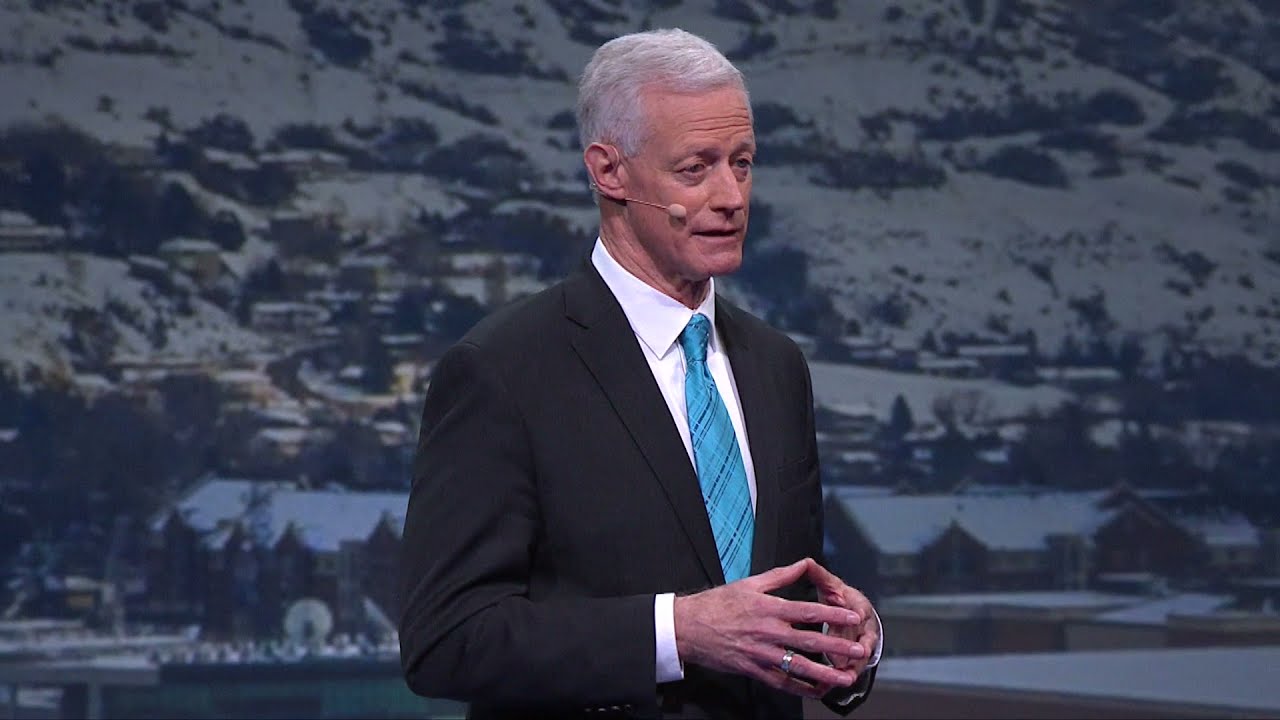
Kevin J Worthen, president of Brigham Young University, delivered this devotional address on January 4, 2022.
Related Topics
Related Speeches