Coming Closer to Jesus Christ
President of The Church of Jesus Christ of Latter-day Saints
 Facebook
  Twitter/X

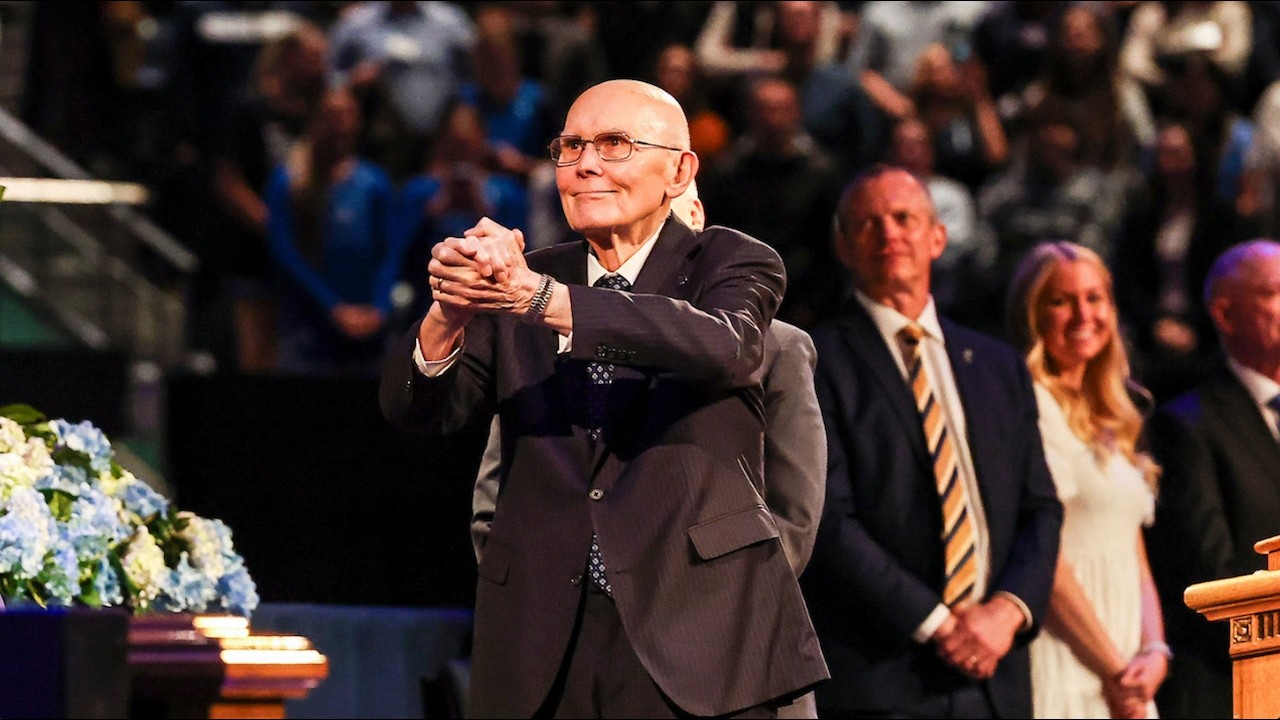
Whatever those doubts, the way to overcome them is to get closer to our Savior Jesus Christ. Again and again, He has taught us that He is the way.
My dear brothers and sisters, it is good to be here. You are an audience greatly loved by the Lord, and He desires all of you to return to His presence.
Beginning with my service as BYU president in 1971, I have spoken to many BYU audiences, but never before as the leader of The Church of Jesus Christ of Latter-day Saints. As your current leader, I have prayed for inspiration in what I should say to you and to the larger audience we include with current technology.
You are celebrating the 150th anniversary of BYU. I was the president of BYU when we celebrated the 100th anniversary. In that year, President Spencer W. Kimball gave his historic address “The Second Century of Brigham Young University.”1 That second century is now half over.
What has BYU become as it seeks to meet those prophetic challenges? What have you become with the added experience of your portion of the second century?
To reinforce spiritual impressions that I have previously shared with your university leadership, I firmly believe that it is the destiny of Brigham Young University to become what past and present prophets knew it could become. With the consecration and leadership of this community, BYU “will become the great university of the Lord—not in the world’s way but in the Lord’s way.”2
Now I address a BYU audience, but what I have to say applies to all who follow the words of a prophet.
I. Introduction
I want to thank the many friends and members who have prayed and expressed support for me in my new calling. Frequent references to the “mantle” of the office settling on me have suggested that I begin with some observations on the significance of that term.
The word mantle is used in the Bible to describe the cloak of the prophet Elijah that descended on Elisha as a symbol of the passage of prophetic authority.3 The term mantle came into the restored Church’s history in many reports of the meeting in Nauvoo on who would succeed the murdered Joseph Smith. Many who were present recorded their experience of the “mantle of Joseph” settling on Brigham Young. Those experiences took many forms. Some had visual experiences, some heard Joseph’s voice, and many had a feeling, as each of us receives revelation differently.
When Russell M. Nelson was called as our prophet, I had a similar experience. I had sat beside this apostle in the meetings of the Quorum of the Twelve for 34 years, but when the mantle of the prophet settled upon President Nelson, I felt that his prophetic gifts were magnified. We all have witnessed his profound leadership.
Upon President Nelson’s death, I experienced another meaning of the mantle. To observers, it symbolizes a transfer of priesthood authority. To the person who receives that authority, it is very different and very real. Within a few minutes after learning of our president’s death, I felt the heaviness of responsibility settle upon me, along with important impressions of what I was required to do now.
As your leader, I pray for what our Heavenly Father wants for each of us—and that is to be or become active members of The Church of Jesus Christ of Latter-day Saints, proceeding forward on the covenant path into the eternities. We need one another’s prayers. I feel the positive effect of your prayers. I am thankful, and I love you.
II. Doctrinal Issues for Latter-day Saints
I feel to emphasize the warning President Russell M. Nelson issued us: that “in coming days, it will not be possible to survive spiritually without the guiding, directing, comforting, and constant influence of the Holy Ghost.”4 One of the many reasons you will need the constant influence of the Holy Ghost is that you live in a season in which the adversary has become so effective at disguising truth that if you don’t have the Holy Ghost, you will be deceived. Many obstacles lie ahead. The distractions will be many. Even active members may sometimes have concerns about some historical, doctrinal, or social issues connected with the Church.
I want to help all our members overcome present or future doubts. Whatever those doubts, the way to overcome them is to get closer to our Savior Jesus Christ. Again and again, He has taught us that He is the way.
III. Four Ways to Draw Closer to Our Savior
I share four impressions that will draw us closer to our Savior:
- First, strengthen our faith in Him.
- Second, increase our humility.
- Third, seek help from others.
- Fourth, be patient.
1. Strengthen Our Faith in Him
The first is for us to focus on developing our faith in God and in the mission of His Son, Jesus Christ. Strong faith requires more than strong desire. It means daily trying, one step at a time, with prayer and scripture study.
We can increase our commitment to the principles in the first article of faith, which states, “We believe in God, the Eternal Father, and in His Son, Jesus Christ, and in the Holy Ghost.”5 These principles anchor our faith in God and will keep us anchored to gospel truth and to our Savior’s example of service to our fellow men and women.
2. Increase Our Humility
Secondly, increased humility draws us closer to Jesus Christ. This will help us overcome questions about the Lord’s doctrine. When we are humble, we can more clearly hear the Lord’s voice. We all need helpers to teach us humility. I share an early personal experience that helped get me back on the path of humility.
In my first year as a professor at the University of Chicago Law School, a famous faculty member died, and the dean asked me to teach his classes for several weeks until a suitable teacher could be provided. The legal subject was one with which I was not very familiar, so I struggled hard and finally felt like congratulating myself on fulfilling the assignment.
Afterward, a student gave me what I thought was going to be a compliment. He said, “Mr. Oaks, I was in that class you taught for Professor [So-and-So], and I must tell you I was really impressed. You will make a good teacher someday.”
Why did that experience help me? I was overly confident in my abilities as a teacher, and that student provided a perspective that has blessed me to this day.
President Ezra Taft Benson gave us a great teaching about humility. He did this as part of his memorable teachings about pride: “The antidote for pride is humility—meekness, submissiveness.”6
He also said, “Humility responds to God’s will—to the fear of His judgments and to the needs of those around us.”7
“Let us choose to be humble,”8 he pleaded.
I add: Look to the needs of others, and humility follows.
Like faith in God, humility is a master virtue, given to help us learn other virtues necessary for us to become what our Heavenly Father and His Only Begotten Son created us to become.
In a talk given here at BYU many years ago, President Spencer W. Kimball defined humility as “teachableness.” He explained:
Humility is teachableness—an ability to realize that all virtues and abilities are not concentrated in one’s self. . . .
. . . Humility is never accusing nor contentious. . . .
Humility is repentant and seeks not to justify its follies. It is forgiving others in the realization that there may be errors of the same kind or worse [that we ourselves commit]. . . .
Humility makes no bid for popularity and notoriety; demands no honors.9
To have humility is one of the powerful commandments we have been given to guide us in our mortal journey. It prepares us for our appointed meeting with our Savior and Redeemer, Jesus Christ. Take care not to become distracted. Remember His parable of the ten virgins.10 We want to be among the five humble ones who were admitted to the presence of the Lord.
The Lord loves all of His children and longs for their return, but we all know examples of returned missionaries who have interrupted their spiritual growth with periods of inactivity. We know of youth who have jeopardized their spiritual growth by separating themselves from Church teachings—such as those who are expressing little desire to be married or to have children. And there are adult members who do not seek to be a covenant-making people—such as men who do not prepare for ordination to the Melchizedek Priesthood.
Those of diminishing faith and activity in the restored Church are a major source of concern to your prophet leaders. We love you, young and old, men and women. So does the Lord! God is relentless in His loving pursuit of each of you. Keep the commandments and be true to the covenants so many of you have made to guide you along the covenant path. Never let your secular learning limit your horizons.
We are grateful to know that there are two methods of gaining needed knowledge: (1) the evolving disclosures of man discovered by the scientific method and (2) the truths disclosed by the spiritual method, which begins with faith in God and relies on scriptures, inspired teaching, and personal revelation. There is no ultimate conflict between knowledge gained by these different methods because God, our omnipotent Eternal Father, knows all truth and beckons us to learn by both methods.
Those who don’t believe in God, who formally reject traditional religious morality, and who rely solely on the tests of scientific evidence fulfill a Book of Mormon description of those “who live without God in the world.”11
Elder Richard L. Evans had a good answer for those who are caught off balance by some scientific evidence that seems to be contrary to what we interpret from the scriptures:
There may be some seeming discrepancies. Do not worry about them. Eternity is a long time. I have a great respect for learning, for academic endeavor and the university atmosphere. . . . I have a great respect for science and scientists and for the search for truth. But remember this: science after all (even when it is true and final and factual) is simply man’s discovering of a few things that God already knows and controls in his ordering of the universe. . . . God has not told us all he knows. We believe in continuous revelation. Be patient. Keep humble and balanced in all things.12
Humility, faith, and trust in the Lord are the remedies for wavering. As the Book of Mormon teaches, the Lord “doth bless and prosper those who put their trust in him.”13 Trusting in the Lord is a particular need for all who wrongly discount the commandments of God and the teachings of His prophets by measuring them against the latest findings and wisdom of man.
3. Seek Help from Others
A third way to draw closer to our Savior is to associate with other believers. This includes discussions with trusted associates, local Church members, and other faithful friends.
Remember, “to survive spiritually,” you will need the “constant influence of the Holy Ghost.” An abundance of speculation and false information in podcasts and on social media surrounds us. Some may protest or question the truth of Church doctrine without knowing or even understanding the fulness of that doctrine.
Don’t be persuaded by false or inaccurate information. Discuss your concerns with faithful, well-informed friends and always take those concerns to the Lord.
The Lord has told us very little about some things. For example, we know very little about the spirit world that follows mortality or even about the spirit world that preceded it. This lack of knowledge can be harmful when we rely on beliefs on these subjects from well-meaning people who teach beyond what God has chosen to reveal. Trusting God in what we know and in what we don’t know is a great protection against doubts based on mistaken ideas instead of on what God has chosen to reveal.
I share the experience of a wise stake president here on this campus. He was approached by a young man in his stake who admired him and asked him to mentor him in business.
After a few weeks, the young man confided, “I should share with you that I have decided to step away from the Church. I no longer believe.”
The surprised stake president immediately began to share his profound testimony of the gospel that had brought him so much joy, peace, and inspiration.
The young man sat stunned, staring back at the stake president with tears in his eyes. He said, “I have not heard anyone speak like that in months. I have been hanging out with friends who don’t believe.”
I say to all of you, as that wise stake president said to this young man, seek friends and associates who are striving to follow the Lord—friends and associates with whom you can feel the Spirit and with whom you can reinforce your faith.
Surround yourself with people who believe. A great Book of Mormon prophet taught this truth:
Believe in God; believe that he is, and that he created all things, both in heaven and in earth; believe that he has all wisdom, and all power, both in heaven and in earth; believe that man doth not comprehend all the things which the Lord can comprehend.
And again, believe that ye must repent of your sins and forsake them, and humble yourselves before God.14
Protect yourself with the weekly renewing of your covenants by partaking of the sacrament and with consistent efforts to live according to those sacred covenants. Those who have been endowed should include regular attendance at the temple. In sum, stay on the covenant path. These simple practices will protect and strengthen you.
4. Be Patient
We are all a work in progress. We are all at different places on what President Nelson called “the covenant path.”15 We need to be patient with one another and, occasionally, even with ourselves. Overcoming doubt—resolving conflicts between the evolving understanding of science and the sometimes incomplete teachings of religion—can be a lengthy process, as with building faith or acquiring humility. Hold on to the first article of faith, even if something else is uncertain. And while you wait, wait upon the Lord, which includes trusting in His timing as well as in His promises.
And while we wait, we should busy ourselves with service. Again and again, Jesus taught and demonstrated the power of service to others.
My dear brothers and sisters, I testify of Jesus Christ. As apostles, we are taught to testify of His name, meaning His sacred work, in all the world. I testify of the truths taught by the restored Church. And I share with you and testify to the truth of these things I have said today, in the name of Jesus Christ, amen.
© by Intellectual Reserve, Inc. All rights reserved.
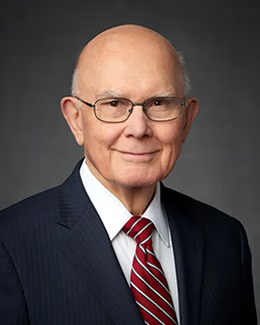
Dallin H. Oaks, president of The Church of Jesus Christ of Latter-day Saints, delivered this devotional address on February 10, 2026.
Related Topics
Related Speeches