





Speech link copied
To BYU, or Not to BYU: That Is the Question—It’s Up to You
Dale G. Renlund
of the Quorum of the Twelve
April 17, 2026
of the Quorum of the Twelve
April 17, 2026
BYU will only become BYU when its phenotype is a truthful, faithful, and balanced expression of its genotype.
Brothers and sisters, I’m grateful to be with you. I’m grateful for Michael A. Jensen, Laura Padilla-Walker, Diane Thueson Reich, C. Shane Reese, and Elder James R. Rasband and for what they have shared with us today. And I’m grateful for Christina Castellanos for the flute rendition that she gave us in the special musical number that brought the Spirit.1
I need to let you know of the inspiration that came in the assigning of Elder James R. Rasband to be the commissioner. It is just amazing. Every time I’m with Elder Rasband, he exerts this Christlike influence that makes me want to be a better person. That has come to him because of a lifelong discipleship. He just brings to this role something very special that makes me want to excel and to try to do better.
I have been serving on the Executive Committee of the Church Board of Education since January 2026. I have sensed how much God cares about the associated institutions, and I have been made more aware of the resources devoted to them. I am grateful to faithful members around the world who make this possible. I am also grateful for the way every one of you handles that stewardship.
The most important message I have for you today in this BYU President’s Leadership Summit is this: Thank you! Thank you for your goodness, for your faith and your faithfulness. Thank you for caring enough about the students, this university, and The Church of Jesus Christ of Latter-day Saints to work as you do in a job that is more than employment.
I have another message that’s longer, but it’s not more important than that. It relates to BYU itself. When I have complimented some aspects of the BYU experience, many have explained to me that the specific aspect results from BYU’s DNA. This has caused me to wonder about DNA, because it is, after all, weird to refer to an institution as having biological underpinnings. But let’s lean into the analogy. For those who know so much more about this than I, please forgive my simplistic explanations.
In an organism, the genetic makeup is encoded within DNA. For simplicity and clarity, we can describe the intrinsic DNA as “genotype.” We can also describe the outwardly observable characteristics as “phenotype.” Thus, let’s refer to BYU’s DNA as its genotype and refer to its outwardly observable characteristics as its phenotype.
In nature, the genotype is not completely determinative of the phenotype. For instance, identical twins have the same genotype. If the genotype were determinative, their phenotypes would develop identically. However, studies have shown that many personality characteristics are genetically determined only half the time. Nongenetic factors are obviously involved.2
For example, there is the 2024 story of two brothers, Sam and John Fetters, identical twins who grew up in the same household. Both have autism, but they are
at opposite ends of the autism spectrum.
Sam is a sophomore at Amherst College who plans to double major in history and political science. In his free time, he runs marathons.
John attends a special school, struggles to form sentences, and likes to watch Teletubbies and Sesame Street.3
The Fetters twins have the same genotype. Their phenotypes, though, are dramatically different.
Another example comes from Korea. Koreans on both sides of the demilitarized zone are genetically very similar. Yet South Koreans are four to six inches taller than their northern counterparts.4 While their genotypes are similar, their outwardly observable characteristics differ, based on nutrition and disease-related factors.
A final example comes from a rare, inherited metabolic disorder known as phenylketonuria, or PKU. PKU is caused by mutations in a gene that encodes for the enzyme that metabolizes phenylalanine. Individuals with the mutation can end up with toxic accumulations of phenylalanine. This in turn can cause severe brain damage and intellectual disability.
But the PKU genotype confers risk, not a determined or fixed outcome. If identified early, through routine newborn screening, and treated continuously—initially with a special formula and later with strict restriction of high-protein foods—individuals with PKU can have normal brain development and live healthy lives. If treatment is delayed or not maintained, irreversible neurological deficits occur. The phenotype emerges from a gene-environment interaction. PKU is an example in which genotype specifies vulnerability but not outcome.
Recognizing that genotype is not completely determinative of phenotype in nature, let us return to consideration of BYU’s genotype and phenotype. President C. Shane Reese spoke at his inauguration as president of Brigham Young University. His topic was “becoming BYU.”5
Throughout his inaugural address, President Reese spoke of BYU having a “unique institutional identity.”6 We heard more of that today. But I would call the unique institutional identity BYU’s genotype. President Reese stated:
Our task is to become the university that prophets have foretold—to become the world’s “greatest institution of learning” and “the fully anointed university of the Lord about which so much has been spoken in the past.”7
President Reese explained that BYU has “a double heritage”8—the development of both “the secular and the spiritual.”9 President Reese taught that the “paired aspirations”10 of “the spiritual and the secular are not opposing spheres locked in inevitable conflict.”11 Rather, the optimal expression of both together is the goal. Optimizing two functions simultaneously is much more difficult and complicated than optimizing one function in isolation. But it is worthwhile. You are asked to do it. You are charged to do it. I would like to suggest that “becoming BYU” recognizes that a genotype needs to be metaphorically transcribed to messenger RNA and then, via ribosomes, into proteins that eventually lead to the fully developed phenotype.
For BYU’s genotype to be fully expressed to its optimal phenotype, important gene regulation must take place in the form of decisions (such as hiring), choices, and approaches. The question for us is “What will BYU become? The fulfillment of its optimal identity or something less than that?” BYU will only become BYU when its phenotype is a truthful, faithful, and balanced expression of its genotype.
In healthy cells, there are promoter genes that promote cell division as well as suppressor genes that suppress cell division. These genes can be thought of as accelerators of growth and as brakes on growth.12 These genes are turned on when appropriate signals have been received.
In a healthy BYU, these promoters and suppressors—as accelerators and brakes—function cooperatively, collaboratively, jointly, harmoniously, and symbiotically. Thus, both the secular and the spiritual function ideally and optimally together. Then teaching, research, and citizenship—aspects of the spiritual mission—are balanced within and by the BYU faculty.
In a cell, imagine what happens when a promoter gene mutates such that it is always turned on—similar to an accelerator in a car that is stuck fully pressed to the floor. For a time there may be some stability if the suppressor gene goes into high function. But if the suppressor gene also mutates such that the brake function is broken, then unrestricted cell growth occurs. We call this cancer.
If BYU’s promoter and suppressor genes are not functioning appropriately, the ideal phenotype will be distorted. The resulting phenotype would be an overemphasis on teaching, research, citizenship, or the student experience—or even on sports. One or more facets would be compromised at the expense of the others.
President Reese identified several areas that are key in expressing the Lord’s intended phenotype at BYU. Let me mention a few:
1.
Becoming “a Christ-centered, prophetically directed university of prophecy.”13
2.
Becoming a “spiritually strengthening, . . . intellectually enlarging, and . . . character-building” university that helps students and faculty devote themselves to “lifelong learning and service.”14
3.
Becoming a university that shines a “unique light”15 that is reflective of the life of the Savior Jesus Christ and of His restored gospel.
The desire of the Church Board of Education is for the students to develop greater faith in Jesus Christ, to gain a stronger testimony of living prophets and apostles, and to become academically and professionally successful. For that to happen, faculty who are successful in both secular and spiritual realms are necessary. Such faculty need the courage to be different and yet believe that they can be successful.
President Spencer W. Kimball noted that this
faculty has a double heritage that they must pass along: the secular knowledge that history has washed to the feet of mankind along with the new knowledge brought by scholarly research, and also the vital and revealed truths that have been sent to us from heaven.16
I should also edit that: not just “vital and revealed truths that have been sent to us from heaven” but also that are being sent to us from heaven now and will be sent to us from heaven in the future.
I used to be a cardiologist specializing in the treatment of heart failure. My wife jokes that I specialized only in the left ventricle. She continues by asserting that a specialist is someone who learns more and more about less and less until finally he or she knows everything about nothing. She also says to anyone who will listen that it was a bad prognosis to become one of my patients—which was statistically true but not causal. Over the years I saw many people die who had perfectly functioning kidneys, liver, and lungs. Disease in one organ system was fatal. Similarly, a patient can have many perfectly functioning organ systems and yet die of cancer.
At BYU, we need everyone to focus on the health of the whole—balancing appropriately the teaching, research, and citizenship components of the spiritual mission of BYU. Any department, college, or individual faculty member can cause failure even though the others are functioning well. No department or faculty member can assume that their contribution does not need to be balanced because their contribution may be the one that has the most influence on a student or group of students. Faculty must honor their double heritage.
The non-determinative nature of genotype on phenotype is an archetypical idea for each of us individually. In the premortal existence, at the time we were born as spirit children of God, we had a divine nature.17 This is asserted in “The Family: A Proclamation to the World”:
All human beings—male and female—are created in the image of God. Each is a beloved spirit son or daughter of heavenly parents, and, as such, each has a divine nature.18
Metaphorically, we could say that the divine nature is in our spiritual DNA—our spiritual genotype.19 But our spiritual genotype is not determinative. It did not predestine any of us to be evil. What we as spirit children of God become—what we develop as our phenotype—results from the interaction of our spiritual genotype with the choices we make and with the environment we are in.20
Throughout our premortal existence, our divine spiritual genotype did not change. However, outcomes among God’s children did differ; several phenotypic expressions were evident in the premortal existence.
First, consider Satan. He rebelled against God, tried to usurp God’s power, and sought to destroy the agency of man.21 Do you think God made Lucifer’s spiritual genotype flawed and evil? I don’t.
But let me digress a bit with an anecdote. At general conference, I had several relatives come from Sweden and Denmark to attend conference sessions. One of them was a precocious 10-year-old girl from Copenhagen named Emma Krylborn. Her Swedish is perfect; her English is perfect; and I’m told her Danish is perfect. She is only 10. She is my first cousin thrice removed.
About two months before conference, she started to pray for Lucifer that he would stop being as naughty as he was. Her father, Marcus, talked to her and suggested that that might not be an appropriate thing to do. So she stopped praying for Lucifer.
Then, in the Sunday morning session of general conference, President Dallin H. Oaks spoke about praying for our enemies. Emma elbowed Marcus in the side and said, “See! We’re supposed to pray for him!”
I reported this to President Oaks, and I said, “President Oaks, you need to give me an answer. Are we supposed to pray for Lucifer?”
He laughed through my whole recitation of the episode and then said, “Well, when you come up with an answer, let me know.”
Emma emailed me and said that she is going to continue praying for him because President Oaks said it was okay for her to do so. Anyway . . .
Second, a “third part” of the hosts of heaven chose to not follow the plan of Heavenly Father.22 Did God make them with a flawed genotype? I don’t think so. They became phenotypically flawed as they chose to be rebellious. Their spiritual phenotype differed from that of those who chose to follow the plan.
Third, among the two-thirds part of the hosts of heaven who chose to follow the plan, some are labeled as “noble and great.”23 If there are some who are “noble and great,” perhaps some are not so noble or not so great. Was this predetermined because of their spiritual genotype? I don’t think so. Their phenotype was based on choice.
After the Fall of Adam, mankind was born into a mortal, or fallen, world in which choices continued to influence phenotype.24 While the spiritual genotype does not change, there is an overlay of physical genotype.25 After many generations, mankind’s genotype likely included hereditary predispositions and inclinations. Environmental factors greatly influence how the genome was expressed. The whole field of epigenetics explores these profound effects.
Mankind’s spiritual genotype is derived from heavenly parents. Once born into the world, we bring our own divine nature as well as some aspects of our premortal development. Once mortal, the diversification of outward characteristics continues. These characteristics can range from becoming a son of perdition to becoming a saint. But becoming “carnal, sensual, and devilish”26 is not predetermined. It results when man chooses to follow the enticings of Satan.27 It results when we love Satan more than God and also through our willful disobedience of the commandments.
The Lord revealed through the Prophet Joseph Smith:
Every spirit of man was innocent in the beginning; and God having redeemed man from the fall, men became again, in their infant state, innocent before God.
And that wicked one cometh and taketh away light and truth, through disobedience, from the children of men, and because of the tradition of their fathers.28
Our phenotype, then, is determined by our choices. President Russell M. Nelson taught:
Your choices today will determine three things: where you will live throughout all eternity, the kind of body with which you will be resurrected, and those with whom you will live forever.29
President Jeffrey R. Holland has taught:
Our deepest desires, our premortal yearnings, are still divine in their origins, and they are still deep in our souls. The echoes of our earlier innocence still reverberate, and the light that forsakes the evil one still shines. Our hearts . . . desire that which is spiritual and holy rather than that which is “carnal, sensual, and devilish.”30
Whether we transform our divine nature into our intended eternal destiny depends on us. In a similar way, whether BYU’s divine, heaven-established genotype is transformed into its intended destiny—the optimal BYU phenotype—does not depend solely on students. Nor does it depend solely on faculty. Nor does it depend solely on faculty leaders or on the administration. It depends on each individual part, each individual division, each individual department, and each individual who touches on BYU’s mission. Each part is crucial.
Even though the resulting phenotype depends on each part, I have an invitation for you as faculty leaders. First, accept the invitations you received from President Reese. He issued a few. One was to take those two lists of questions that he provided and review them with your faculty. I believe that as you do that, you will be richly blessed.
Next, evaluate yourselves as if the outcome depends solely on you. To echo Elder Dieter F. Uchtdorf, stand where you are and “lift where you stand.”31 Ask yourself, “What is it I can do to transform BYU’s genotype into the phenotype God intends?” Ask yourself, “What can I do to help motivate others to do the same?”
As you do, I promise you rich blessings. Will BYU become BYU or not? To BYU, or not to BYU: that is the question.32 But it’s up to you. May God bless you in these endeavors.
I absolutely know that Jesus Christ lives, that He is your Savior and He is my Savior. He is your Redeemer and my Redeemer. He’s your and my divine, kind, “heav’nly Friend.”33 I absolutely know it. I absolutely know that we are led by a prophet of God today. I absolutely know this. I know that God has directed the establishment of this university and sees its future as glorious and optimistic—but it depends on each of us to do our part. In the name of Jesus Christ, amen.
© by Intellectual Reserve, Inc. All rights reserved.
Notes
1. Michael A. Jensen, dean of the BYU Ira A. Fulton College of Engineering; Laura Padilla-Walker, dean of the BYU College of Family, Home, and Social Sciences; Diane Thueson Reich, dean of the BYU College of Fine Arts and Communications; C. Shane Reese, president of BYU; Elder James R. Rasband, commissioner for the Church Educational System; and Christina Castellanos, assistant professor in the School of Music in the BYU College of Fine Arts and Communications.
2. See Jane E. Brody, “What Twins Can Teach Us About Nature vs. Nurture,” Personal Health, New York Times, 20 August 2018.
3. Jon Hamilton, “These Identical Twins Both Grew Up with Autism, but Took Very Different Paths,” Shots, Health News, heard on Morning Edition, National Public Radio (NPR), 4 April 2024, npr.org/sections/health-shots/2024/04/04/1242264274/siblings-science-identical-twin-brothers-autism-spectrum.
4. See Daniel Schwekendiek, “Height and Weight Differences Between North and South Korea,” Journal of Biosocial Science 41, no. 1 (January 2009): 51–55. The summary for this article (p. 51) reads:
This paper investigates height and weight differences between the two Koreas by comparing national anthropometric data published by the South Korean Research Institute of Standard and Science with United Nations survey data collected inside North Korea in 2002. For socioeconomic reasons, pre-school children raised in the developing country of North Korea are up to 13 cm shorter and up to 7 kg lighter than children who were brought up in South Korea—an OECD member. North Korean women were also found to weigh up to 9 kg less than their Southern counterparts.
5. C. Shane Reese, “Becoming BYU: An Inaugural Response,” address delivered at his inauguration as BYU president, 19 September 2023.
6. Reese, “Becoming BYU: An Inaugural Response.”
7. Reese, “Becoming BYU: An Inaugural Response”; quoting Spencer W. Kimball, “Education for Eternity,” address to BYU faculty and staff, 12 September 1967, and Kimball, “The Second Century of Brigham Young University,” BYU devotional address, 10 October 1975.
8. Spencer W. Kimball used the phrase “a double heritage” in his 1967 BYU talk “Education for Eternity” and also in his 1975 BYU address “The Second Century of Brigham Young University”; quoted in Reese, “Becoming BYU: An Inaugural Response.”
9. Kimball, “Second Century”; Kimball, “Education for Eternity.”
10. James R. Rasband, “Paired Aspirations,” BYU university conference faculty session address, 28 August 2017; quoted in Reese, “Becoming BYU: An Inaugural Response.” See also Kevin J Worthen, “BYU: A Unique Kind of Education,” BYU university conference address, 28 August 2017.
11. Reese, “Becoming BYU: An Inaugural Response.”
12. See Siddhartha Mukherjee, The Emperor of All Maladies: A Biography of Cancer (New York: Scribner, 2010), 369.
13. C. Shane Reese, “Developing Eyes to See,” BYU devotional address, 9 January 2024; see also Reese, “Perspective: Becoming BYU,” Opinion, Deseret News, 11 December 2023, deseret.com/opinion/2023/12/11/23997519/c-shane-reese-what-byu-must-become.
14. The Aims of a BYU Education (1 March 1995); quoted in Reese, “Becoming BYU: An Inaugural Response.”
15. Kimball, “Second Century.”
16. Kimball, “Second Century.”
17. Before being born as spirit sons and daughters of heavenly parents, man existed as intelligences—intelligences that were coeternal with God. We do not know enough about the intelligences that were incorporated into the spirit children of God to determine whether they were predestined to a specific fate, but we doubt it. See Doctrine and Covenants 93:29–30; Abraham 3:22.
18. “The Family: A Proclamation to the World” (23 September 1995). Also, the Young Women theme begins with “I am a beloved daughter of heavenly parents, with a divine nature and eternal destiny.”
19. DNA is deoxyribonucleic acid. DNA encodes all genetic material in humans and is found in chromosomes.
20. President Dallin H. Oaks has written:
Perhaps these persons, as the saying goes, were “born that way.” But what does that mean? Does it mean that persons with susceptibilities or strong tendencies have no choice, no free agency in these matters? Our doctrine teaches us otherwise. Regardless of a person’s susceptibility or tendency, his will is unfettered. His free agency is unqualified. It is his freedom that is impaired. . . . We are all responsible for the exercise of our free agency.
. . . Most of us are born with thorns in the flesh, some more visible, some more serious than others. We all seem to have susceptibilities to one disorder or another, but whatever our susceptibilities, we have the will and the power to control our thoughts and our actions. This must be so. God has said that he holds us accountable for what we do and what we think, so our thoughts and actions must be controllable by our agency. Once we have reached the age or condition of accountability, the claim “I was born that way” does not excuse actions or thoughts that fail to conform to the commandments of God. We need to learn how to live so that a weakness that is mortal will not prevent us from achieving the goal that is eternal.
God has promised that he will consecrate our afflictions for our gain (see 2 Nephi 2:2). The efforts we expend in overcoming any inherited weakness build a spiritual strength that will serve us throughout eternity. Thus, when Paul prayed thrice that his “thorn in the flesh” would depart from him, the Lord replied, “My grace is sufficient for thee: for my strength is made perfect in weakness” [2 Corinthians 12:7, 9]. [“Free Agency and Freedom,” in Monte S. Nyman and Charles D. Tate Jr., eds., The Book of Mormon: Second Nephi, the Doctrinal Structure (Provo: BYU Religious Studies Center, 1989), 13–14]
21. See Moses 4:3–4.
22. Joseph Smith Translation, Revelation 12:4; see also Abraham 3:26–28.
23. Abraham 3:22; see also verse 23.
24. See Alma 13:3–4.
25. See Jeffrey R. Holland, Christ and the New Covenant: The Messianic Message of the Book of Mormon (Salt Lake City: Deseret Book, 1997), 205–7; see also 1 Corinthians 2:14; Alma 26:19–22; 41:11; Doctrine and Covenants 29:41.
26. Moses 6:49.
27. See Moses 5:10–12.
28. Doctrine and Covenants 93:38–39.
29. Russell M. Nelson, “Think Celestial!” Liahona, November 2023.
30. Holland, Christ and the New Covenant, 207; quoting Moses 6:49.
31. Dieter F. Uchtdorf, “Lift Where You Stand,” Ensign, November 2008.
32. Paraphrasing William Shakespeare, Hamlet, act 3, scene 1, line 56: “To be, or not to be: that is the question.”
33. “I Know That My Redeemer Lives,” Hymns, 2002, no. 136.
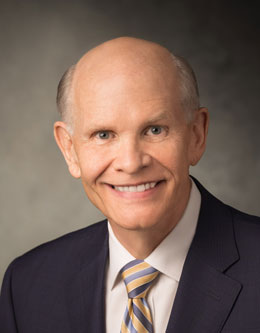
Dale G. Renlund, a member of the Quorum of the Twelve Apostles of The Church of Jesus Christ of Latter-day Saints, delivered this BYU leadership meeting address on April 17, 2026.