

Envisioning BYU
Volume One
Foundations and Dreams
FOREWORD
PREFACE
A Gospel Ground for Education: An Academic Credo
John S. Tanner
16 Feb 2005
The purpose of this preface is to explain the primary scriptural injunctions for education. It thus provides an introduction to this first volume of Envisioning BYU. It is also a personal credo, outlining views that have animated me over the years. This preface was originally delivered as a talk, titled “A Gospel Ground for Education: An Academic Credo,” to BYU graduate students at the Faith and Scholarship Symposium on February 16, 2005.


PODCAST




The Basic Constitution of Church Education
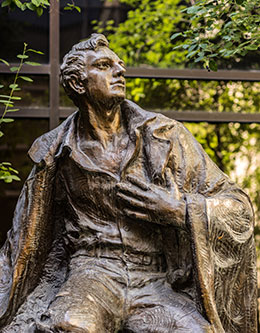
D&C 88, 90, and 93
27 Dec 1832
President Dallin H. Oaks called Doctrine and Covenants 88 “the first and greatest revelation of this dispensation on the subject of education” and “the basic constitution of Church education. It defines Brigham Young University’s role in the kingdom” (“A House of Faith,” BYU annual university conference address, 31 August 1977). As BYU’s basic constitution, Doctrine and Covenants 88—which Joseph Smith named the Olive Leaf—reminds us that the university’s spiritual origins predate the founding of Brigham Young Academy in pioneer Utah. The Olive Leaf links BYU to the Prophet Joseph, with his extravagant thirst for knowledge, and to similar revelations he received affirming that “the glory of God is intelligence” and admonishing the Saints to “become acquainted with all good books, and with languages, tongues, and people”; with “history,” “countries,” and the “laws of God and man” (Doctrine and Covenants 90:15; 93:36, 53).
The Olive Leaf links BYU to the School of the Prophets, which placed learning among Latter-day Saints on spiritual foundations, and to the University of the City of Nauvoo, with its ambitious Olive Leaf–inspired curriculum and with the high hopes Joseph had to found a university that would become “one of the great lights of the world” ( Joseph Smith, Sidney Rigdon, and Hyrum Smith, “A Proclamation to the Saints Scattered Abroad,” Times and Seasons 2, no. 6 [15 January 1841]: 274). These and many other educational currents flow from the Church in Joseph’s day to BYU today.
But above all, the Olive Leaf links BYU to the Church’s first temple and to Latter-day Saint temples generally. Verses from this revelation, including the oft-repeated injunction to “seek learning, even by study and also by faith” (Doctrine and Covenants 88:118), were quoted in the dedicatory prayer of the Kirtland Temple (see Doctrine and Covenants 109:7). The overlap between Doctrine and Covenants 88 and 109 bespeaks deep continuities and homologies between school and temple in Latter-day Saint history and doctrine. Church schools were originally housed in temples. Today they often stand beside temples. And they share with temples a mandate to become houses of faith, learning, and the Spirit (see Doctrine and Covenants 88:119, 137).
The following excerpts from the Olive Leaf and from Doctrine and Covenants 90 and 93 illustrate foundational principles of Church education regarding truth, learning, and schools:
• Truth: God is the source of truth and light; His light quickens the understanding; He gives law to all things; His creations reveal His majesty.
• Learning: To comprehend light, learners must be clean and sanctify themselves, having eyes and minds single to God; they are to seek learning diligently, both by study and by faith; they are to teach one another not only doctrine but broadly of things in heaven and in earth so as to be prepared in all things.
• Schools: Church schools are to be temple-like houses of learning and faith; in them, teachers and students are to learn from each other such that all are edified of all; in them, all gather as brothers and sisters in the bonds of love, remembering their covenants and determined to walk in the commandments.
Brigham Young’s 1876 Charge to Karl G. Maeser
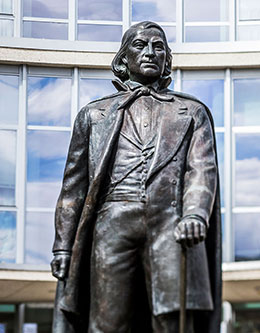
Reinhard Maeser
5 Apr 1876
Brigham Young’s famous founding charge to Karl G. Maeser—that he “ought not to teach even the alphabet or the multiplication tables without the Spirit of God”—is well known (page 14). It is BYU’s prime directive. Maeser himself referred to the charge as the “one thing constant” and “the mainspring of all her labors” (“History of the Academy,” page 21).
The version here has been excerpted from Reinhard Maeser, Karl G. Maeser: A Biography by His Son (Provo: Brigham Young University, 1928), 76–80; the text has been modernized.
History of the Academy
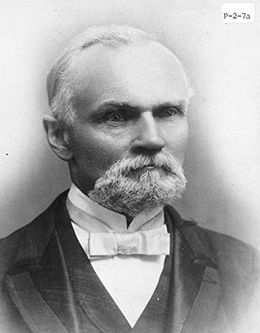
Karl G. Maeser
16 Oct 1891
This address was delivered at Brigham Young Academy’s first Founders Day exercises. President Maeser recounted how Brigham Young Academy began with the revelation to Brigham Young of “the necessity for the establishment of a new kind of educational institution for Zion” (page 19). The new educational system was not merely to duplicate existing models, for “following . . . in the old grooves would simply lead to the same results” (page 20). Brigham Young Academy was to be unique. At BYA “neither the alphabet nor the multiplication tables should be taught without the Spirit of God” (page 20). “The spirit of the latter-day work” was to go through the academy “like a golden thread” (page 21). Karl G. Maeser served as president of Brigham Young Academy from 1876 to 1892. This speech was originally printed in Karl G. Maeser: A Biography by His Son by Reinhard Maeser (Provo: Brigham Young University, 1928), 128 32.
The Charted Course of the Church in Education
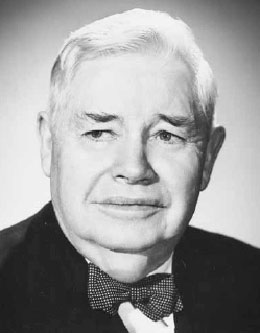
J. Reuben Clark Jr.
8 Aug 1938
Concerned about rising secularism in Church education, J. Reuben Clark Jr., first counselor in the First Presidency, gave this address to Church seminary and institute leaders at the BYU summer school in Aspen Grove. It has been called “the most influential address to seminary and institute teachers in the history of Church education” (By Study and Also by Faith: One Hundred Years of Seminaries and Institutes of Religion [Salt Lake City: The Church of Jesus Christ of Latter-day Saints, 2015], 101). While President Clark focused on seminary and institute teachers, the talk also implied the university’s need to hire Latter-day Saint faculty in all disciplines who were fully converted, for “our Church schools cannot be manned by unconverted, untestimonied teachers” (page 33). President Packer admonished BYU faculty that “The Charted Course” “should be read by every one of you every year. It is insightful; it is profound; it is prophetic; it is scripture” (“The Snow-White Birds,” page 230). So it is included among BYU’s founding documents even though its focus is on seminaries and institute teachers
The Second Century of Brigham Young University
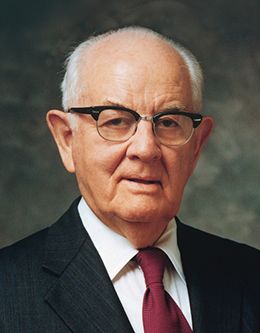
Spencer W. Kimball
10 Oct 1975
Spencer W. Kimball was president of The Church of Jesus Christ of Latter-day Saints when he gave this seminal address at the Founders Day commemoration on October 10, 1975—almost a hundred years to the day after the university’s founding. Speaking prophetically, President Kimball envisioned a remarkable destiny for BYU in its second century. His talk drew upon his visionary 1967 speech “Education for Eternity”; it also became the basis for his inaugural charge to Jeffrey R. Holland in 1980. This speech was unique as a major address by a president of the Church in that it was entirely focused on BYU’s mission. Its soaring expectations and sobering admonitions have guided the pursuit of excellence at BYU for nearly half a century. It has become a foundational discourse for the university, much as “The Charted Course of the Church in Education” (pages 23–41) has for the Church Educational System.

The Mission of Brigham Young University

Brigham Young University
4 Nov 1981
When President Jeffrey R. Holland began his administration, the university did not have a formal mission statement. It was felt that BYU needed to set forth its mission publicly, clearly, succinctly, and boldly. President Holland briefly discussed writing that statement in a BYU devotional in 1981. He said that he “tried to read almost everything that had been said about BYU and then attempted to reduce that down to a single statement . . . as to why BYU exists” (“Virtus et Veritas,” BYU devotional address, 8 September 1981). He then drafted a lofty, eloquent mission statement that, with very little modification, was endorsed by the board and adopted by the university. It has guided and inspired BYU for more than four decades.
The Aims of a BYU Education

Brigham Young University
1 Mar 1995
The Aims of a BYU Education builds upon the Mission of Brigham Young University. Focusing on student outcomes, it attempts to articulate the desired effect of a BYU education in the lives of students. The document appeared just as higher education was undergoing a fundamental paradigm shift from a “teaching paradigm” to a “learning paradigm” (Robert B. Barr and John Tagg, “From Teaching to Learning—New Paradigm for Undergraduate Education,” Change: The Magazine of Higher Learning 27, no. 6 [November–December 1995]: 12–26). The aims prepared the university to translate its educational aspirations into learning outcomes, as would soon be required by its accrediting bodies. The sections were purposefully ordered “to envelop BYU’s intellectual aims within a more complete, even eternal, perspective that begins with spiritual knowledge and ends with knowledge applied to the practical tasks of living and serving” (page 71).
Inspiring Learning
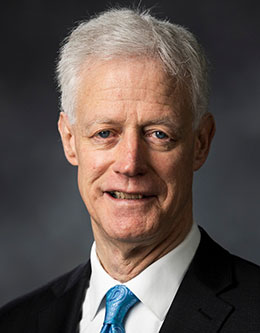
Kevin J Worthen
22 Aug 2016
In this university conference address, President Kevin J Worthen captured the essence of BYU’s mission and aims in a memorable two-word phrase: “inspiring learning.” The idea of inspiring learning quickly spread across campus, guiding educational initiatives and enabling student learning in new and expansive ways.
Religious Education in BYU’s Prophetic Historical Context
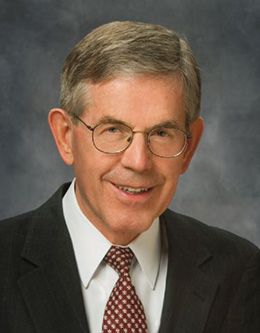
Bruce C. Hafen
28 Aug 2019
Though Elder Hafen was particularly addressing religious educators when he gave this speech, he chose to focus on the broader history and mission of BYU. Elder Hafen traced the history of why prophets have chosen to preserve a few Latter-day Saint colleges and universities—such as BYU and its sister institutions—in which religion can be integrated across the entire campus, rather than opt exclusively for the much less expensive and simpler model of Latter-day Saint institutes, where the faith is taught next door to secular universities. The history Elder Hafen recounted illustrates both the problems and promises of teaching and learning at a fully integrated Latter-day Saint university such as BYU.
The Second Half of the Second Century of Brigham Young University

Jeffrey R. Holland
23 Aug 2021
When Elder Holland gave this talk, it was one of three addresses during university conference that spoke to the need for BYU to remain faithful to its unique mission, as President Kimball had admonished in his centennial address. Elder Holland emphasized what must happen during the second half of BYU’s second century. Having loved BYU for nearly three-fourths of a century, Elder Holland spoke with great feeling, reminding the audience that “BYU will become an ‘educational Mt. Everest’ only to the degree it embraces its uniqueness, its singularity” (page 139).
Everything Pertaining to Learning
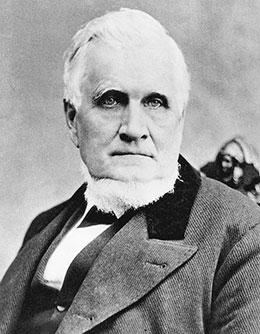
John Taylor
13 Apr 1879
This prophecy was given by President John Taylor in a discourse delivered on a Sunday morning at a stake conference in Ephraim, Utah. At the time, President Taylor was not only president of The Church of Jesus Christ of Latter-day Saints but also territorial superintendent of district schools for Utah, a position he held from 1877 to 1881. The text for this prophecy was originally published in the Deseret News Semi Weekly (1 June 1880) and in the Journal of Discourses 21:100 (13 April 1879).
Final Address
Karl G. Maeser
4 Jan 1892
On January 4, 1892, Karl G. Maeser and other dignitaries led the faculty and students assembled in the ZCMI warehouse—which had been housing Brigham Young Academy—in a formal procession to an impressive new academy building. On this occasion, Maeser gave an emotional farewell address as outgoing principal. In it, he reiterated BYA’s two founding principles: first, from Joseph Smith, to teach students to govern themselves; and second, from Brigham Young, to teach everything with the Spirit. Then he recounted how the design for the new academy building had been revealed to him in a dream some years before by Brigham Young himself. After this, President Maeser bid fond farewell to the academy, bequeathing his president’s chair to his successor and “maybe others after him” (page 150). The text for this talk was originally printed in The Normal 1, no. 10 (15 January 1892): 82.
Accepted in the Heavens
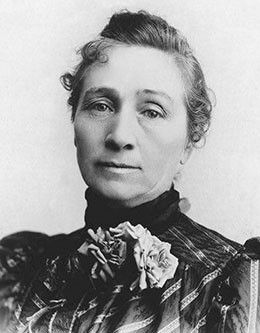
Zina P. Young Williams Card
15 Dec 1878
Zina P. Young Williams Card was the daughter of Brigham Young, a student of Karl G. Maeser, and the first Ladies Matron (equivalent of dean of women) at Brigham Young Academy. In “Short Reminiscent Sketches of Karl G. Maeser,” Card told of visiting with President John Taylor about her concerns over the dire financial condition of the academy. He comforted her by telling her of a dream he had had of her father, Brigham Young, who visited him and told him that Brother Maeser’s school was “accepted in the heavens” and would play “a part [in] the great plan of life and salvation” (page 156).
This document, along with another that is a record of a vision by Zina’s mother that “Jesus Himself claimed” Brigham Young Academy as “His school,” are found in the Zina Presendia Young Williams Card Papers: “Short Reminiscent Sketches of Karl G. Maeser” and “Sketch of School Life in the B.Y.A. 1878–1884,” unpublished typescript, undated, MSS 1421, box 2, folder 20, L. Tom Perry Special Collections, Harold B. Lee Library, Brigham Young University, Provo, Utah. Someone wrote “probably an address” on the top of Card’s “Short Reminiscent Sketches of Karl G. Maeser,” so it is possible that this was given as a speech. The text has been modernized and excerpted.
Education for Eternity
Spencer W. Kimball
12 Sep 1967
This talk was given at the annual faculty workshop at Brigham Young University when Spencer W. Kimball was a member of the Quorum of the Twelve Apostles. Although this speech was not literally a dream or revelation, Elder Kimball articulated a breathtaking vision for the future of BYU. “For long years,” he said, “I have had a vision of the BYU greatly increasing its already strong position of excellence till the eyes of all the world will be upon us” (page 174). Few who were there ever forgot what they felt when Elder Kimball lifted the curtain on his extraordinary vision of the future. The effect was electric and enduring. “Education for Eternity” has thus enjoyed a long shelf life among seminal university speeches. It figured prominently in subsequent talks about BYU’s future and has stirred the hearts of many, as John Tanner explains in “A House of Dreams” (pages 235–252), delivered on the fortieth anniversary of this talk.
Dedicatory Prayer for the Provo Utah Temple
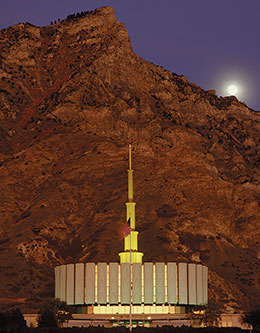
Joseph Fielding Smith
9 Feb 1972
In the dedicatory prayer of the Provo Utah Temple, President Joseph Fielding Smith pled for God to bless not only the temple but “that great temple of learning, the Brigham Young University, and all that is associated with it” (page 189). He also prayed for “all other Church schools, institutes, and seminaries” (page 189), as well as for “those who teach and study in all academic fields” (page 190).
With the completion of the Provo Utah Temple in 1972, Brigham Young University, the Missionary Training Center, and the temple formed one contiguous campus on which were located three similar but different kinds of houses of faith and learning. Commenting on this unique conjunction, then BYU president Dallin H. Oaks observed: “From the beginning of this dispensation the Lord has associated the temple, the school, and the ministry, a trio now brought together in this spot.” Looking out his office window, he would tell visitors that “these three institutions—university, mission, and temple are the most powerful combination of institutions on the face of the earth” (“A House of Faith,” BYU annual university conference address, 31 August 1977).
Almost forty years after making these remarks as BYU president, Elder Dallin H. Oaks was invited to dedicate a second temple in Provo. In his dedicatory prayer for the Provo City Center Temple, Elder Oaks again linked temple, mission, and university, including both BYU and Utah Valley University. Brigham Young University has thus been twice blessed by prophets in conjunction with the dedication of two temples.
The following excerpts are from the dedicatory prayers for these two Provo temples. The full prayers can be found at churchofjesuschrist.org/temples.
Dedicatory Prayer for the Provo City Center Temple
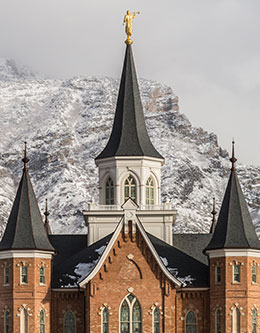
Dallin H. Oaks
20 Mar 2016
In the dedicatory prayer of the Provo Utah Temple, President Joseph Fielding Smith pled for God to bless not only the temple but “that great temple of learning, the Brigham Young University, and all that is associated with it” (page 189). He also prayed for “all other Church schools, institutes, and seminaries” (page 189), as well as for “those who teach and study in all academic fields” (page 190).
With the completion of the Provo Utah Temple in 1972, Brigham Young University, the Missionary Training Center, and the temple formed one contiguous campus on which were located three similar but different kinds of houses of faith and learning. Commenting on this unique conjunction, then BYU president Dallin H. Oaks observed: “From the beginning of this dispensation the Lord has associated the temple, the school, and the ministry, trio now brought together in this spot.” Looking out his office window, he would tell visitors that “these three institutions university, mission, and temple are the most powerful combination of institution on the face of the earth” (“A House of Faith,” BYU annual university conference address, 31 August 1977).
Almost forty years after making these remarks as BYU president, Elder Dallin H. Oaks was invited to dedicate a second temple in Provo. In his dedicatory prayer for the Provo City Center Temple, Elder Oaks again linked temple, mission, and university, including both BYU and Utah Valley University. Brigham Young University has thus been twice blessed by prophets in conjunction with the dedication of two temples.
The following excerpts are from the dedicatory prayers for these two Provo temples. The full prayers can be found at churchofjesuschrist.org/temples.
Nailing Our Colors to the Mast
Jeffrey R. Holland
10 Sep 1985
In this address, Jeffrey R. Holland recounted a remarkable dream that came to a discouraged and desperate Karl G. Maeser, who had tentatively decided to forsake Brigham Young Academy for greener pastures. In the dream, President Maeser foresaw the growth of the campus up onto Temple Hill. It moved him to stay and steer the academy according to principles taught by Joseph Smith and Brigham Young. Under President Maeser’s helmsmanship, BYA “nailed her colors to the mast” (page 197). President Holland resolved to do the same for BYU during his time at the helm.
The Dream Is Ours to Fulfill
Bruce C. Hafen
25 Aug 1992
Bruce C. Hafen was provost of Brigham Young University when he gave this address. He called for “wholesighted teaching, with both eyes open,” (page 209). Teachers using this method resolve the “faith-versus-reason dilemmas” not just by abstract answers but by fully integrated lives (page 205). Wholesighted teaching, according to Hafen, moves students “from dogmatism through healthy skepticism toward a balanced maturity that can tolerate ambiguity without losing the capacity for deep commitment” (page 209). He concluded his talk by telling of the desert father Abba Felix, who rebuked his followers for wanting to know the truth from wise elders but for being unwilling to live it. Smitten, they groaned, “Pray for us, abba” (page 212). Similarly, Hafen called on the campus community to heed the teachings of its inspired elders on the board of trustees and prayed that BYU might fulfill the dream of becoming “a truly great university [that is] absolutely . . . faithful to the gospel of Jesus Christ” (page 213).
The Snow-White Birds
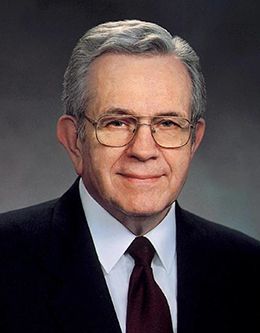
Boyd K. Packer
29 Aug 1995
When he gave this talk, Boyd K. Packer had just been released as a member of the BYU Board of Trustees, having served for thirty-four years. He spoke from long experience and with a long view of the challenges that “seem to cycle back each generation” (page 230). The title comes from a dream that President George H. Brimhall shared with Horace Cummings during one such crisis in the early twentieth century—a crisis that dealt with a deliberate effort to undermine faith. (See endnotes 3 and 4 on pages 232–233 for a fuller account of the administration’s concerns.) Elder Packer noted that properly blending faith and reason is a perennial challenge for each generation. In Church education, “there must [always] be a feeling and a dedication and a recognition and acceptance of the mission of our Church schools” (page 230).
A House of Dreams
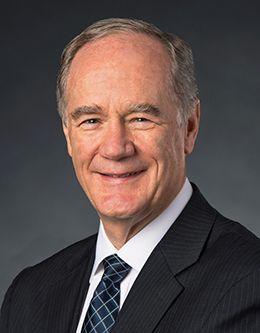
John S. Tanner
28 Aug 2007
John S. Tanner was academic vice president when he gave this address. In it, he argued that BYU is not only “built of brick and mortar” but of “dreams and ideals” (page 237). He recounted many inspired dreams that had come to BYU’s leaders, analyzing in particular how BYU was doing in realizing President Kimball’s vision for BYU in “Education for Eternity” (pages 159–184), which had been delivered forty years before.
Learning in the Light
John S. Tanner
26 Aug 2008
John S. Tanner was serving as academic vice president when he delivered this address. The exhibit Education in Zion had just opened in the newly completed Joseph F. Smith Building. Tanner encouraged faculty to visit the exhibit, which recounts the story of education among Latter-day Saints with a focus on BYU. In a sense, it functions as a visual companion to Envisioning BYU. During his speech, Tanner took the faculty on a virtual tour of the exhibit. He concluded with an image from Lord of the Rings, reminding faculty that they, too, must light fires that rally those who will fight with the King when He returns. The first section of the talk, which deals primarily with administrative matters, has been omitted.
An Education of the Whole Soul
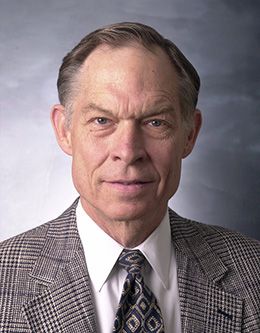
C. Terry Warner
11 Nov 2008
C. Terry Warner gave this beautiful devotional address as he was about to retire, having served for many years at BYU. He had been chair of the philosophy department, director of the Honors Program, and dean of the College of General Studies. At the end of his career, he was the founding curator of the Education in Zion exhibit in the Joseph F. Smith Building. Warner’s devotional provides an inspiring perspective on the university drawn from his years at BYU and his work on the exhibit. He reminds us of the vision of BYU’s founders and calls on BYU to remain true to its heritage.
The Tie Between Science and Religion
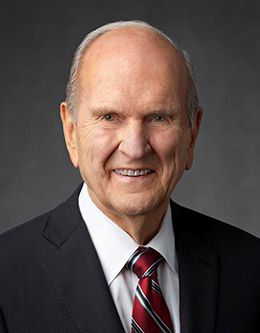
Russell M. Nelson
9 Apr 2015
President Russell M. Nelson, an apostle at the time that he gave these touching remarks, recounted in this talk how the gospel had “provided the undergirding foundation” for his remarkable educational journey (page 292). His journey had taught him, among other things, that “all truth is part of the everlasting gospel” (page 291) and that “when the laws of God are obeyed, wanted blessings will always result, not just maybe or sometimes” (page 293). President Nelson’s sterling example reminds us that we are blessed as we become disciples in the disciplines. Indeed, the Lord expects all of His people to be consecrated covenant keepers who are following the covenant path, no matter their worldly occupation.