


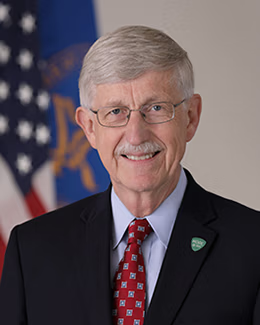
Francis S. Collins
Francis S. Collins is a prominent American physician-scientist best known for his contributions to genetic research and his leadership in large-scale scientific initiatives. His contributions greatly impacted modern genomics and medical research during his time as both a researcher and an administrator.
Collins grew up on a small farm in Staunton, Virginia, where he was homeschooled by his mother for the majority of his early life. It was during this time that his interest in science was fostered. His love of science first centered on chemistry and physics, which led him to earn his bachelor’s degree in chemistry from the University of Virginia. Collins went on to receive his MS and PhD in physical chemistry from Yale University; he later earned an MD with honors from the University of North Carolina at Chapel Hill.
Collins started his career at the University of Michigan, gaining international recognition for developing positional-cloning techniques and identifying genes associated with hereditary diseases, including cystic fibrosis, Huntington’s disease, neurofibromatosis, and more.
In 1993 Collins was appointed as the director of the National Human Genome Research Institute at the National Institutes of Health, becoming a central researcher in the international Human Genome Project. During this time, he led the project to complete the first comprehensive sequence of the human genome in 2003.
Collins was appointed as the 16th director of the National Institutes of Health in 2009 by President Barack Obama. Collins oversaw its progress for more than a decade under multiple US presidents, eventually stepping down from his position in 2021. His work awarded him many honors including the Presidential Medal of Freedom in 2007, the National Medal of Science in 2009, and the Templeton Prize in 2020.
Francis S. Collins is notable for engaging in conversation about science and religion, having written the bestselling book “The Language of God: A Scientist Presents Evidence for Belief.” In his writing, he advocates for theistic evolution and explores ways in which scientific understanding can coexist with religious faith. His work and research continue to shape the scientific landscape, while also promoting discussion about how scientific questions and religious belief can coexist.
1 Talk
The Road To Wisdom: On Truth, Science, Faith and Trust


