Choose Christ
of the Seventy
 Facebook
  Twitter/X

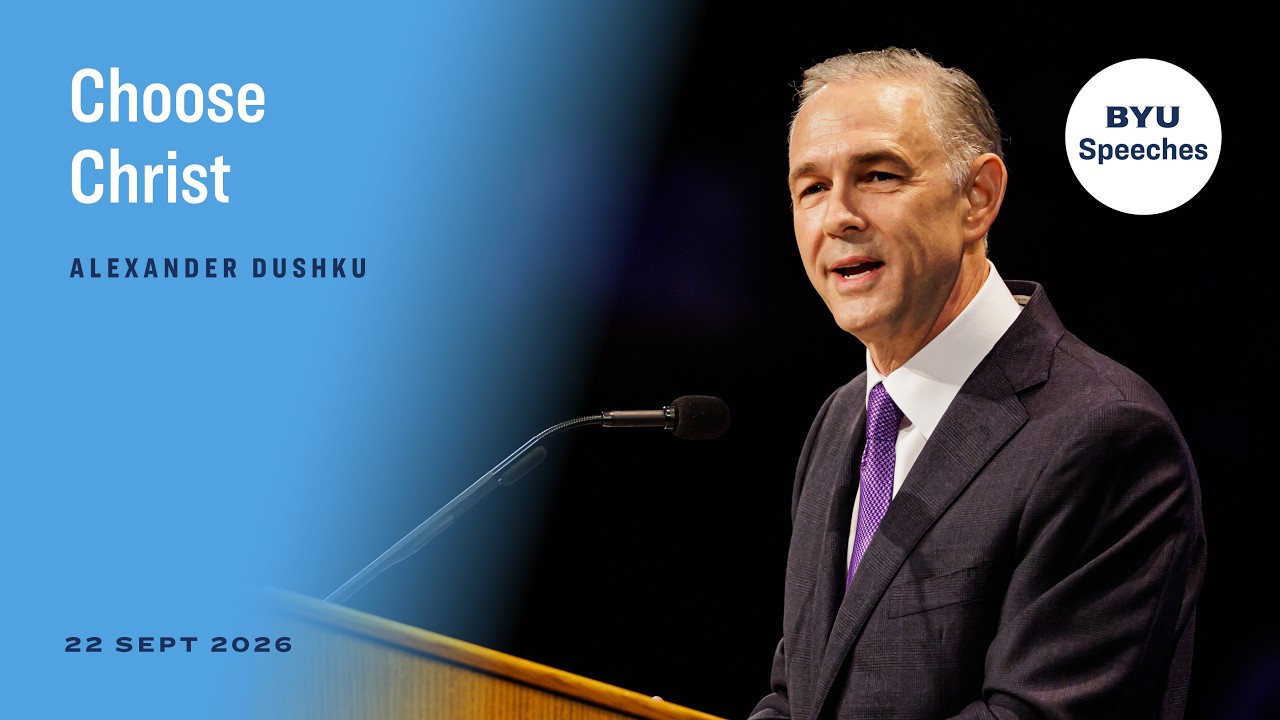
Why choose Christ? Because He is real! He is the most real thing in this world. He is “in all and through all things”—the “light and life” of the whole world, and of your individual world and mine.
My young friends, I am profoundly grateful to be here. How I love Brigham Young University and what it stands for. Together with my good parents and my mission, this school laid the foundation for every good thing in my life. I hope you have a vision of what this BYU experience is really about and that you make the most of it. It will be over soon, and you will miss it.
Before I came here, my son Isaac said, “Dad, you have to understand that those who come to see an ordinary General Authority like you on a Tuesday morning with all they have going on—they are the finest people in the world!” He’s right. So thank you for being here. And thank you for being who you are.
Summary: Choose Christ!
I believe your generation will have more opportunities than any generation in human history. And you will likely face more challenges too.
What will determine everything is what you—each one of you—choose to base your life on. So if you remember nothing else that I say today—if I put you to sleep or everything else fades by lunchtime or you have a TikTok emergency—please remember these two words: Choose Christ!
Last week Elder Neil L. Andersen of the Quorum of the Twelve Apostles stood here and invited you “to have your faith in Jesus Christ and your devotion to the restored gospel settled in your heart.”1 I’m here as another witness to that powerful message.
Crossing the Rubicon
Many of you are familiar with the phrase “crossing the Rubicon.” It means passing a point of no return—making a fateful and final decision from which there is no going back. It comes from a pivotal moment in the life of Julius Caesar.
Julius Caesar was one of the most powerful figures in the late Roman Republic. By 49 BC, Caesar and his Roman legions had spent nearly a decade conquering Gaul, the vast region we now call France. He had become enormously wealthy and extremely popular. And his legions were fiercely loyal to him.
Back in Rome, this sparked intense jealousies and fears among powerful political forces. The Roman Senate commanded Caesar to disband his legions and return to Rome as a private citizen, which threatened him and his family with prosecution, exile, and even death.
Everything hung on his next move.
The River Rubicon marked the northern boundary of Italy. By law, no Roman general could take his army across the Rubicon without permission of the Roman Senate. Caesar knew that to do so was treason and an act of war against Rome.
Nevertheless, in January 49 BC, Julius Caesar took one of his legions across the Rubicon, reportedly declaring, “Alea iacta est” (“the die is cast”). The choice is made. There is no turning back. And on Caesar went, defeating his foes and becoming in effect the first Roman emperor—the first of all the Caesars.
Now Julius Caesar was not a righteous man. I’m not remotely suggesting that you invade Italy or pattern your life after Caesar! But Caesar understood a powerful truth: The time comes when you and I must choose what matters most to us.
You have so much of your lives in front of you. You may well live for another seven decades. But life passes quickly. Now is the time to cross the Rubicon of faith and never look back. Now is the time to decide to be all in for the Lord.
Enoch was commanded by the Lord to tell his people, “Choose ye this day, to serve the Lord God who made you.”2
Now is the time to choose Christ—over everything.
Why Choose Christ?
It will help you to choose Christ over the world if you understand better who He is and what He offers you. “And this is life eternal,” Jesus prayed, “that they might know thee the only true God, and Jesus Christ, whom thou hast sent.”3
When I say choose Christ, I mean choose the living Jesus Christ—the full Christ, the Christ of the Restoration. Not the watered-down Jesus who society sometimes purports to admire for being kind, saying wise things, and caring for the poor. A kind, wise, caring Jesus would certainly be admirable. But Jesus the Christ is no mere guru of kindness or life coach or social worker. He is infinitely more than that.
“For God so loved the world, that he gave his only begotten Son, that whosoever believeth in him should not perish, but have everlasting life.”4
I had an experience that deepened my own understanding of God’s love for us and of Jesus Christ’s saving and exalting work. Almost 20 years ago I was assigned by my bishop to teach the adults in my ward about the temple. I was nervous and didn’t know what to say. Seeking guidance, I fasted and attended the temple every week, but nothing came. On the day before my lesson, I was in the celestial room praying when, through the Spirit, the Lord spoke clearly and unmistakably to my mind: “Teach them that I love them and that I want to be with them.”
I was filled with a sense of God’s loving-kindness and of His desire for a deep and abiding relationship with us. This is profoundly personal for Heavenly Father and Jesus Christ, I learned. For me, that was a great clarifying moment.
The core of Heavenly Father’s plan to save and exalt us is the gift of His Son Jesus Christ, who is full of love for each of us and “mighty to save.”5 The question for you and for me is whether we will choose to receive that gift—whether we will receive Him and allow Him to be with us. Over and over again Christ invites us to abide in Him,6 be one with Him,7 and walk with Him.8 He seeks intimate communion with each of us.
But He cannot force that communion. That is why agency matters so much.
Satan’s plan was both immoral and dumb. Immoral because destroying someone’s agency is evil. And dumb because no one can be forced to be righteous. It never would have worked.
Not even God can save or exalt us by external force. It doesn’t work that way. The change must come voluntarily, from the inside. The problem is that on our own we lack the spiritual power.
We have to let Christ in so He can change our natures—so He can give us a new birth and make us “new creatures.”9 We sometimes feel all this pressure to perfect ourselves when the truth is that only Christ can perfect us. The question is whether we’ll choose to let Him. The ordinances, covenants, and commandments are all about receiving the Father’s gift of Jesus Christ. They are how we “yield” to Him and receive the power of godliness—Christ’s power—so He can transform us.10 It was never the plan, brothers and sisters, for us to do it alone. We can’t save ourselves.
Borrowing from George MacDonald, C. S. Lewis captured some of what I’m trying to say. Lewis wrote:
Imagine yourself as a living house. God comes in to rebuild that house. At first, perhaps, you can understand what He is doing. . . . But presently He starts knocking the house about in a way that hurts abominably and does not seem to make sense. What on earth is He up to? The explanation is that He is building quite a different house from the one you thought of. . . . You thought you were going to be made into a decent little cottage: but He is building a palace. He intends to come and live in it Himself.11
You might wonder whether enduring this kind of remodeling is really worth it. Can I really trust the Savior, even in the dark and messy places in the attic of my soul? Can He really make me—imperfect and broken me—into that palace?
Oh yes! But to believe that deeply enough to choose Him, you need to know and remember who He is and what He has done for us.
Under the direction of the Father, Jesus Christ created the earth. He is the Creator. John taught, “All things were made by him; and without him was not any thing made that was made.”12
He is “Alpha and Omega, the beginning” of our spiritual journey and its glorious “end” and everything in between.13
He is our “advocate with the Father,”14 “the rock of our salvation,”15 and “the good shepherd”16 who is relentlessly seeking us, as Elder Patrick Kearon has taught.17
He is “Immanuel,”18 “God with us”19—as we say at Christmas—and the “bread of life”20 and the “living water”21 for our hungry and thirsty souls.
He is “the way, the truth, and the life.”22
He is the Christ, the Messiah, our Savior and Redeemer.
Alma taught that Christ “[took] upon him death” and suffered “pains and afflictions and temptations of every kind” and even our “sicknesses” so He would know “how to succor [us, how to strengthen us, nourish us, and rush to our aid] according to [our] infirmities.”23
So great was His anguish for us that “blood cometh from every pore,”24 King Benjamin said. “How sore you know not,” the Lord told Joseph, “how exquisite you know not, yea, how hard to bear you know not.”25
His sacrifice was “infinite and eternal” so that His infinite and eternal mercy could encircle you and me “in the arms of safety”—in His arms.26
Why choose Christ? Because He lives. Because He is real! He is the most real thing in this world, brothers and sisters. He is “in all and through all things”27—the “light and the life of the [whole] world”28 and of your individual world and mine.
And He is the perfect embodiment of the highest and most powerful form of love—of charity, which “endureth forever”29 and “never faileth.”30 Christ never fails you. Never. It is not in His nature. His love for you is all-consuming. He knows you, loves you, and has paid the ultimate price for you. He wants to be with you, make you glorious, and take you home to our Father in Heaven.
You have to believe and trust that, brothers and sisters. Because it’s all true.
I had another experience that taught me about Christ’s perfect love for us. Our first child was a beautiful boy who arrived after a very hard pregnancy and delivery. I loved that cute, squirmy little creature so much that I thought my heart would burst. But I soon realized that my wife, Jennifer, loved him even more. I would come and go, but Jennifer literally never left him. Ever.
After about nine months of never being alone with my wife, I had what I thought was a brilliant idea: What if we went on something called a date? You know, where you go out, just the two of you. We could leave our little boy with dear friends who lived below us. Jennifer was skeptical. She perceived that would mean leaving her precious son behind. Yeah, that was the point. Eventually I convinced her, and off we went. I was thrilled!
However, 45 minutes later, Jennifer couldn’t take it anymore, and we were headed back. As we got home, I decided to tease her by driving past our parking spot. Jennifer was having none of it. With the car still moving, she opened the door and began climbing out to get to her baby! I had to slam on the brakes so she wouldn’t get hurt.
“Wow!” I thought, “that is love and connection like I’ve never seen before!”
And so it was no wonder to me when I came across the scripture in which the Lord used the mother-child connection to describe His love for us. Through the prophet Isaiah, the Savior said:
For can a woman forget her sucking child, that she should not have compassion on the son of her womb? Yea, they may forget [this world may be so upside down and confused that even a mother in that situation could forget], yet will I not forget thee. . . .
Behold, I have graven thee upon the palms of my hands; thy walls [that is, your protection and welfare] are continually before me.31
The more we understand and experience Jesus Christ, the more His saving and exalting love becomes overwhelming and irresistible. It is “most desirable above all things,”32 Nephi observed in his great vision. “Yea, and the most joyous to the soul,”33 the angel added. How could we choose anything over His love and the covenant relationship that lets it flow into our lives?
I fear that some of the ways we talk can obscure just how deeply personal Christ’s love is for us. We sometimes speak as if the Atonement of Jesus Christ is an impersonal entity or power we can appeal to or “apply”—as if salvation is a matter of balancing debits and credits in some cold, eternal bank account. It’s not. President Russell M. Nelson taught, “There is no amorphous entity called ‘the Atonement’ upon which we may call for succor, healing, forgiveness, or power. Jesus Christ is the source.”34
It is Jesus Christ who saves us. His offering is not mechanical. It is deeply personal. It is a matter of blood, sweat, and tears; of flesh and bone; of life and death; of agony unfathomable as the price of joy indescribable. It is personal to us and personal to Him.
The scriptures reveal a Savior with a tender heart who mourns when we reject Him. Over and over again in the scriptures, Jesus says, “I came unto mine own, and mine own received me not.”35
The Lord says, “How oft would I have gathered you . . . and ye would not.”36
Enoch saw the Lord weeping over His people and asked God how it could be.
The Lord responded, “[I gave] unto man his agency . . . and also [have] given commandment, that they should love one another, and that they should choose me . . . ; but behold, they are without affection.”37
Does it matter to the Lord when we reject Him? Of course it does!
But on the other hand, “how great is his joy in the soul that repenteth!”38
The Book of Mormon records Jesus weeping with a fulness of joy as His people at last received Him.39
Jesus Christ is the gift. Everything depends on our receiving Him. But the choice is ours.
“Remember,” Jacob says, “that ye are free to act for yourselves—to choose the way of everlasting death or the way of eternal life.”40 Jesus Christ is the way of eternal life.
Choose Christ!
What Does It Mean to Choose Christ?
The prophet Joshua also had a river to cross at his own moment of no return. With the help of the Lord, Joshua and the children of Israel crossed the River Jordan and went on to prevail against impossible odds.
Near the end of his life, Joshua gathered the Israelites to give them his final charge.
We often quote part of what he said in Joshua 24: “Choose you this day whom ye will serve . . . : but as for me and my house, we will serve the Lord.” You have read that many times.
But the full verse emphasizes the stark choice we actually face. Joshua says:
And if it seem evil unto you to serve the Lord, choose you this day whom ye will serve; whether the gods which your fathers served that were on the other side of the flood [in other words, the gods of the Egyptians], or the gods of the Amorites, in whose land ye dwell: but as for me and my house, we will serve the Lord.41
In other words, there is no middle ground. We will either serve the Lord or we will serve some other god or gods.
And that choice between Christ and the world exists every day of our lives. We are constantly presented with options and opportunities, temptations and distractions.
I believe this fallen world is designed to force us to decide what matters most to us—what and who we really love.
“If ye love me,” Jesus said, “keep my commandments.”42 He said, “I am the law, and the light.”43
His commandments are not just rules. Don’t make the mistake of thinking of them that way. They are not just rules; they are opportunities to affirm our love and our loyalty and to receive His light. After His Resurrection, the Lord asked Peter, “Do you love me more than these?”44—more than the things of the world, even more than friends.
The Lord poses the same question to each of us: “Do you love me?” We answer that question by choosing Him and His gospel or by rejecting Him.
At its most fundamental level, sin is not mere rule breaking; it is turning away from Christ—and, at its worst, it is rejection, betrayal, disloyalty.
And we all do it, in one way or another.
But keeping the commandments and our covenants is an act of love and loyalty—it is our invitation for Christ to abide with us.
After Jesus taught some hard things, the scriptures record that “many of his disciples went back, and walked no more with him.”45
The Lord then turned to His dearest friends, His apostles, and asked, “Will ye also go away?”46
That is always the question. Will we walk away from Him too? Or will we love Him and stay?
Then Simon Peter answered him, Lord, to whom shall we go? thou hast the words of eternal life.
And we believe and are sure that thou art that Christ, the Son of the living God.47
Where else would we go? Peter was saying.
Christ’s loving invitation is constant: Come unto me, follow me, receive me, hear me, draw near unto me, walk with me, love me, abide in me. And the invitation is always personal—from Him to you and to me.
The fundamental choice we face, brothers and sisters, is not between one philosophical approach to life and another. It is between Jesus Christ—the living Son of the living God with His outstretched arms bearing the marks of His sacrificial offering and eternal love for us—and the world, Satan, the “great and spacious building,”48 the philosophies of men, the desires of the flesh, fame, fortune, power, or whatever else divides us from Him.
That is the choice! Christ or the world.
When the adversary presses in and temptations come, we must remember that we are choosing in that moment what we love most.
Choose Christ because He loved you first and because you love Him most!
How Do We Choose Him?
How do we make Jesus Christ the center of our lives? You already know. We choose to build and exercise faith in Him, praying with real intent and feasting upon His words. We choose to repent of our sins—our betrayals—and return to Him quickly when we fail Him, as all of us surely will. We choose to keep our covenants and obey His commandments out of love and loyalty. We choose to partake of the sacrament with “a broken heart and a contrite spirit,”49 witnessing and covenanting again that we do always—always—remember Him.50 We choose to receive His Spirit and allow Him to change our natures “line upon line.”51 We choose to build the pillar of our testimonies one spiritual ray at a time.52 We choose to love and serve one another in His name. We choose to follow the guidance of His living prophets and apostles.
In short, we love Him with all we have and choose to trust Him and follow Him, becoming His true disciples.
In my own personal prayers, I have found great strength in saying simply, “Heavenly Father, I choose Thy plan and my Savior, Jesus Christ.”
One of the greatest barriers to choosing Christ is the widespread notion that this life is about being true to yourself.
“You do you,” we are constantly told.
But Christ says, “I am the way.”53 He says, “Take up [your] cross, and follow me.”54
The world says, “You do you.”
But Christ says, “You do me, and I’ll make you the most glorious and joyful you imaginable!”
Conclusion
My dear friends, now is the time to rise up, cross the Rubicon of faith, plant yourself on the rock of our Redeemer, and take your stand for Christ and the Restoration and the cause of truth.
Now is the time to choose Christ—over everything.
I testify of our Savior Jesus Christ. He lives! I am a witness of Him, and so are you.55
And so, with you:
I stand all amazed at the love Jesus offers me,
Confused at the grace that so fully he proffers me.
I tremble to know that for me he was crucified,
That for me, a sinner, he suffered, he bled and died.
[Chorus]
Oh, it is wonderful that he should care for me
Enough to die for me!
Oh, it is wonderful, wonderful to me!56
I choose Christ!
In His holy name, Jesus Christ, amen.
© by Intellectual Reserve, Inc. All rights reserved.

Alexander Dushku, a General Authority Seventy of The Church of Jesus Christ of Latter-day Saints, delivered this devotional address on September 22, 2026.
Related Topics
Related Speeches