Lessons from the Master Engineer
Associate Chair of the Department of Mechanical Engineering at Brigham Young University
 Facebook
  Twitter/X

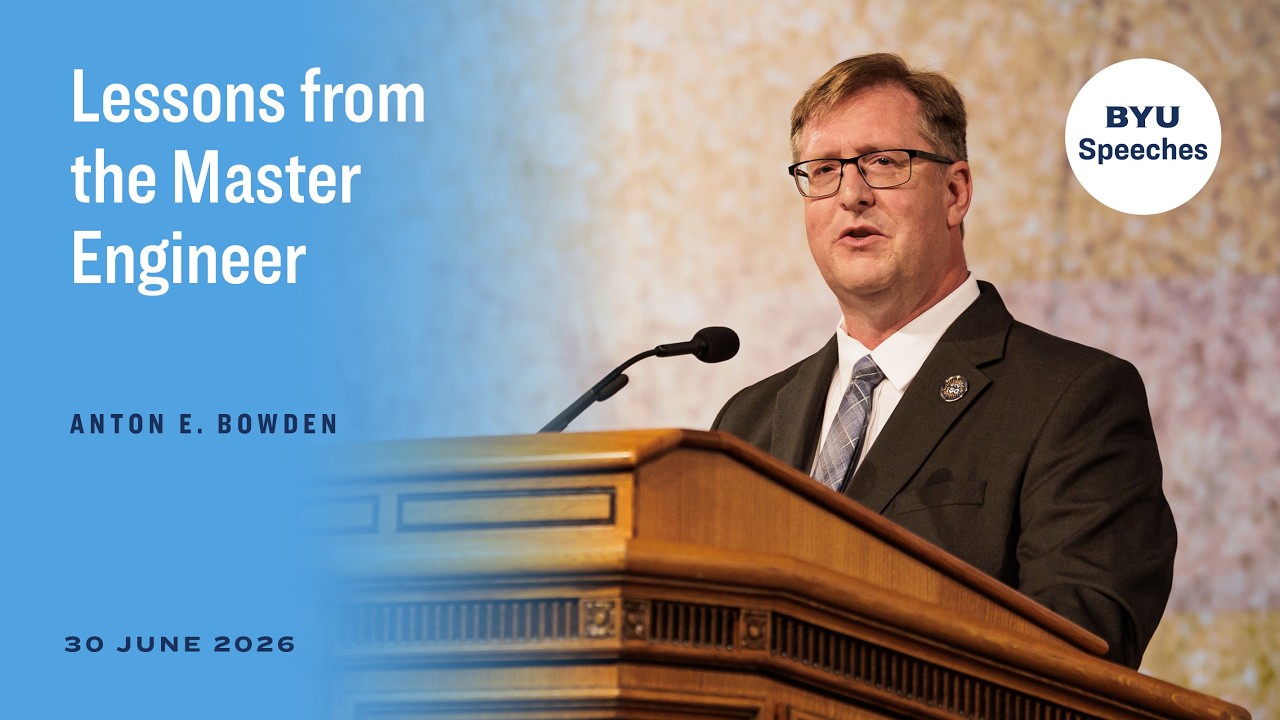
Our bodies are gifts, designed by a Master Engineer and bestowed upon us because He is our loving Heavenly Father. By studying how our bodies work, we can learn a bit more about Him.
Brothers and sisters, I am grateful to be with you today. The title of my devotional message is “Lessons from the Master Engineer,” and my hope is that by the end of my talk, each of us will have a deeper understanding of both our Creator and of ourselves.
We can learn some interesting things about a person by studying the things that they create. For example, I have several neighbors who are very talented artists.
The scene in this painting by Joseph Brickey depicts a family at Winter Quarters on the banks of the Missouri River near Council Bluffs, Iowa, during the bitter cold of January 1847. [A picture of Joseph Brickey’s painting Icy Crucible was shown.]
The history of that winter provides a powerful lesson about faith in the midst of extreme circumstances as these early Saints gave their all. The history of that scene is worth a devotional all on its own. But there is also a personal story in the painting—one about a family that is facing a challenging circumstance with faith and compassion for one another.
From this painting I also learn some profound things about my neighbor, Brother Brickey. I learn of his faith, his love of Church history, and his love for the early Saints. I learn about the love of his family for each other because he is able to show that love in his painting. I learn that he too has been asked to do hard things and knows how that feels.
This painting by my neighbor Roland Thompson is an abstract art depiction entitled Retreating Radiance. [A picture of the painting was shown.]
At first glance it may be harder to see meaning in it. By definition, abstract art is about evoking emotional experiences and mood. This piece is large, and the mixture of materials creates deep colors and a mesmerizing effect. When I look at it, it draws me into the darkness of space but also directs my vision to the points of light that make that environment a place of beauty.
In talking with Brother Thompson, he let me know that, for him, this piece is about God and about our place in the universe. The piece gives me insight into Brother Thompson himself and into his relationship with God. From the painting I learn that he has witnessed the majesty of divinity and that it is imprinted indelibly upon his soul.
My technical background is in biomedical engineering with a specific area of focus on the spine. I have spent more than 30 years investigating the human body through the lens of an engineer. Today I hope to share with you some insights from that study and, more specifically, some of the lessons that we can learn about the Master Engineer by studying His engineering work.
Alma testified that “all things denote there is a God,” including “the earth, . . . its motion, . . . and also all the planets which move in their regular form.”1 That same witness is present in the human body.
From the microscopic to the macroscopic, from DNA to organ systems, from the beating heart to the healing bone, our bodies testify of the wisdom, patience, creativity, mercy, and love of the Master Engineer.
The Gift I Received 54 Years Ago
It has been almost 54 years since I received a gift that changed me forever. I received this mortal body. After 54 years, it is perhaps a little worse for wear.
But even though it is worn—with scars, stiffness, and occasional strange noises from my joints when I stand up—I am deeply grateful for the gift of this body.
Each of you has received a similar gift. I hope that your body also inspires feelings of gratitude, for it is truly a miraculous gift. Each of us, regardless of our temporal circumstances, has received a gift that is so valuable as to be simply beyond price. There is no amount of money that you could pay any engineer on the planet to design and build something equivalent to your body—even on its worst day. Our best attempts in robotics, electronics, materials science, and artificial intelligence are inspiring yet feeble imitations of that gift.
We have often heard that there are two major purposes of mortality: to receive a body and to be tested.
And in the Church we talk a lot about the “being tested” part. We have talks about trials, adversity, faith, endurance, patience, repentance, consecration, sacrifice, and pressing forward.
We have far fewer talks that begin, “Brothers and sisters, today I would like to bear testimony of cartilage.”
And that may be a missed opportunity. Because receiving a body is not just the opening formality of mortality. It is not just the container in which the real spiritual work happens. It is part of the work. It is part of the gift. It is part of the plan.
The Doctrine and Covenants teaches that “the spirit and the body are the soul of man” and that “the resurrection . . . is the redemption of the soul.”2
Joseph Smith taught, “We came to this earth that we might have a body and present it pure before God in the celestial kingdom. The great principle of happiness consists in having a body.”3 That was Joseph’s quote: “consists in having a body.”
Our bodies are not incidental to the plan of salvation or to our eternal happiness. They are central to it. And even though the temporal versions of our bodies may have challenging flaws, nevertheless our bodies are magnificent gifts.
I would like you to consider for a minute the body from the perspective of an engineer. Let me give you an analogy I frequently share with my students.
Imagine for a minute that you are tasked with designing a car. That car will be the size of a Matchbox car.
But this tiny vehicle is not an ordinary toy. Every system in the car must fully function just as it does in its full-sized equivalent. The engine, the transmission and braking, the steering and suspension, and every other component of the car must function. The windshield wipers, headlights, electric seat warmers, and even the convertible top must be fully functional.
Now that fully functional but incredibly tiny vehicle will be set on the road and start on a journey that has never been even conceived of by an automotive design engineer. The car will start to drive continuously down the road. Sure, it will start on isolated neighborhood roads, but those will quickly transition to larger highways and eventually interstates. The car can refuel, but it must do so while continuing to drive.
This amazing vehicle that you are designing must undergo an astonishing transformation. While it is driving down the interstate, it must remodel itself—not just once but continuously—growing from its initial tiny size until it reaches the dimensions of a full-sized automobile. And when the vehicle runs over the inevitable potholes on the road or receives “door dings” from neighboring cars or is even sideswiped and crashed into a telephone pole, it must repair itself. Indeed, the self-repair must also happen while it continues to drive down the road. And that car must continue to drive for 90 years or so.
Of course I am talking about the human body, and the car I just described represents just a fraction of the functionality of that body.
To study the engineering design that makes such a creation possible is to study a miracle of engineering. It is studying the work of a true Master Engineer. It inspires me—and I hope it inspires you—and that is the point. By studying the body, we can learn more than just how it works; we can learn much about the Master Engineer who created it and about what is important to Him. Today I have time to share just a few lessons I have learned from a lifetime of study.
Lesson One: The Master Engineer Marks His Creations
In engineering, when a licensed professional engineer approves a design, they place their stamp or seal on it. That seal means something. It says: “I stand behind this work. I accept responsibility for this design. It is connected to me.”
Our Heavenly Father has placed a much holier mark upon us. He has created us in His image.4 He also gave each of us the Light of Christ to identify us as being His creations and to direct us back to Him.5
President Russell M. Nelson referred to our identity as a child of God as being our “most important” identity.6 Surely it is fitting that God has given us a persistent reminder of that identity.
Elder Gary E. Stevenson taught in April 2026 that in a sacred way our Heavenly Father places a claim upon us: “You are mine. I know you. You are not alone. I have not forgotten you. I intend to bring you home.”7
That is not about ownership. That is about covenant love.
That is not God saying, “This is my property.”
It is God saying, “This is my child.”
Elder Stevenson also compared this divine claim to “a tag” marking each soul as “precious” and not “to be forgotten, neglected, or lost.”8
That tag also gives us a destination. It marks us as returning to Him at the end of the journey and even provides helpful information for contacting Him should we become separated.
Lesson Two: Diversity Is Not a Manufacturing Error
As mortal engineers, we rely very heavily upon repeatability and consistency in the products that we design. However, some of the first things the human body teaches us are that the Master Engineer is not interested in bland uniformity and that He has a different metric for perfection.
As humans, we have an interesting love-hate relationship with sameness.
We appreciate sameness when we are buying a replacement phone charger or a part for our car.
But we do not usually search for beauty in sameness.
Imagine walking through a neighborhood of identical houses. Same color. Same roofline. Same landscaping. Same mailbox. Same inflatable Christmas decoration.
At first you might think, “This is efficient.”
Then you think, “I have no idea which house is mine.”
And then you think, “I hope I didn’t just walk into my neighbor’s kitchen.”
The Lord’s creations are not like that.
For example, this is a picture that I took while visiting the Sacred Grove in Palmyra, New York. [A picture was shown.] Each tree, each branch, each leaf is different.
Similarly, each of our bodies is unique, inside and out, and we come in all shapes, sizes, colors, personalities, and talents.
That is part of the design!
Each laugh line and expression on the face of our loved ones is a beautiful and unique representation of who they are—not just statically but dynamically—as we see their expressions evolve from surprise to joy or from annoyance to love.
We appreciate efficiency and familiarity, but when we search for beauty and identity, we focus on the unique aspects of the things we choose for our lives. The Master Engineer has given each of us the gift of being one of a kind. And because we are each unique, we each have something unique to give.
Lesson Three: We Work and Heal Better Together
Some of the strongest tissues in your body are composites. Bone, tendon, ligament, heart valves, teeth, fingernails—all of these rely on materials with different properties working together.
In bone, for example, stiff minerals give strength while collagen gives flexibility and toughness. If bone were only mineral, it would be hard but brittle. If it were only collagen, it would be flexible but weak. Together, these different materials create something neither could become alone.
That is a divine design principle. Strength often comes not from eliminating difference but from consecrating difference.
One of the most remarkable things about the human body is that healing is not purely mechanical. It is influenced by connection.
As I mentioned previously, my research is in spine biomechanics and medical device design. Over the last seven years, our group has been applying that research to better understand chronic low back pain with the hope of improving our ability to treat it. Chronic pain is challenging—and also ubiquitous. One in three adults has experienced low back pain in the last three months—and one in 10 is experiencing chronic low back pain that has lasted an average of seven years or more.
The research is very clear that our chronic pain and its impact on our quality of life and overall happiness is only partially driven by an underlying mechanical problem. It is also affected in a large manner by our own mental health and self-perception and, intriguingly, by the strength of our social network of family and friends. In fact, our social network plays a larger role in how chronic pain affects our lives than does the severity of the pain itself. The data also shows that someone who is both socially isolated and lonely has almost double the risk of chronic low back pain compared with someone who is not.
As someone who has had my own experiences with chronic back, neck, and shoulder pain, I do not wish to imply that this relationship somehow diminishes the validity or challenge associated with chronic pain. In fact, I would emphasize that chronic pain is one of the most severe challenges of mortality. It pushes us to our limits—physically, mentally, emotionally, and spiritually.
What we have learned is that treating such a severe challenge requires more than simply treating a physical ailment. It requires treating the body, the mind, and even the heart—and that is often best accomplished through connection to other people.
As an engineer, I find this astonishing and intensely frustrating to understand, because most engineered systems do not work that way!
If a bridge develops a crack, you cannot place it next to another bridge and say, “Be supportive,” and expect it to heal the crack.
If your car breaks down, you can’t park it beside a reliable car and hope it feels encouraged and starts to work again.
If your laptop stops working, you cannot improve it by gathering other laptops together for a quorum meeting in which all the laptops go away working more efficiently. (Although, to be fair, I have tried less rational things with computers!)
But human beings are different.
The Master Engineer designed us for connection. In the book of Genesis, after Adam had been placed in the garden, the Lord said, “It is not good that the man should be alone.”9
That statement is often applied to marriage—and rightly so—but the principle is broader: We were not designed for isolation.
Connection is not a decorative feature of the plan of salvation. It is part of the design.
We heal better together.
We grow better together.
We endure better together.
Lesson Four: The Master Engineer Uses Compliant Mechanisms to Achieve both Strength and Flexibility
When I started working at BYU almost 20 years ago, a good friend and colleague introduced me to the beauty of his research area in compliant mechanisms. A compliant mechanism achieves motion not through rigid joints but through flexibility. It bends. It stores energy. Its appearance can be deceptively simple, but its motion can be incredibly complex.
As I mentioned previously, one of my primary interests is studying the biomechanics of the spine. It is such a beautiful and unique structure. It is comprised of 33 vertebrae stacked on top of each other in a curved column. However, a naïve inspection of the spine might lead one to question the sanity of the designer! As anyone who has ever played blocks with a toddler can attest, stacking blocks in a tall, curved tower does not make an inherently stable structure.
So why did the Master Engineer choose that design to bear the weight of our bodies, to serve as the fulcrum for some of the most powerful muscles in the body, and to protect the second most important neurological structure in our body, the spinal cord? Surely there must be more to it!
I think if someone had described the engineering design requirements for the spine to me without having shown me an actual spine beforehand, I would have envisioned something very different—probably something more like a concrete bunker. Certainly I would not have made it so very flexible!
Yet the spine is one of the most elegantly engineered structures in the entire body. It incorporates rigid vertebrae and ribs, compliant spinal discs, elegantly crafted facet joints, a system of passively strong and flexible ligaments, and a complex array of muscles into an epic compliant mechanism. The design of the spine achieves those goals of stability, protection, and strength while also providing a simply astounding level of flexibility.
I believe that the compliant mechanism design of our spine provides a lesson from the Master Engineer of how strength and flexibility can be beautifully synergistic. It is a beautiful metaphor of how both justice and mercy can be part of the same design.
Lesson Five: We Are Constantly Being Repaired and Remodeled
Every day your body experiences small amounts of stress and damage. Muscles are stressed. Bones are loaded. Tendons are stretched. Cells are challenged. Tiny injuries occur all the time.
And that is not bad. The body is designed to heal those injuries. In fact, one of the most amazing aspects of the body is its constant repair processes. The tissues of our bodies are never at the extremes of either being “broken” or “perfect.” Their normal state is on a spectrum between damage and repair. They are constantly being broken down and being built back up.
It is always road construction season for our bodies.
Even better, in the right amount, the stresses on our body stimulate growth. Muscles grow stronger when they are challenged. Bone remodels in response to load. The number and size of our blood vessels increase in places where needed. Cells and tissues adapt to become better and more useful.
But there is balance.
Too little load leads to weakness.
Too much load leads to injury.
The body teaches a better way. Growth usually comes through steady, appropriate, repeated effort.
King Benjamin taught, “It is not requisite that a man should run faster than he has strength” while also teaching that we should be diligent and do things “in wisdom and order.”10
That is not an excuse for laziness.
It is divine biomechanics.
The Lord knows that both overloading and underloading can harm us. He asks for diligence, not panic. Consecration, not self-destruction. Progress, not performance theater.
In engineering terms, the Lord understands load limits.
In spiritual terms, He understands mercy.
On a related note, due to both the activities and the damage we experience—as well as the constant repair and remodeling—in a very real sense, the stories of our lives are written on our bodies.
Some of those stories are joyful: A laugh line. A strong hand. A scar from an adventure. A worn-out knee from years of service, work, or play.
Some stories are painful: Disease. Trauma. Disability. Addiction. Anxiety. Grief. Aging. Injury. Exhaustion.
Our bodies remember.
Some damage heals almost perfectly. Some damage leaves a scar. Some damage—quite a bit of it, in fact—will not be fully repaired in this life.
That can be difficult to accept.
But it can also be sacred.
I look forward to the day when those traumas will be removed—when I will receive a new, fully restored, upgraded version 2.0 resurrected body! But I also wonder if there are some of those lessons imprinted on our bodies that will have become sacred to us.
The Savior Himself chose to retain marks in His resurrected body. When He appeared to His disciples after His Resurrection, He invited them to behold His hands and feet and to know that it was truly Him.11
The marks were not evidence of failure.
They were evidence of love.
I do not pretend to understand all that means. But in part I believe it means that the Lord can transform even the marks of suffering into witnesses of redemption.
Lesson Six: Our Body Truly Is a Temple
President Nelson promised that “every sincere seeker of Jesus Christ will find Him in the temple.”12I believe that with all my heart. And I would add my witness that those who seek the hand of the Lord in the design of the body will also find Him.
Paul wrote, “Know ye not that ye are the temple of God, and that the Spirit of God dwelleth in you?”13 Not because the body replaces the temple but because the body also points us toward God. The body is a continuous and ever-present reminder of His love and a living source of lessons about Him.
I want to introduce you to two people who I love.
One is my youngest grandson, Seth. Seth is 19 months old. His body is new, dynamic, and constantly increasing in capacity. Every day he is learning something new. His brain is forming connections at a staggering rate. His muscles are growing. His coordination is improving.
And he is constantly moving! Walking, running, climbing, wriggling—and if you catch him in just the right moment and frame of mind, you can sometimes get a hug.
At the other end of the mortal experience is my dear mother-in-law, Jeanne Openshaw. Jeanne’s body has become uncooperative. It resists many voluntary movements. Pain is a daily companion. Sometimes she needs help from family and caregivers for some of the activities that most of us take for granted.
Seth and Jeanne stand at opposite ends of mortality. One body is growing in capacity; another is losing capacity. One is learning to move; another fights valiantly against the loss of movement. But they are both amazing works of engineering—and both are held in the same divine promise that they will eventually be replaced with an even more miraculous version.
President Dallin H. Oaks taught in April 2026 that the literal Resurrection of Jesus Christ is settled doctrine for believers in the Bible and the Book of Mormon and that because of the Resurrection, “mortal deficiencies are only temporary!”14
The Resurrection is not a metaphor or poetic decoration. It is not the fine print in the plan of salvation. It is doctrine. It is promise. It is engineering beyond anything we can presently comprehend.
Alma taught that in the Resurrection “the soul shall be restored to the body, and the body to the soul; yea, and every limb and joint shall be restored.”15
Through Jesus Christ, every faithful son and daughter of God will receive a perfected, resurrected body.
That means Seth’s growing body, Jeanne’s uncooperative body, your tired body, my aging body, the body that feels too weak, too anxious, too limited, too disabled, too scarred, too sick, too imperfect—all of it is temporary.
But despite being temporary, our bodies are gifts that enable us to do more than we can possibly imagine. Gifts with a divine promise of an even more miraculous version, a resurrected and perfected version. In engineering vernacular: Following our experience with the prototype version of our body, we will receive an automatic upgrade to the final version.
Conclusion: What I Hope You Remember
Brothers and sisters, if you remember anything from this message, I hope you remember:
- Our bodies are gifts designed by a Master Engineer and bestowed upon us because He is our loving Heavenly Father. By studying how our bodies work, we can learn a bit more about Him.
- Our bodies are not perfect in their present form, but they are amazing.
- Our bodies enable us to learn and love, to lift and serve, and to become more like our Father in Heaven.
- Our bodies are required for our happiness, and through Jesus Christ they will one day be resurrected and perfected.
When your body feels weak, remember this: Weakness is not the end of the design. But, just as with our muscles and bones, we must go through these processes as part of the plan to help us grow and become what our Father would have us be.
I testify that Jesus Christ lives.
I testify that He is the Creator, Redeemer, and Master Engineer of our bodies and also of our salvation. Our bodies are precious gifts that point us back to Him and that also require us to engage with and serve one another.
I testify that the Resurrection is real.
I testify that our mortal deficiencies are temporary.
And I testify that each of us bears the divine mark of a loving Heavenly Father who knows us, remembers us, and intends to bring us home.
In the name of Jesus Christ, amen.
© Brigham Young University. All rights reserved.

Anton E. Bowden, professor and associate chair in the BYU Mechanical Engineering Department, delivered this devotional address on June 30, 2026.
Related Topics
Related Speeches