





Speech link copied
“What Desirest Thou?”
B. Corey Cuvelier
General Authority Seventy
November 11, 2025
General Authority Seventy
November 11, 2025


Every small act of faith—every time we pray, study, serve, or choose to align our will with His—invites heaven’s help.
Wendi and I are so grateful to be here. We love this university. Ever since we graduated from BYU—before most, if not all, of you were born—no matter where we have lived, we have made an annual trip to Provo. We are a BYU family through and through. No one cheers louder or with more passion at games than Wendi. She was a cheerleader here; she knows how to cheer!
Our two oldest sons graduated from BYU. Our third son, who just offered the opening prayer, is a finance major here—and, ladies, he’s still a prospective marriage candidate. (You’re welcome, Ryan.) Our fourth will return to BYU following his mission in Japan. You can say that our family bleeds blue!
I share this because BYU isn’t just a place for us—it’s a part of our family’s spiritual story. It’s where our testimonies grew, our friendships deepened, and our faith in Jesus Christ was strengthened.
In April 2024 we attended BYU commencement here in the Marriott Center. President C. Shane Reese opened his address with a line I won’t soon forget. He said, “If somehow you managed to escape BYU without getting a parking citation, there are still plenty of opportunities ahead.”1
I am here to tell you that this is a true statement! And, as a good statistics professor, President Reese would attest that it’s a statistical probability—or, in my case, an inevitability. But his closing statement at commencement caught my attention. He promised: “If you do get a parking ticket when you return to campus, come see me. I will take care of it.”2
Well, President Reese . . . Let’s talk!
Since graduation many years ago, Wendi and I have spent countless hours reflecting as we’ve moved from one phase of life to another—sometimes moving gracefully, sometimes more like a toddler learning to walk. Through the changes and transitions, one question has consistently guided our conversations and prayers. It’s a question I’ll pose to you today: “What do you want?”
That isn’t a question we answer once and then forget about. It’s an answer that deepens and evolves as we grow—especially as we mature spiritually.
When I graduated from BYU, my primary “want” was simple: get a job that could put food on the table and launch a career. My mind was consumed with applications, résumés, networking, and interviews. It was a mental marathon and grind—and at times an involuntary comedy.
One interview taught me more than I expected—not so much about business but about how the Lord works in the details of our lives. One day I sat down for what I thought was my big break: an interview with a large multinational company visiting this campus. I was confident and prepared. I really wanted the job. About 10 minutes in, I had started answering a standard interview question when I noticed the interviewer’s head starting to bob—as if he were listening to slow jazz. Then his eyes closed. He had fallen asleep! He was out cold!
I paused and looked around, almost hoping that someone would jump out with a camera and tell me I was on a prank show. But no such luck. I just sat there in a long, awkward silence, not knowing what to think. After what felt like an eternity, his eyes suddenly popped open. He looked straight at me and said, “Thank you for that response.” Then the interview ended. That was it. Done. No follow-ups. No second round. Just my hopes dying a slow, quiet death in a small room in the Tanner Building.
Feeling deflated, I wandered into the BYU career center and noticed a stack of résumés for Shell Oil Company. At this point I figured, “Well, why not?”—and dropped mine on top. The next morning I got a call asking if I could meet within the hour for an interview. Another door had opened!
I said a quick prayer, knowing only divine intervention could help me, and rushed to campus. The interview began with a question I was not prepared to answer: “What do you know about Shell?” My mind raced. My first thought was “not much!” Then inspiration—or maybe desperation—struck.
I grabbed the calculator from my backpack and said, “Well, the first thing I learned about Shell was in second grade.” I typed the numbers 71077345, flipped the calculator upside down, and nervously awaited his response. (You can see it spells Shell Oil.)
For the record, I do not recommend this approach in any professional setting! But somehow it worked. The ice was broken; the interviewer laughed and began a genuine conversation. Of all the things we discussed, he was most interested in my missionary service in Brazil, and at the end of our conversation he invited me for three more rounds of interviews in Houston. Those interviews led to what became a nearly 30-year career with Shell.
It’s interesting how life unfolds when we remain persistent and resilient, put forth effort, and trust the Lord. Looking back, I can see that even in my insecurities, with the résumés, the interviews, and even the calculator tricks, the Lord was guiding me toward something deeper—understanding a question He had eloquently asked both John the Beloved and Nephi: “What desirest thou?”3
Throughout scripture, the Lord asks variations of this same question:
As we read these passages, do you see the pattern in the question? Each time, the Savior is not testing His followers—He’s teaching them! When He asks the question, it is not for His information—it’s for our transformation.
The question invites us to look inward, think a little deeper, and consider why and what we truly seek and most desire.
When Jesus asked these questions, He already knew the answer. He taught, “Your Father knoweth what things ye have need of before ye ask him.”12 Yet that doesn’t mean we shouldn’t seek or pray for spiritual and temporal help.
The Savior taught, “Ye must watch and pray always lest ye enter into temptation.”13
And Amulek taught that we should
cry unto him in [our] houses, yea, over all [our] household. . . .
Cry unto him over the crops of [our] fields, that [we] may prosper in them.
Cry over the flocks of [our] fields, that they may increase. . . .
. . . Let [our] hearts be . . . drawn out in prayer unto him continually for [our] welfare, and also for the welfare of those who are around [us].14
The Savior’s question isn’t about our career path or daily plans, though He cares about those things as well as our happiness. But the answer to His question should reflect the innermost desire of our hearts. Ultimately, He invites us to look beyond worldly measures and to align our “wants” with His will. We trade personal ambition for eternal purpose and replace fear with faith. And in that process, we discover that the Savior truly desires our joy15—lasting, eternal joy—and that His miracles, revelations, and judgments all flow both according to His will and timing and “according to [our] desire, whether it be unto death or unto life . . . , according to [our] wills, whether they be unto salvation or unto destruction.”16
Jesus modeled this perfectly. Even at the age of 12, He reminded His mother, “Wist ye not that I must be about my Father’s business?”17
Later, He said, “My meat is to do the will of him that sent me, and to finish his work,”18 and “I seek not mine own will, but the will of the Father which hath sent me.”19
And of course, as you know, in Gethsemane He said, “Not my will, but thine.”20
Perhaps these declarations are best summarized by the Savior’s simple statement “I do always those things that please him.”21
The Savior’s only desire was to be one with His Father.22 So if the Savior stood before you today and asked, “What desirest thou?”—how would you respond?
I’ve answered that question differently at different stages in my life. This is probably a good thing, for “when I was a child, I spake as a child, I understood as a child, I thought as a child: but when I became a man, I put away childish things.”23 Had I been asked this question as a teenager, I simply would have begged for a few more inches in height and some visible biceps! Frankly, I probably spent too much time back then thinking about soccer, the weekend, and my grades—in that order!
So I will be the first to admit that my journey has had its share of flaws and road bumps. My spiritual maturity has evolved as the Lord has patiently helped me educate and prioritize my desires.
As I’ve grown, I’ve come to understand what President Joseph F. Smith, Elder Neal A. Maxwell, and Elder Neil L. Andersen have taught about the education of our desires.24 Elder Andersen explained that our “desires are being constructed or developed, fortified or weakened constantly, whether they are righteous or unrighteous.”25
That process accelerated for me while I was on my mission. That’s when my heart started to change26—when I stopped asking only for blessings and started asking how I could be a blessing. A desire began to work within me27 as I read the scriptural accounts of people striving to follow Jesus and the words of His prophets. Let’s consider the following examples:
Talk about educating my desires! I was so fired up after reading these verses that I remember thinking, “I can stay on my mission forever!” (My mom would’ve been so disappointed!) But my mission president wisely reminded me that the Lord’s plan also included education, employment, and marriage—not necessarily in that order!
When I returned home from my mission, life moved fast. I was studying, playing soccer for BYU, enjoying friends and family—but something was missing. On my mission, my prayers had been focused on others and on asking for help to become a more effective disciple. Now here I was at BYU, and my greatest desire was that a water leak would shut down the Testing Center!
I realized that my spiritual desires had dulled somewhat. A few months into the fall semester, I still hadn’t received a calling and felt I needed to be more engaged. So one Sunday I approached my bishop and asked for a calling. Any calling. I just wanted to serve, reignite a spiritual fire, and find a deeper sense of purpose and direction. Soon after, I was called as an assistant ward clerk. I started attending the temple on a more regular basis and looked for more opportunities to share my testimony. I was starting to feel a bit more balanced.
I was learning that to educate and strengthen my righteous desires, I had to combine my own effort and intent with God’s grace. Elder Andersen taught that this process requires “sincerity, real intent, courage, and willpower” with “the added blessing of the gifts and grace that our Heavenly Father” sends when we are magnified by faith in Christ and love of God.37
Developing these spiritual desires doesn’t come by accident. It takes time. President Dallin H. Oaks said, “Our divinely granted willpower gives us control over our desires, but it may take many years for us to be sure that we have willed and educated them to the point that all are entirely righteous.”38
This process also takes effort. It is not an easy path, but developing this desire and aligning our wants with God’s will are part of our journey to return to our heavenly home.
Any spiritual blessing or experience requires our active participation.
This truth was powerfully illustrated by President Jeffrey R. Holland when he met with our missionaries in Curitiba, Brazil, in May 2018. President Holland spoke with his trademark passion, moving from the pulpit to the chapel floor and approaching the sisters in the front row. As you can see in this picture, for Sister McKenzie Baker, this was a moment of pure panic! For everyone else, they were just thinking, “Better you than me!” [A picture was shown.]
President Holland looked directly at Sister Baker and declared with all the love and fire of his soul, “You can’t have a million-dollar experience with 50 cents’ worth of effort!”
That phrase has stayed with me—because it reminds me that what we most desire always requires our best effort. And we remember that God’s blessings are meant to draw us closer to Him, not to simply impress us from a distance. The Lord promised, “Draw near unto me and I will draw near unto you.”39 Every small act of faith—every time we pray, study, serve, or choose to align our will with His—invites heaven’s help. As Elder Maxwell taught, “What we insistently desire, over time, is what we will eventually become and what we will receive in eternity.”40
Now, I’m not saying we should not seek after and enjoy the best this life has to offer. We can find great satisfaction and joy in our relationships, hobbies, studies, careers, music, and good food. And especially in the celestial sport: soccer!
You might have a desire and pray to Heavenly Father that you will perform well on a test. Or that you will be accepted into your preferred major. Or that you will get along better with your roommates. You may even find yourself saying a silent prayer that Chase Roberts hauls in another one-handed catch to win next month’s Big 12 championship! Or that our incredible basketball team earns us more free Tater Tots for every win during March Madness!
Of course we want to excel in our various pursuits and interests. In an address here at BYU years ago, President Holland encouraged us, saying that what we choose to do we will do extremely well.41 The Lord wants you to develop your talents and make a real difference in the world. In fact, President Spencer W. Kimball taught, “Your double heritage and dual concerns with the secular and the spiritual require you to be ‘bilingual.’”42 We must become fluent not only in our discipleship and in the gospel of Jesus Christ but “in the language of our disciplines, professions, and training.”43
But, as Elder Andersen said, we cannot let the “inconsequential things [of life] . . . detract us from our most important inner desires.”44
The Savior clearly taught this principle of prioritization with a promise: “But seek ye first the kingdom of God and his righteousness, and all these things shall be added unto you.”45 The measure of this is also found in the words of Jesus: “Lay up for yourselves treasures in heaven . . . : For where your treasure is, there will your heart be also.”46
President Ezra Taft Benson said:
When we put God first, all other things fall into their proper place or drop out of our lives. Our love of the Lord will govern the claims for our affection, the demands on our time, the interests we pursue, and the order of our priorities.47
My dear friends, as we talk about our deepest desires, remember: It’s good to want to do well—to study hard, to succeed, to perform your best, to build good relationships. The Lord wants you to enjoy this life48 and to develop the talents He’s given you.
But He also invites you to keep your eyes lifted—to make eternal life your greatest desire. We cannot afford to sacrifice or substitute the spiritual for the secular. Indeed, as President Russell M. Nelson implored:
Now is the time for us to make our discipleship our highest priority. . . .
It is neither too early nor too late for you to become a devout disciple of Jesus Christ.49
Years ago, when I played soccer for BYU, I learned a lesson that changed how I prioritized my “double heritage” and my desire to be both a good student-athlete and a good disciple. We were playing at Notre Dame—a big game I had circled months before on the schedule. I was determined and driven to play my best. But that night nothing went right. It was quickly turning out to be the worst game of my life. I felt out of sorts, as if I were playing with two left feet. By halftime, the coach pulled me aside and told me to get it together or I’d find myself on the bench.
It didn’t get better. No more than 10 minutes had passed in the second half when I heard my name called from the sideline: “Cuv!” A substitute was coming in for me. My night was over. Frustrated, I exited the field, muttered a few words of contempt, and kicked a chair because I knew kicking the coach would’ve only satisfied me for a moment.
The coach pulled me aside and said, “Cuv, settle down. There’s another reason I took you out.”
He directed me behind the bench, where my teammate Hugh Smith was lying flat on his back—pale as a ghost, struggling to breathe, and covered in hives. The coach told me that Hugh was about to be taken to the emergency room and asked me to give Hugh a priesthood blessing.
In that moment, being a soccer player became inconsequential. The game didn’t matter. My performance on the field didn’t matter. The only thing that mattered was that I held the priesthood of God and could act in His name. And under a tent covering a bench during a game in Notre Dame’s soccer stadium, I knelt next to Hugh, laid my hands on his head, and gave him a priesthood blessing.
As I’ve reflected on that experience and others, I’ve learned that what once seemed urgent becomes secondary, and what once seemed small becomes sacred. When we align our desires with the Savior, our perspective changes.
This experience reminded me of President Thomas S. Monson’s desire, and I’ve taken the liberty to personalize it: “I always want the Lord to know that if He needs an errand run, [Cuv] will run that errand for Him.”50
So when the Savior asks, “What desirest thou?” today my answer is simple: “I want to be a disciple of Jesus Christ.”
Discipleship is not about callings or titles. It’s about emulating Jesus Christ, doing good, and interacting with others so they feel God’s love and the confirming power of the Holy Ghost.51 It is about serving others, “whether out of the church or in the church.”52
President Oaks taught that our actions and desires “cause us to become something, whether a true friend, a gifted teacher, or one who has qualified for eternal life.”53 What it comes down to, as he taught, is “that desires dictate our priorities, priorities shape our choices, and choices determine our actions.”54
When we desire to follow Jesus Christ, everything else begins to align and fall into place.
I close with a simple invitation as you leave here today. Whether you’re going to your dorm, to your apartment, to the library, or to the top of Y Mountain, I invite you to dedicate some meaningful, quiet time to pray. You just may hear the Lord’s gentle echo of the same question He has asked His disciples over centuries: “What desirest thou?” Share the deepest desires of your heart with Heavenly Father. Then pause and listen.
As President Henry B. Eyring said:
You will listen best when you feel, “Father, thy will, not mine, be done.” You will have a feeling of “I want what you want.”55
If you pray with faith, seeking for inspiration to ask according to God’s will and timing, He will answer. It will be done.56 As Peter wrote, “The Lord is not slack concerning his promise.”57 He has promised to bless you, knowing “that all things shall be done unto thee according to thy word, for thou shalt not ask that which is contrary to [His] will.”58
Remember, you followed Jesus before you were born. Follow Him again now—and prepare for His return. Seek Him! As you align your will with His, you will find peace, direction, and joy far beyond anything you could plan for yourself.
I testify that Jesus Christ lives. He loves you. He always does the will of the Father—and He will strengthen your desire to do the same. In the name of Jesus Christ, amen.
© by Intellectual Reserve, Inc. All rights reserved.
Notes
1. C. Shane Reese, “Becoming the Sine Qua Non,” BYU commencement address, 25 April 2024.
2. Reese, “Becoming the Sine Qua Non.”
3. Doctrine and Covenants 7:1; 1 Nephi 11:2.
4. 1 Kings 3:5; 2 Chronicles 1:7.
5. John 1:38.
7. John 20:15.
8. Matthew 20:21.
9. 3 Nephi 28:4; see also Matthew 20:32; Mark 10:51; Luke 18:41.
10. Ether 2:23.
11. 3 Nephi 28:1.
12. 3 Nephi 13:8; see also Matthew 6:8; Doctrine and Covenants 6:16.
13. 3 Nephi 18:18; see also verse 15.
14. Alma 34:21–27; see also verses 17–20.
15. See 2 Nephi 2:25.
16. Alma 29:4; see also Alma 41:3–8; Doctrine and Covenants 137:9.
17. Luke 2:49.
18. John 4:34.
19. John 5:30; see also John 6:38.
20. Luke 22:42.
21. John 8:29.
22. See John 10:30; see also Doctrine and Covenants 93:1–6.
23. 1 Corinthians 13:11.
24. See Joseph F. Smith, GD, 297–98; Neal A. Maxwell, “Answer Me,” Ensign, November 1988; Neil L. Andersen, “Educating Our Righteous Desires,” BYU Education Week address, 20 August 2024.
25. Neil L. Andersen, “The Education of Our Desires,” BYU Investment Professionals Conference, 16 September 2011.
26. See Alma 5:14.
27. See Alma 32:27.
28. Luke 1:38.
29. See 1 Nephi 3:7; 17:8–51.
30. See Mosiah 5:1–5.
31. See Alma 36:12–24.
32. See Alma 17:9–16; 26:27–30.
33. See Alma 22:15–18.
34. See Doctrine and Covenants 7:1–3.
35. See 3 Nephi 28:1–3.
36. 3 Nephi 28:6; see also verses 1–13.
37. Andersen, “Educating Our Righteous Desires.”
38. Dallin H. Oaks, “The Desires of Our Hearts,” BYU devotional address, 8 October 1985.
39. Doctrine and Covenants 88:63; see also James 4:8.
40. Neal A. Maxwell, “According to the Desire of [Our] Hearts,” Ensign, November 1996.
41. See Jeffrey R. Holland, remarks at the celebration of the 25th anniversary of the BYU Kennedy Center, 20 November 2008; quoted in “David M. Kennedy Center: Celebrating 25 Years,” Bridges (Spring 2010): 4. Then-Elder Holland said, “We couldn’t do everything and no institution could, but what we chose to do, we would do very well; we would put our heart and soul into it.”
42. Spencer W. Kimball, “The Second Century of Brigham Young University,” BYU devotional address, 10 October 1975.
43. Gerrit W. Gong, “Becoming Our Best BYU Self,” BYU commencement address, 25 April 2024.
44. Andersen, “Educating Our Righteous Desires.”
45. 3 Nephi 13:33; see also Matthew 6:33.
46. Matthew 6:20–21.
47. Ezra Taft Benson, “The Great Commandment—Love the Lord,” Ensign, May 1988.
48. See 2 Nephi 2:25.
49. Russell M. Nelson, “The Lord Jesus Christ Will Come Again,” Liahona, November 2024.
50. Thomas S. Monson, On the Lord’s Errand: The Life of Thomas S. Monson, video, The Church of Jesus Christ of Latter-day Saints, 2008, 59:03–59:12, youtube.com/watch?v=th6OrORV8os&list. President Monson said, “I always want the Lord to know that if He needs an errand run, Tom Monson will run that errand for Him.”
51. See B. Corey Cuvelier, “The Name by Which Ye Are Called,” Liahona, November 2025.
52. Alma 1:30.
53. Dallin H. Oaks, “Desire,” Ensign, May 2011.
54. Oaks, “Desire.”
55. Henry B. Eyring, “To Draw Closer to God,” Ensign, May 1991.
56. See Doctrine and Covenants 46:30.
57. 2 Peter 3:9.
58. Helaman 10:5.
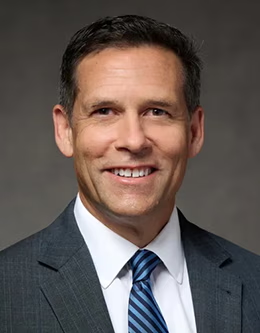
B. Corey Cuvelier, a General Authority Seventy of The Church of Jesus Christ of Latter-day Saints, delivered this devotional address on November 11, 2025.