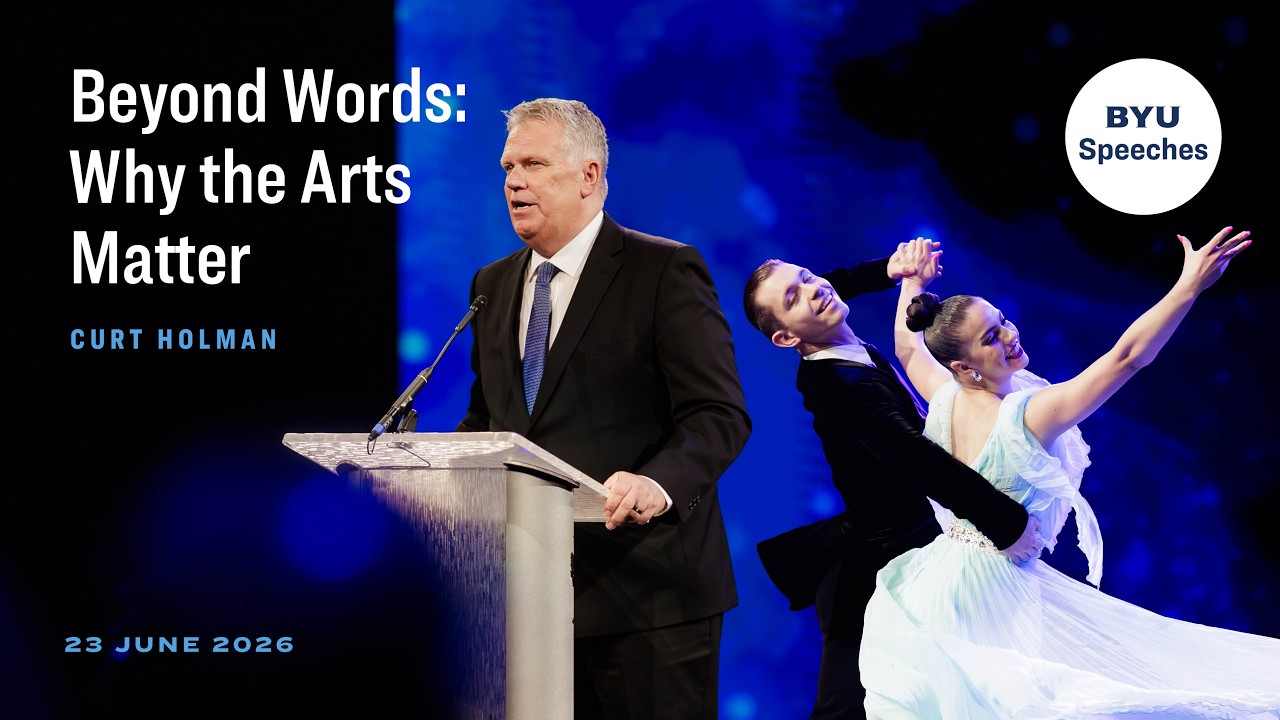
Beyond Words: Why the Arts Matter
Chair of the Department of Dance
 Facebook
 Twitter/X


The arts deepen understanding, strengthen connection, and invite us to become more than we were when we began.
Nearly a year ago, I was outside doing yard work when I noticed the mail carrier stop in front of our house and place a stack of mail into the mailbox. After finishing my work and putting the lawn mower away, I walked down the driveway, opened the mailbox, and began sorting through what appeared to be the usual assortment of advertisements, flyers, and junk mail.
But one envelope immediately caught my attention. The return address said:
Office of the President
Brigham Young University
As you can imagine, this is not a typical occurrence, so naturally my curiosity—and perhaps my blood pressure—rose just a little.
I walked back into the house, sat down, and opened the envelope. As you can see from the photograph on the screen, I didn’t take great care or have much dignity when I opened it. I tore into it rather aggressively. [A photo was shown.]
As I unfolded the letter, I checked President C. Shane Reese’s signature at the bottom of the page just to confirm the letter’s origin. Then I quickly returned to the beginning and started reading more carefully.
I read the opening paragraph once, furrowed my brow, and then stopped. I read it again. Convinced that I had somehow skipped an important sentence, I went back to the beginning and read it a third time. I lowered the letter and sat there staring at it. I was completely caught off guard and honestly felt a little bewildered. After a long pause, this thoughtful, articulate one-word response came out: “What?”
My wife, who was nearby, responded,
“What what?”
“I think I’ve just been awarded the Karl G. Maeser Distinguished Faculty Lecturer Award,” I said.
She replied with what I think was a perfectly reasonable spousal response: “Well, isn’t that a good thing?”
I said, “No, I don’t think you understand. The Karl G. Maeser Distinguished Faculty Lecturer Award is usually given to people who find cures for cancer—not people who teach the cha-cha.”
In all seriousness, this truly is a remarkable honor, and one for which I am deeply grateful. Over the years this award has been given to BYU’s most distinguished scholars, teachers, and thinkers—individuals whose contributions have shaped their disciplines, advanced human understanding, and enriched university life. Never once did I imagine that I would be among them.
As I reflected on that reality, I found myself considering what it meant that a university like BYU would choose to honor someone from the arts in this way. At a time when many institutions of higher education face increasing pressure to justify programs through measurable outcomes and immediate utility, BYU continues to invest in artistic education and creative expression.
The new Music Building and the soon-to-be-completed Arts Building stand as visible reminders of that commitment. Within those walls, thousands of students sing, dance, perform, compose, design, write, create, and imagine.
Those buildings represent more than construction projects. They represent a belief that education is more than preparing students for a profession. Education is also about helping them become fully developed human beings.
BYU’s continued investment in arts education raises a question that I have spent much of my professional life considering: Why do the arts matter?
For many years I thought they mattered because of what they produced. However, over time, I have come to believe that they matter even more because of what they produce within us. And this raises an interesting question: Why have human beings in every age and every culture been drawn to music, dance, storytelling in imagery, and artistic expression? Why is it that we create? And furthermore, what does the impulse reveal about who we are?
The Call to Create
To begin answering these questions, it’s worth noting something remarkable. The act of creation has always been part of the human experience.
Long before there were universities, governments, corporations, or modern economies, there were stories, images painted on cave walls, dance, music, and rituals that helped people make sense of their world. Many things we associate with civilization emerged gradually and unevenly, yet artistic expression seems to accompany human beings wherever they go.
I often think about our own pioneer heritage. The Saints who entered the Salt Lake Valley had endured an exhausting journey. They had crossed the plains, left homes and communities, and buried loved ones along the way. They arrived in an unfamiliar desert, seeking a place where they could finally build a life in peace.
When they reached the valley, enormous practical challenges stood before them. They needed homes, roads, irrigation systems, schools, businesses, and places of worship. There was certainly no shortage of urgent work to be done.
And yet Brigham Young also insisted on music, drama, dance, and theatrical performance. In fact, in 1853, only a few years after the Saints arrived in the valley, they built the Social Hall. This was a gathering place dedicated to music, drama, dancing, and cultural life. And it might be interesting to note that its successor, the Salt Lake Theatre, became one of the most celebrated theaters in the American West.
The decision to build the Social Hall early on is revealing. The pioneers understood that human flourishing requires more than survival. Even while building a civilization, they made room for beauty, creativity, celebration, and expression.
The arts are not a luxury that civilizations pursue after everything else is finished. They help us celebrate, mourn, worship, remember, and hope along the way.
In many ways, that legacy remains visible today. Ours is a faith that sings. We gather in chapels around the world and raise our voices together. We tell stories, create music, stage performances, write, paint, and build. Even as we focus on doctrine, service, and discipleship, artistic expression continues to shape how we worship, remember, and belong.
Artistic expression is not merely something we do. It is part of who we are. As President Dieter F. Uchtdorf once observed, “The desire to create is one of the deepest yearnings of the human soul.”1
If artistic expression is so deeply woven into the human experience, what is it that the arts actually do? What gives certain songs, paintings, poems, and performances the power to stay with us long after facts and figures have faded? How do they express things that we often struggle to convey with words alone?
Expression Beyond Language
To explore these questions, it may be helpful to begin with something that we often take for granted: language. We often think of language as a primary means of understanding the world. And certainly language is powerful. After all, universities are built upon it. We explain ideas, analyze evidence, define concepts, and debate conclusions through language. Language is one of humanity’s greatest tools. Yet there are some experiences that explanation alone never seems to capture completely.
Most of us have experienced something similar to this: You’re driving in the car, minding your own business, when a song comes on the radio. You haven’t heard this song in years, and it takes you back to a specific place and time. For me, it might be ABBA’s “Dancing Queen.” Within a few notes I’m no longer sitting in my car. I’m at a seventh-grade school dance: I recall the paper that was taped over the windows to darken the room, the scratch of a record beginning to play (ask your mom and dad what that means), the friends, the excitement, and perhaps a few dance moves that are best left in seventh grade. I can even remember how the gymnasium smelled. The song does more than remind me of a memory. It allows me to experience it again.
Isn’t it remarkable that a simple melody can do that?
The arts have a remarkable capacity to engage parts of us that facts and information alone cannot reach. They help us remember, perceive, understand, and communicate in ways that extend beyond information alone. A painting can help us notice beauty that we had previously overlooked. A poem can give language to feelings we have struggled to express. A dance can communicate emotion and meaning without the performers speaking a single word. The arts do not simply communicate information; they communicate meaning.
For many of us, some of life’s most meaningful experiences are among the most difficult to describe: Love. Grief. Awe. Reverence. Sacred moments. We often struggle to find words equal to what we have felt. Perhaps this is one reason that the arts have long occupied such an important place in religious life. They help express and illuminate truths that seem to reach beyond ordinary language.
Those of us in the Latter-day Saint tradition understand this intuitively. Many of us have sat through a sacrament meeting in which a musical number communicated something that a sermon alone could not. We have felt truths confirmed not merely through explanation but through an experience that touched both mind and heart. In moments such as these, the arts can become a vehicle through which the Spirit teaches, inspires, comforts, and testifies.
Twentieth-century philosopher Hans-Georg Gadamer, one of the most influential thinkers on art and interpretation, suggested that a work of art finds its true being when it sparks an experience that changes the person who encounters it.2 That’s a compelling idea.
The greatest works of art do more than pre-
sent something beautiful to observe. They invite us to see differently, feel differently, and ultimately become different. They don’t replace language. They extend it, allowing us to experience aspects of life that often lie beyond the reach of explanation.
I was reminded of this during the inauguration of President Reese some three years ago. Many of us had the opportunity to witness a remarkable artistic moment right here in the Marriott Center as student singers and musicians from the School of Music came together under the direction of Professor Andrew Crane to perform the beloved hymn “Come, Thou Fount of Every Blessing.”3
I could spend several minutes describing this inspiring performance. I could talk about the size of the ensembles, the looks on the faces of those students, the quality of the musicians, or the structure of the music itself. But none of those explanations would fully communicate what happened in this arena on that day. Allow me to share just a brief excerpt of that moment. [A video was shown.]
See what I mean? Even just seeing that brings back the feeling that I felt. And not to change the essence of the feeling that we’re experiencing right now, but being there for that incredible performance made me believe that at any moment the roof would come off and those who were in the building were going to just rise into heaven in an experience similar to that of the city of Enoch. It was truly remarkable.
A video can’t capture it, but those who were there in person understand. What happened in that moment was more than a musical performance. It became a shared experience. It invited thousands of people to feel something together. Experiences like that remind us that some truths are not merely understood. They are felt.
Transformation and Connection Through Dance
Allow me to share a recent experience from my work here at BYU.
Just over a year ago, the BYU Ballroom Dance Company began preparing to compete at the famed Blackpool Dance Festival in England—the most prestigious ballroom dance competition in the world. For BYU the event carries special significance. You see, in 1971 BYU became the first American team ever to win the Ballroom Formation Championship in the competition. This marked the beginning of a remarkable five-decade relationship with one of the most prestigious events in ballroom dance.
The competition itself is a powerful experience. It provides a goal that focuses effort and demands excellence. Students spend months pursuing a standard that often feels just beyond their reach. They rehearse early in the morning and sometimes late into the evening, and they return day after day with the shared hope of creating something truly exceptional.
The approaching competition creates a sense of urgency. Every rehearsal makes a difference and every detail matters. The students learn to work together under pressure, solve problems, adapt to setbacks, and persevere. Through disappointment they discover that meaningful achievement rarely comes quickly and almost never comes easily.
Over the course of the year, we revise, refine, and begin again. Progress is often slower than the students would like, and breakthroughs are often harder won than they expect.
Somewhere in the process, something else begins to happen. The work starts to shape the people doing it. The students become more disciplined, more resilient, and more capable of trusting one another and contributing to something larger than themselves. Those qualities may ultimately prove more enduring than any score, ranking, or trophy. I have come to believe that the deepest value of these experiences lies in who we become along the way.
The video you’re about to see captures some of the rehearsals, challenges, and triumphs that accompanied our preparation for Blackpool. But if you watch closely, you’ll see something else as well. [A video was shown.]
As I watch that video now, I find myself noticing something very different from what occupied my attention during the year. At the time I was focused on the choreography, the music, and the countless technical details and on helping the students become their best—which was required to bring this work to life. Today I find myself paying far more attention to the students. Certainly the dancing improved. That was expected. But it was not the only thing changing.
Over time a collection of talented individuals became a team. Trust deepened. Problem-solving became collaborative. Setbacks that once felt discouraging became challenges that students learned to navigate together. The competition eventually came and went. The applause faded almost as quickly as it arrived.
At BYU we often speak about the importance of becoming. For nearly a year we thought we were creating a performance, but somewhere along the way, we were in the process of creating us.
But the story’s not over yet.
About halfway through the year, we received an invitation from the Asia Area presidency to travel to India immediately following the championships. The trip to India would include three full-length performances and a variety of service opportunities in Delhi and Bengaluru.
At the time we were very excited, but our attention remained focused and fixed on Blackpool—rehearsals, preparation, and competition. Only later did I begin to understand how closely the two experiences were connected.
One week after the championships, we got on a plane, left England, and flew to India. Just one week separated two remarkably different stages: the elegant floor of the Empress Ballroom in Blackpool, England, and a dusty courtyard at a school in India where nearly 1,200 kids sat cross-legged in the dirt.
In Blackpool, an audience dressed in formal tuxedos and evening gowns surrounded the dancers. In India, the audience sat shoulder to shoulder on the ground, watching with the same excitement and anticipation.
The contrast could not have been greater. Yet the two experiences were not opposites. In many ways they were connected. You see, the opportunity to travel to India existed because these students had devoted themselves to excellence. And now that same pursuit was creating something entirely different.
As I watched the children respond, I found myself reflecting on the purpose of artistic excellence. It matters because it inspires. It opens doors. It creates opportunities that might not otherwise exist. But one of the highest purposes of excellence is not to simply impress but to connect.
What mattered most in that schoolyard on that day was not the complexity of the choreography or the precision of the technique. It was shared joy: The excitement in the faces of the children. The realization that people separated by language, culture, geography, and circumstance could nevertheless understand one another through movement, music, and human expression.
We arrived believing we had something to offer. But we left knowing that we had received just as much. In that schoolyard I was reminded once again of the power of the arts.
The Ongoing Work of Creation
As I think about the stories we have considered today, I am struck by how different they appear on the surface: A hymn performed in a university arena. A group of students preparing for an international competition. A schoolyard filled with children halfway around the world. At a glance, they seem to have very little in common. Yet each revealed something important about the arts.
The music at President Reese’s inauguration reminded us that some truths are felt before they are fully understood. The journey to Blackpool demonstrated that the creative process often shapes the people engaged in it as much as it shapes the work itself. And finally, the experience in India revealed that artistic excellence finds some of its highest purpose when it becomes a means of connecting people to one another.
Different settings. Different circumstances. Yet all point toward the same reality: The arts possess a remarkable capacity to deepen understanding, transform the lives of those who engage in the process, and strengthen human connection. Perhaps that is why the creative process feels so very familiar to all of us. It actually mirrors life itself.
In creating a dance, a painting, a piece of music, or a story, we recognize the same patterns of uncertainty, discovery, struggle, and transformation that shape our own becoming.
President Thomas S. Monson once observed:
God left the world unfinished for [men and women] to work [their] skill upon. He left the electricity in the cloud, the oil in the earth. He left the rivers unbridged and the forests unfelled and the cities unbuilt. God gives [us] the challenge of raw materials, not the ease of finished things. He leaves the pictures unpainted and the music unsung and the problems unsolved, that [we] might know the joys and glories of creation.4
This insightful observation suggests that creation is not merely something we do. It appears to be woven into the very purpose of mortality.
Whether we are creating a work of art, building a family, pursuing an education, serving in a calling, or striving to become better disciples of Jesus Christ, the pattern is very recognizable. We begin with a possibility, a vision of what might be. Things rarely unfold exactly as planned. There are setbacks. Revisions. Disappointments. Unexpected turns. Progress often comes more slowly than we hope. Yet through persistence and grace, something gradually begins to emerge—not only in what we are striving to accomplish but within us.
The arts deepen our understanding, strengthen connection, and invite us to become more than we were when we began.
God’s work has never been presented as a finished product to admire from a distance. From the beginning, men and women have been invited to participate in the ongoing work of creation. That invitation reveals something important about who we are: We are children of a Creator.
Across cultures and centuries, people have continued to sing, dance, tell stories, create images, and make meaning. The forms may change, but the impulse remains remarkably constant. In some deep and enduring way, these things help us understand one another and our place in the world.
Throughout this lecture I have suggested that some things are understood most fully through an experience. Rather than conclude with more words, I’d like to leave you with an experience. Please welcome the BYU Ballroom Dance Company. [The forum concluded with a performance by the dance company.]
© Brigham Young University. All rights reserved.

Curt Holman, chair of the BYU Department of Dance, delivered this forum address on June 23, 2026.
Related Topics
Related Speeches