Miracles of the Multitude
Professor of Law at Brigham Young University's J. Reuben Clark Law School
 Facebook
  Twitter/X

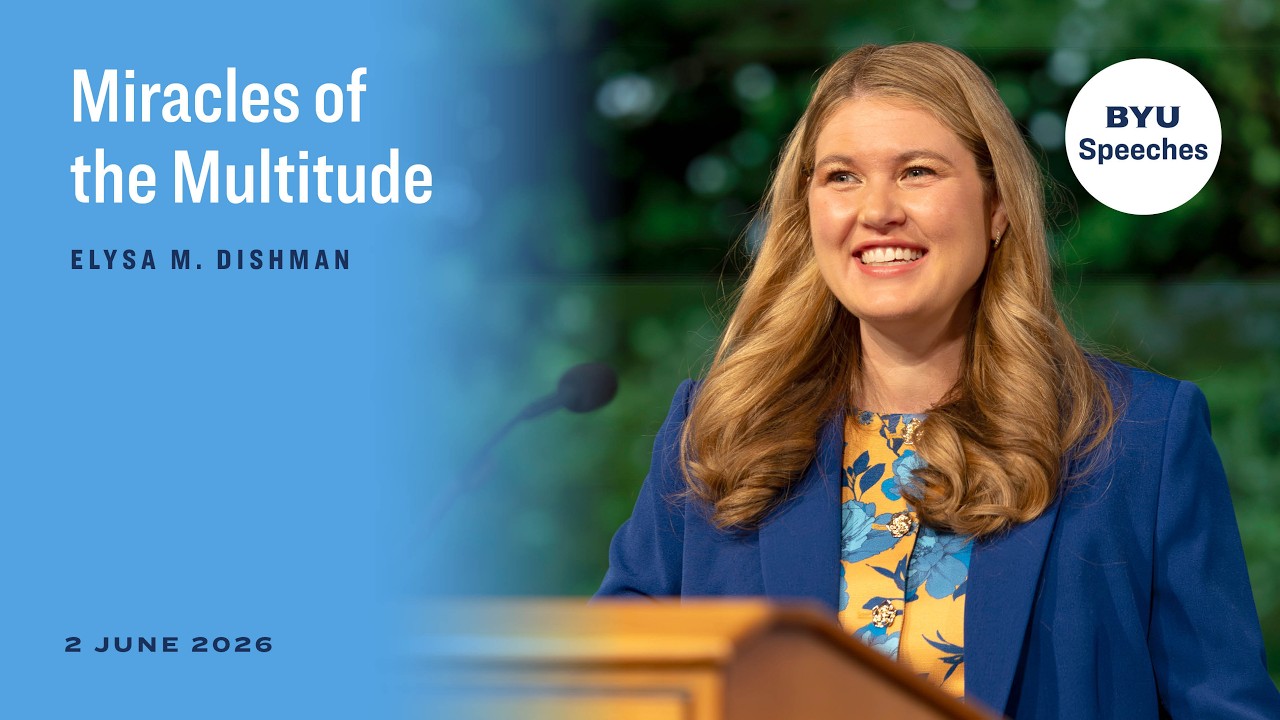
Jesus will take what you offer, bless it, and multiply it in ways you cannot imagine.
About a year and a half ago, my husband and I sat in a children’s hospital for a parents’ workshop. Our daughter was struggling with significant chronic pain, and a small group of parents—all of us with children facing different health challenges—had gathered to learn techniques to ease our children’s suffering. Down the hall, our children were doing the same: learning from medical professionals and each other how to manage their pain so they could more fully participate in school, friendships, and everyday life.
Our workshop was led by a capable, highly credentialed, and deeply compassionate psychologist—and, I might add, an alumna of BYU. She walked us through the nature of chronic pain and introduced us to a relaxation tool called visualization. Visualization, or guided imagery, is a therapeutic technique in which the mind creates detailed, positive mental scenarios to reduce stress, ease physical pain, and improve emotional well-being.
We practiced visualization together as parents. The psychologist asked us to close our eyes and imagine ourselves sitting on a bench in a park. I visualized myself sitting on a bench, but instead of being in a park, I saw a curving brick pathway. I saw a stream running nearby and heard water rippling over the rock streambed. I saw tall trees that shaded the bench and green plants along the banks of the stream. I felt sunlight filtering through trees as a breeze fluttered the sleeves of my dress. I was amazed by the quiet calm and by the feeling of peace that washed over me. I was struck by the power of the mind to create that image and its associated feelings.
Then I abruptly realized, as you might be realizing too, that my mind had taken me to a very specific and real place: the south side of BYU campus along the brick path above the Botany Pond. It is a place many of you walk past every day, climbing up those steep stairs on the way to class. It is one of my favorite places on campus that I have shared with my University 101 students, and I was surprised that when my mind was searching for comfort, it immediately brought me here to our campus. Most people’s minds would not instinctively retreat to their workplace when conjuring images for peace and relaxation. But mine did.
Two things stood out to me from that experience, and they have shaped what I want to share with you today.
The first was the feeling of stepping into a room with other parents who truly understood what I was going through. There is something powerful—almost tangible—about being surrounded by people who understand what you are going through. It can be profoundly lonely to care for a person who is suffering, or to be suffering ourselves. Being among people who are all doing their best to find healing or to help someone they love who is hurting creates a strong connection within a group, even if they start out as strangers.
The second was this: I believe my mind brought me back to BYU that day because this community played a real role in the healing of my family. I want to speak to you today about the role of community in the miracles of Jesus Christ and what that means for us here at BYU.
The Heritage and Legacy of Community: Kirtland, Restoration, and the Work of Healing
BYU’s roots stretch back to a very humble community of early Saints in Kirtland, Ohio. As many of you know—perhaps from your University 101 class—Kirtland was the site of revelations that form “the basic constitution of Church education.”1 It was where the Prophet Joseph Smith received revelations such as the Olive Leaf in Doctrine and Covenants 88 and established the School of the Prophets. It was where the Saints built the first latter-day temple. Kirtland was the place of an outpouring of revelations in the Restoration of the gospel of Jesus Christ.
I visited Kirtland for the first time at a deeply personal moment in my life. After about a year of treatment, my daughter was struggling with a neurological disorder triggered by an accident—one that had caused significant chronic pain and that had greatly limited her ability to attend school and engage in daily life. We decided to take her to an intensive pediatric rehabilitation program at the world-renowned Cleveland Clinic, one of the few inpatient programs in the country that treats her condition. This meant temporarily moving our family to Cleveland, where we were fortunate to have extended family living nearby.
The rehabilitation program was rigorous. Our daughter participated in several hours of therapies and treatments each day and attended school within the clinic with a small group of other patients suffering from chronic health conditions. My husband and I spent many hours attending parent education meetings, treatments, and medical consultations. Our older son came to support his sister and attended meetings for siblings and families. It was during some of our limited downtime in Cleveland that my husband, son, and I drove the 30 minutes to Kirtland while my daughter continued in her program.
Visiting this sacred place of restoration while my daughter was seeking her own restoration felt deeply significant. To stand in Kirtland and feel the weight of what had happened there—the miraculous outpouring of light and revelation alongside heartache, betrayal, and sacrifice—was intensely personal. Wondrous miracles and intense suffering coexisted in Kirtland. Both are part of the story of the Restoration and the legacy of faith we inherited from that early community of Saints.
Our daughter graduated from the Cleveland Clinic program with our family there to cheer her on. On graduation day, the cohort of young people who had completed the program walked down the clinic halls together to the cheers of family, friends, and medical professionals. Using my very limited artistic abilities, I had made posters to give encouraging messages to the graduates.
These pictures are of our family at graduation day at the clinic. [Photos of the family holding posters were shown.] You can see that BYU was part of that special day: My husband rocked his royal Cougar blue and I had drawn the Y on the mountain in a poster that read, “You can do hard things.” And if you have ever hiked the Y or even made it past the seventh switchback, you know that you can do hard things too.
Many of these young people, our daughter included, still had very long healing journeys ahead. There would be fits and starts, good days and bad. But at that moment we were all there to cheer her and all the other patients along the way.
Experiencing Kirtland through the lens of my daughter’s process of restoration taught me an important lesson: Restoration—whether of the gospel or of a person—can be painful and challenging but also glorious and miraculous. And community is woven through every moment of that journey in the disappointments and the triumphs.
There is a large painting of Kirtland that hangs in the Education in Zion Gallery in the Joseph F. Smith Building here on campus. It is 18 feet tall and 10 feet wide. It is called The Temple, a Holy School. Most of the painting is made up of dark, cloudy sky. But light also breaks through and shines on the relatively small temple on the bluff. This painting reflected the experience I had in Kirtland, showing that darkness and light, setbacks and breakthroughs, and heartache and transcendence can exist in the same place and be part of the same story.
At the other end of the gallery, a companion painting, The School, a Temple of Learning, shows the BYU Academy and the Maeser Building bathed in light. These buildings were the beginning of our campus today and are a visual testimony that the work of restoration goes forward: Out of small and difficult beginnings, great things can come to pass when a group of people is dedicated to a common purpose and gathered around the Savior.
I have taken my University 101 students to see these paintings. One of my favorite details—something our student tour guide at the gallery pointed out—is that the artist is simply listed as Anonymous. This is not because no one knows who painted these two paintings but because they were created by a group of BYU students working together. This combined effort is symbolic to me of community—the community in Kirtland that is our history and the BYU community today that is our legacy.
Community and Miracles: The Role of Community in the Savior’s Miracles
In preparation for this devotional, I reread the miracles of Jesus Christ in the Gospels with a slightly different lens. Rather than focusing only on the individual being healed and on the Savior, I found myself thinking about everyone else: the crowd that thronged Him, the apostles and disciples who were His companions, the friends and family who sought Him to heal their loved ones, and the multitude that followed Him. There is a larger audience or community in the stories of the miracles performed in the Gospels. Pondering about that expanded community teaches us something important about how restoration and healing occur in our Christ-centered community.
Before I continue, I want to speak directly to anyone who is waiting for a miracle right now—anyone whose prayers have not been answered in the way you have hoped or on the timetable you have expected. I have felt that too. There was a time when hearing about the miracles of Christ was painful to me because I had not received the miracle I was praying for. But in those seasons of waiting, I also found that studying the healing miracles of Christ brought me hope and increased my faith.
I testify that miracles—large and small, hard-sought and unexpected—occur in our daily lives when we are attuned to recognize them. My prayer is that wherever you are on your healing journey, the Spirit will whisper to you that you are a beloved child of heavenly parents and a valued member of this community.
With that in mind, I’d like to discuss three aspects of community found in the healing miracles of Christ:
1. Miracles of community restoration
2. Miracles prompted by community members
3. Miracles of community abundance
1. Miracles of Community Restoration
First, I would like to speak about miracles of community restoration.
When Jesus healed people, He did not simply cure their physical ailments, He restored them to their communities. Consider His healing of those afflicted with leprosy. In biblical times, a person with leprosy was required to announce their own uncleanness, to keep distance from others, and to live apart from family and friends.2 At the time, many skin conditions were classified as leprosy, even if they were not contagious or what we would consider leprosy today.3 The isolation was often more injurious than the disease itself.
In the story of Jesus healing the ten lepers who “stood afar off,” the lepers lifted their voices and said collectively, “Jesus, Master, have mercy on us.”4
And when he saw them, he said unto them, Go shew yourselves unto the priests. And it came to pass, that, as they went, they were cleansed.5
Jesus directed the lepers to show themselves to the priests so they could be declared clean. When Jesus healed the lepers physically, He simultaneously pointed the way back to their families, their friends, and their communities. This was not an afterthought. Returning to their community was an important part of their restoration and healing.
As you know, of the ten healed, one returned “and fell down . . . at [Jesus’s] feet, giving him thanks: and he was a Samaritan.”6
It is significant that the one who returned was a Samaritan, perhaps a person even more accustomed to being marginalized than the others—one who had not only suffered from leprosy but also from social stigma based on his heritage. Jesus acknowledged this marginalization when He observed that none had “returned to give glory to God, save this stranger.”7 To the grateful Samaritan, Jesus said, “Arise, go thy way: thy faith hath made thee whole.”8
Another example of the role of community restoration in healing is the man at the Pool of Bethesda who had had an infirmity for 38 years.9
When Jesus approached him, knowing that the man
had been now a long time in that case, he saith unto him, Wilt thou be made whole?
The . . . man answered him, Sir, I have no man, when the water is troubled, to put me into the pool: but while I am coming, another steppeth down before me.
Jesus saith unto him, Rise, take up thy bed, and walk.
And immediately the man was made whole, and took up his bed, and walked.10
Because the infirm man was alone, no one could move him into the pool when the waters were stirred. Jesus healed him and told him to take up his mat and walk—to leave a place of isolation and rejoin the world. The absence of community was not incidental to his condition; it was part of what had kept him in a place of suffering.
There are many other instances in the Gospels in which the Savior healed someone and then sent the healed person back to the community:
- To the woman with the issue of blood, Jesus said, “Go in peace.”11
- To the man with the unclean spirits, He said, “Go home to thy friends.”12
- To the paralytic man, Christ said, “Go thy way into thine house.”13
- To blind Bartimaeus, He said, “Go thy way.”14
The Lord often told those He healed to “go” in contrast to other calls of discipleship to “follow me.”15 For those who had been pushed to the margins, returning to family and community was not separate from healing—it made the miracle complete.
These stories matter deeply to us here at BYU. A community that isolates its vulnerable members is itself in need of healing. When Jesus healed the sick and welcomed the outcasts, He was doing the work of healing a broken community, not just broken individuals.
Paul captured this sentiment when he wrote, “And whether one member suffer, all the members suffer with it; or one member be honoured, all the members rejoice with it.”16
None of us is fully healed until we are all healed and restored to the body of Christ.
Dr. Martin Luther King Jr. expressed a similar truth beautifully: “We are caught in an inescapable network of mutuality, tied in a single garment of destiny. Whatever affects one directly, affects all indirectly.”17
Dr. King also said, “I can never be what I ought to be until you are what you ought to be.”18
BYU’s mission “is to assist individuals in their quest for perfection and eternal life.”19 But this is not a quest that can be taken on alone. We need this community to reach our destination. What brings us together—a love of our Savior and our identity as children of God20—must be greater than the pressures that divide us.
2. Miracles Prompted by Community Members
Next I’d like to speak about miracles prompted by community members.
In many stories of Christ’s healing, members of the community brought about miracles based on their faith in petitioning the Lord. It was often not the sick or afflicted person who initiated the miracle but rather someone else: a friend, a mother, a father, a sister, a Roman centurion. These community members acted as agents of faith, and their creative, determined love moved the Savior to act. I would like to share three examples of different ways that community members brought about the Savior’s healing miracles.
First, consider the paralytic man whose four friends carried him on a bed to where Jesus was preaching to the crowd. When the crowd was too thick to get their friend to Jesus, they did not give up. Instead, “they uncovered the roof where he was: and when they had broken it up, they let down the bed wherein the sick of the palsy lay.”21
When Jesus saw the faith of this committed group of friends, He healed the paralytic man—first by forgiving his sins and then by healing his physical infirmity. The faith that moved the miracle was not the paralytic man’s own; it was the faith of his friends.
“And immediately [the man] arose, took up the bed, and went forth before them all; . . . and
[they] glorified God.”22 All of the community gloried in the healing of the one, and I imagine there was an amazing reunion between the man and his friends—once his friends got off the roof.
Second, there is Jairus,23 a ruler of the synagogue, who fell at Jesus’s feet and begged Him to come to his dying “little daughter.”24 Jairus entreated Jesus to “come and lay [His] hands on her, that she may be healed; and she shall live.”25
As Jesus traveled with him through a pressing crowd, a messenger arrived with news, saying to Jairus, “Thy daughter is dead: why troublest thou the Master any further?”26 Imagine Jairus’s devastation: He had brought the Savior, but it was too late. His daughter was gone, and he had missed her final moments.
But upon hearing this news, Jesus said simply, “Be not afraid, only believe.”27 Exercising his faith, Jairus brought the Savior to what appeared to be a hopeless situation, and Jesus raised the young girl from the dead.28
Third, a servant sick of the palsy was healed through the faith and intervention on his behalf by a Roman centurion.29 In this example, the Roman centurion did not bring his servant to Jesus, nor did he bring Jesus to heal his servant. The centurion went to the Jewish elders, who brought him to Jesus.30 At the centurion’s beseeching on his servant’s behalf, Jesus offered to come and heal the servant. The centurion demonstrated exceptional faith, saying, “Speak the word only, and my servant shall be healed.”31
Jesus marveled and said to those around Him that He had “not found so great faith, no, not in Israel.”32 Christ told the centurion, “Go thy way; and as thou hast believed, so be it done unto thee. And his servant was healed in the selfsame hour.”33
The healing of the servant is a miracle. But it is also a miracle of community that a Roman centurion, the Jewish elders, and the Savior came together to bring about the healing of one servant.
These three examples are a pattern for us. In the first example, friends brought the paralytic man to Jesus. In the second, Jairus brought Jesus to his daughter. In the third, the centurion’s faith brought the Savior’s healing power to his servant.
We can do all three. We can bring our friends to Jesus by inviting them to have spiritual experiences through church services, temple worship, devotionals, and service opportunities. We can bring Jesus to our friends by sharing our testimonies, listening compassionately, and offering kindness as the Savior would. And we can be a conduit of His healing power by praying for our friends and rallying our community around those in need.
In all of these examples, someone intervened on behalf of a vulnerable person who could not help themselves. Intervening for the benefit of another is something that drew me to the path of law. Lawyers are in a unique position to act for the benefit of their clients in ways that their clients often cannot act on their own.
The BYU Law Mission Statement encapsulates that aspect of being a lawyer and links it to the roles of Christ. The statement says:
We are committed to the teachings of Jesus Christ and honor His many roles, including healer, mediator, counselor, peacemaker, advocate, lawgiver, and judge. In striving to emulate His example, we seek to be and develop people of integrity who combine faith and intellect in lifelong service to God and neighbor.34
Let me share a video showing several beautiful paintings along with the artist, Jorge Cocco. [A video panning through the paintings was shown.] These paintings hang in the Law School to represent our mission. They depict each of the Savior’s roles as they relate to the role of the disciple-lawyer: healer, mediator, counselor, peacemaker, advocate, lawgiver, and judge. Mr. Cocco happened to be at the Law School touching up the paintings the same day this video was filmed, and I consider it a tender mercy that he was there that day so we could appreciate seeing him with his inspiring art.
These roles of the Savior reflect lawyering at its best: advocating for clients who cannot speak for themselves, helping people understand the law, creating healing and peace by using legal processes to resolve disputes, counseling and mediating for clients in difficult situations, and offering sound judgment so clients can make better decisions. Each of these roles is, at its core, an act of community—helping people to seek fairness, obtain redress, and navigate conflict to live together more peaceably.
If you are starting to feel at all inspired to attend law school, not to worry: We have admission counselors standing by, ready to answer your questions and take your applications.
3. Miracles of Community Abundance
And now I would like to discuss miracles of community abundance.
As I reread the Gospels searching for the community surrounding miracles, I was struck by how the multitude is described. They were often numerous—thousands of people. At a time when long-distance travel was hard, these people walked “on foot out of the cities.”35 They brought their sick with them, carrying them on beds to wherever Jesus was. They followed Him so persistently that He sought solitude on ships, in mountains, or in the desert—and the multitude followed Him there too. Jesus had “compassion toward [the multitude]” and “healed their sick.”36 And upon seeing the miracles, the multitude glorified God.37
The feeding of the five thousand and four thousand are defining miracles of community abundance. And those numbers only counted men; the true multitude was far larger.38 In the feeding of the five thousand, the disciples sought to send the multitude away from the desert so they could buy food. But Jesus did not desire to send them away. Rather, He said, “They need not depart; give ye them to eat.”39
The disciples responded that they only had five loaves and two fishes. In the hands of the Master, five loaves and two fishes became a feast, and after everyone had eaten, there “remained twelve baskets full.”40
In the feeding of the four thousand, “great multitudes”came to Jesus on a mountain, bringing with them their sick, injured, and afflicted and casting them at Jesus’s feet.41 Jesus had compassion on them, explaining, “They continue with me now three days, and have nothing to eat: and I will not send them away fasting, lest they faint in the way.”42
The disciples asked Jesus how they would feed a multitude in the wilderness, and Jesus asked how many loaves they had. They responded, “Seven, and a few little fishes.”43 Again, Jesus blessed these offerings, feeding the multitude until they were filled—and there were seven full baskets left over.44
Where the disciples saw scarcity in the multitude, Jesus saw abundance. When the disciples wanted to send the multitude away, Jesus drew them in. When the disciples saw what was lacking, Jesus saw an opportunity to nourish. These miracles are not just about bread and fish. They are about what becomes possible in a community gathered around the Savior. They are miracles of the multitude.
This insight has prompted some questions about our BYU community. What miracles of the multitude do we have here at BYU? What greater miracles might occur if we increased our efforts to gather ourselves around the Savior? How do we, as a multitude of BYU, glorify God in gratitude for the miracles we witness?
I want to close by returning to the visualization I shared at the beginning of this talk and telling you why I believe my mind went to this campus in a moment of distress.
During this hard season for our family, our BYU community surrounded us in ways I will never forget. A colleague organized a meal delivery service within days of my daughter’s accident, and many others generously donated. A student’s toddler included my daughter in his family’s evening prayers. My college dean and his wife invited my daughter and me to their home so she could pet their new puppies. Student body officers from the Law School came to my office with a card and a gift for my daughter. Faculty, staff, and administrators regularly checked on me in personal conversations and through email and text messages. Colleagues kept my daughter in their prayers, and one in particular added her name to his personal prayer list and prayed for her by name for months. An undergraduate student took night classes so she could work during the day as my daughter’s aide at school.
Each of those acts was a loaf of bread or a fish that went toward feeding my family during a difficult time. And together those offerings became an abundance of love and support that eased a burden we could not have carried alone. This community showed me what it looks like to be “willing to bear one another’s burdens, that they may be light.”45
Alma taught the people in the Book of Mormon that Christ “will take upon him their infirmities, that his bowels may be filled with mercy, according to the flesh, that he may know according to the flesh how to succor his people according to their infirmities.”46 This verse came to my mind often during those years of receiving care from the BYU community. The word succor means assistance or relief given to someone in distress.47 While I desperately wanted my daughter to be immediately healed, I came to believe that Christ knew me and knew that I needed and valued the support of my community. Christ succored me in a difficult time by blessing me with an outpouring of love from this community, and I am grateful to the many people here who exemplified the Savior’s love in serving me and my family.
Conclusion: You Have Fish and Bread to Offer
As you leave today, I hope you will pause to remember who in this community has supported you and to offer gratitude for them. I also know that some of you may have felt let down or left out by our community at times. I know Christ is aware of that pain. After all, His most trusted apostles fell asleep in the Garden of Gethsemane when He needed them most. One betrayed Him. One denied Him. And yet, when the resurrected Lord returned to His apostles, He entrusted them to “feed [His] sheep” and to care for His flock.48 As a community centered on Christ, we are all responsible to improve how we love, include, and help each other heal.
I hope you will also ask yourself: Is there someone nearby who is suffering or alone and within my reach to help? Am I paying enough attention to notice when someone is struggling, isolated, or missing? Am I listening to the Holy Ghost when He prompts me to act? Am I following through on those promptings? What am I doing right now to build a community of Christ at BYU?
A BYU education is a once-in-a-lifetime opportunity to build your intellect, your faith, your character, and your relationships. You will miss the full benefit of a BYU education if you pursue only the “education” part and skip the “BYU” part—the community, the connection, and the belonging that are central to attending this university.
You don’t have to feed thousands on your own. It took only a few fish and a few loaves of bread to feed a multitude. You have something to offer, even if it’s frozen fish sticks or Goldfish crackers. Jesus will take what you offer, bless it, and multiply it in ways you cannot imagine. It is my hope that we will be a community that gathers around the Savior and that experiences miracles in our multitude. I say these things in the name of Jesus Christ, amen.
© Brigham Young University. All rights reserved.
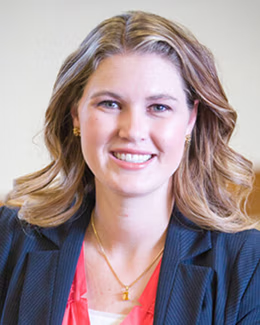
Elysa M. Dishman, professor of law at the BYU J. Reuben Clark Law School, delivered this devotional address on June 2, 2026.
Related Topics
Related Speeches