





Speech link copied
Excellence in Living
James E. Faust
of the Quorum of the Twelve Apostles
August 26, 1987
of the Quorum of the Twelve Apostles
August 26, 1987

From its shaky beginnings, Brigham Young University has now risen to a position of eminence and promise throughout the world.
I come to this assignment with considerable humility. My main purpose in coming is to express much thanks and appreciation to all of you. As I conclude, I also want to ask the Lord’s blessings upon you. I have a grandson to whom everything is “awesome.” I borrow his overused expression to describe you collectively and individually—you are awesome.
My involvement in Brigham Young University has come later in life. As a young man I competed against BYU in some athletic contests. BYU was awesome then, as it is now. I couldn’t afford to come to Brigham Young University. I had to live at home, where I had free board and room and some access to an automobile. So I have come to feel that it is a special privilege to be associated in any way with BYU.
In my tenure as a General Authority, I have not always been closely associated with BYU. More recently, however, under the direction of the First Presidency, I have been involved with President Howard W. Hunter, President Jeffrey R. Holland, Robert C. Taylor, David B. Galbraith, Fred A. Schwendiman, Robert J. Smith, and many others who have helped in developing your newest campus: the Jerusalem Center for Near Eastern Studies.
We have met with many leaders in Jerusalem, including some of its great sages, on behalf of Brigham Young University. We have been trying to build bridges and to develop relationships. We still have some challenges in that area that we hope can be resolved. Of the Jerusalem Center experience, I would only quote President Holland, who said, “I did not walk across the plains with the pioneers, but I have worked on the Jerusalem Center.”
Brigham Young University has come so far so fast. As traditional universities go, it is a newcomer. We have come a long way since faculty members were paid in potatoes, onions, and other produce and the president was paid with an order to be drawn on the Provo bishops’ storehouse. The university’s very survival has been in question many times—twenty-one of which have been recorded. We must acknowledge with gratitude the great builders of the past and the present, from Karl G. Maeser to Jeffrey R. Holland. We have all read many statements to the effect that this university is to become the greatest university in the world.1 This would come about in large measure through excellence in teaching and excellence in learning.
I think I would challenge all of us, however, to rise above even excellence in teaching and learning. I would hope that all such excellence would reflect excellence in living according to the principles taught by its sponsoring church. Our experience at BYU, whether we be students, groundskeepers, cooks, security officers, faculty, or administration, can be the leaven of excellent living through which others can be blessed—in the neighborhoods where we may reside, in the schools where we may teach, in the businesses where we may work, and in the boardrooms where we may sit.
The role of Brigham Young University has been defined in many ways by many people. President Marion G. Romney gave one definition that I particularly like when he described the mission of the J. Reuben Clark Law School. In substance, he said that those who would come to the Law School were to acquire “‘a knowledge of . . . [the] laws of . . . man’ in the light of the ‘laws of God.’”2 I think this charge should also apply to learning the laws of physics and chemistry, the laws of the social sciences, and the laws of commerce so that all these laws would be learned in light of the laws of God.
The man whose name this institution memorializes stated:
Where did the knowledge come from which has enabled man to accomplish such great achievements in science and mechanism within the last few years? We know that knowledge is from God.3
From its shaky beginnings, Brigham Young University has now risen to a position of eminence and promise throughout the world. You might ask, “Is Brigham Young University now indispensable to the Church?”
I would answer, “No, not indispensable, but very, very helpful.” It has been helpful in bringing the Church out of obscurity. I have had some personal experiences in that area. If the Jerusalem Center for Near Eastern Studies has so far served no other purpose, I think we can say that it has certainly brought the Church out of obscurity in the Holy Land.
My wife, Ruth, and I, with Bruce L. Olsen and Randy Boothe and some others, took the first BYU performing group into China in 1979. I was privileged to rededicate that great land in the Ten Thousand Springs Pavilion within the Forbidden City. What happened on that trip and what has happened since with reference to our relations in China is very remarkable. To the Chinese, Brigham Young University is possibly one of the best-known universities located outside China.
Two years ago, President Hunter and his sister, Dorothy Rasmussen, and Ruth and I joined the BYU performing group that performed in Jordan in the ancient Roman city of Jerash. Being completely free of prejudice as we are, we thought that BYU stole the show. We sat near Queen Noor of Jordan and the little prince and princesses. After the performance was over, with something of a sigh of relief, the American ambassador said, “That show was squeaky clean.”
Now it is not just the scholars, athletes, and performers—important as they are—who make the role of BYU so very helpful to the institutional Church: it is all of you. It includes those of you who paint the buildings, serve the banquets, and cut the grass—all who make BYU a sparkling jewel in the Lord’s work.
Brigham Young said:
It is the duty of the Latter-day Saints to live their religion so that all the world can say there is a pattern for us, not only in our business and worship, but in our knowledge of things that are, things that have been and of things that are yet to come, until the knowledge of Zion shall reach the uttermost parts of the earth, and the kings and great men shall say, “Let us go up to Zion and learn wisdom.”4
He also said:
Not only does the religion of Jesus Christ make the people acquainted with the things of God, and develop within them moral excellence and purity, but it holds out every encouragement and inducement possible, for them to increase in knowledge and intelligence, in every branch of mechanism, or in the arts and sciences, for all wisdom, and all the arts and sciences in the world are from God, and are designed for the good of His people.5
Brigham Young also had this to say:
Go to work and start some schools, and . . . go to school and study; have the girls go, and teach them chemistry so that they can take any of these rocks and analyze them. . . . The sciences can be learned without much difficulty. . . . I want to have schools and entertain the minds of the people and draw them out to learn the arts and sciences.6
Brigham stated:
We should be a people of profound learning pertaining to the things of the world.7
Dean Bruce C. Hafen and his associates in the Law School will find these further comments of Brigham Young interesting:
If I could get my own feelings answered I would have law in our school books, and have our youth study law at school. Then lead their minds to study the decisions and counsels of the just and the wise, and not for ever be studying how to get the advantage of their neighbor. This is wisdom.8
In general conference, Brigham Young urged
from one to five thousand of our young and middle-aged men to turn their attention to the study of law. I would not speak lightly in the least of law, we are sustained by it; but what is called the practice of law is not always the administration of justice, and would not be so considered in many courts.9
Most importantly, I wish to tell you how much you are appreciated. President David O. McKay addressed the group in the mission home when I was there in 1939. He took a piece of chalk and wrote this on the board: “It is a greater honor to be trusted than to be loved.”10
I think it can be said that you are both trusted and loved. I believe there is no better group of people anywhere in the world than is concentrated in this institution. The great majority of you are committed members of The Church of Jesus Christ of Latter-day Saints. So many of you have been or are priesthood leaders in bishoprics, high councils, and stake presidencies; members of Relief Society presidencies and Primary presidencies; and Young Women and Young Men leaders. More importantly, however, most of you are trying to keep the covenants and ordinances of the gospel with fidelity.
You of the faculty are valued and appreciated, even though you may not be renowned for your research or scholarly treatises, important as they are. You are greatly honored if you teach with integrity, inspiration, and motivation and bless and change lives. I appreciate very much the theme of this conference taken from Job 28:20: “Whence then cometh wisdom? and where is the place of understanding?” I am satisfied that much wisdom is taught at Brigham Young University and that it is a place of understanding.
The early educational aim of Harvard University was that students shall “consider [that] the main end of [their] life and studies is to know God and Jesus Christ which is eternal life.”11 That is an appropriate educational aim for this university and for all who are affiliated with it. If this institution is more faithful to this aim than other universities originally founded to teach Christian moral values, it will remain more the place of supernal understanding than they have been.
The underlying strength and eminence of this university is not in its impressive buildings nor in its expansive sparkling campus nor in the great stadium nor in its laboratories of learning, important as they are. Nor does its greatest strength lie in the erudition, the accomplishment, the prestige, and the capacity of the faculty, great as it collectively is. Its uniqueness is also not in the makeup of its student body nor in the dedicated support system, special as they are.
The greatest strength of this institution lies in the profound, personal witness lying deep in the heart and soul of all associated with it to some underlying verities. Those truths are that Jesus of Nazareth is the Christ, the Redeemer, the Savior of the world; that Joseph Smith was the restorer of the gospel of Christ in its day, with its covenants, authorities, keys, and doctrine; and the further conviction that all the presidents of the Church since the Prophet Joseph, to and including President Ezra Taft Benson, possessed the same keys and authority as did Joseph. That is the strength of this university. The challenge is how that strength may become translated into excellence of living.
I now wish to bear you my witness, even my personal witness; I do so in the words of Peter. At the time of the Savior, many of the disciples of Christ became weak “and walked no more with him.”12 This must have been heartbreaking for the Savior.
And Jesus said unto the twelve apostles:
Will ye also go away?
. . . [Peter then answered for the Twelve and said:] Lord to whom shall we go? thou hast the words of eternal life.
And we believe and are sure that thou art that Christ, the Son of the living God.13
I am sure. I know.
Lastly, I should like now, in the authority of my calling, to ask the Lord to bless each of you. May you be sustained and magnified in your responsibilities as son or daughter, father or mother, grandfather or grandmother. May you be sustained and protected in your separate assignments at this great university, whether in the classroom, in the administrative offices, in the laboratories, in the seminars, with the physical facilities, with food services, on the playing fields, in the gymnasiums, on the entertainment stages, and everywhere—especially as you travel. May you be inspired in your ecclesiastical callings as presiding officers, as auxiliary leaders, as gospel teachers, as home teachers and visiting teachers.
I pray that through your faithfulness the Lord will say:
Come unto me ye blessed, for behold, your works have been the works of righteousness upon the face of the earth.14
I bless you with “a pure heart and clean hands” so that you can “look up, having the image of God engraven upon your countenances.”15 I pray that each of you will “sit down in the kingdom of God, with Abraham, with Isaac, and with Jacob . . . , whose garments are cleansed and are spotless, pure and white.”16 I bless you with peace in your hearts and joy in your lives and renew upon you the hope of eternal life in the life hereafter. This I say in the name of Jesus Christ, amen.
© by Intellectual Reserve, Inc. All rights reserved.
Notes
1. Speaking about Brigham Young University on Founders Day in 1923, President Franklin S. Harris said, “Behold the greatest university campus in all the world—in embryo!” (quoted in J. Marinus Jensen [Prof. J. M. Jenson (sic)], “Future of Brigham Young University Is Portrayed by President F. S. Harris,” Daily Herald [Provo], 16 October 1923, 1).
President Harold B. Lee said, “Because of its unique combination of revealed and secular learning, Brigham Young University is destined to become a leader among the great universities of the world” (“Be Loyal to the Royal Within You,” BYU devotional address, 11 September 1973). See also Spencer W. Kimball, “Education for Eternity,” address to BYU faculty and staff, 12 September 1967; Kimball, “The Second Century of Brigham Young University,” BYU devotional address, 10 October 1975.
2. Marion G. Romney, “Becoming J. Reuben Clark’s Law School,” in Addresses at the Ceremony Opening the J. Reuben Clark Law School, August 27, 1973 (Provo: Brigham Young University, 1973), 20; quoting Doctrine and Covenants 93:53.
3. Brigham Young, “Discourse,” Deseret News, 26 August 1868, 231; JD 12:257 (9 August 1868).
4. Brigham Young, “Discourse,” Deseret News 26 August 1868, 231; JD 12:257.
5. Brigham Young, “Discourse,” Deseret News, 21 July 1869, 284; JD 13:147 (11 July 1869).
6. Brigham Young, “Discourse,” Deseret News, 17 September 1873, 517; JD 16:170 (31 August 1873).
7. Brigham Young, “Remarks,” Deseret News, 6 June 1860, 97; JD 8:40 (8 April 1860).
8. Brigham Young, “Remarks,” Deseret News, 23 April 1873, 180; JD 16:9 (7 April 1873).
9. Brigham Young, “Remarks,” Deseret News 23 April 1873, 180; JD 16:9.
10. President David O. McKay often liked to quote George MacDonald: “To be trusted is a greater compliment than to be loved” (The Marquis of Lossie [1877], chapter 4).
11. “Rules and Precepts That Are Observed in the College,” adopted by Harvard College in 1646; quoted in foreword by Leonard J. Arrington in Ernest L. Wilkinson and W. Cleon Skousen, Brigham Young University: A School of Destiny (Provo: Brigham Young University Press, 1976), vii. See John 17:3.
12. John 6:66.
13. John 6:67–69.
14. Alma 5:16.
15. Alma 5:19.
16. Alma 5:24.
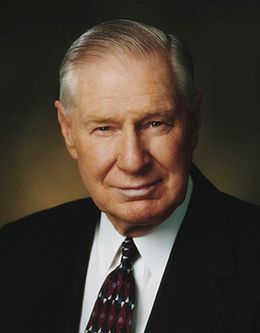
James E. Faust, a member of the Quorum of the Twelve Apostles of The Church of Jesus Christ of Latter-day Saints, delivered this BYU annual university conference address on August 26, 1987.