To Those Enduring Trials with No End
Associate Professor of Management at Brigham Young University
 Facebook
  Twitter/X

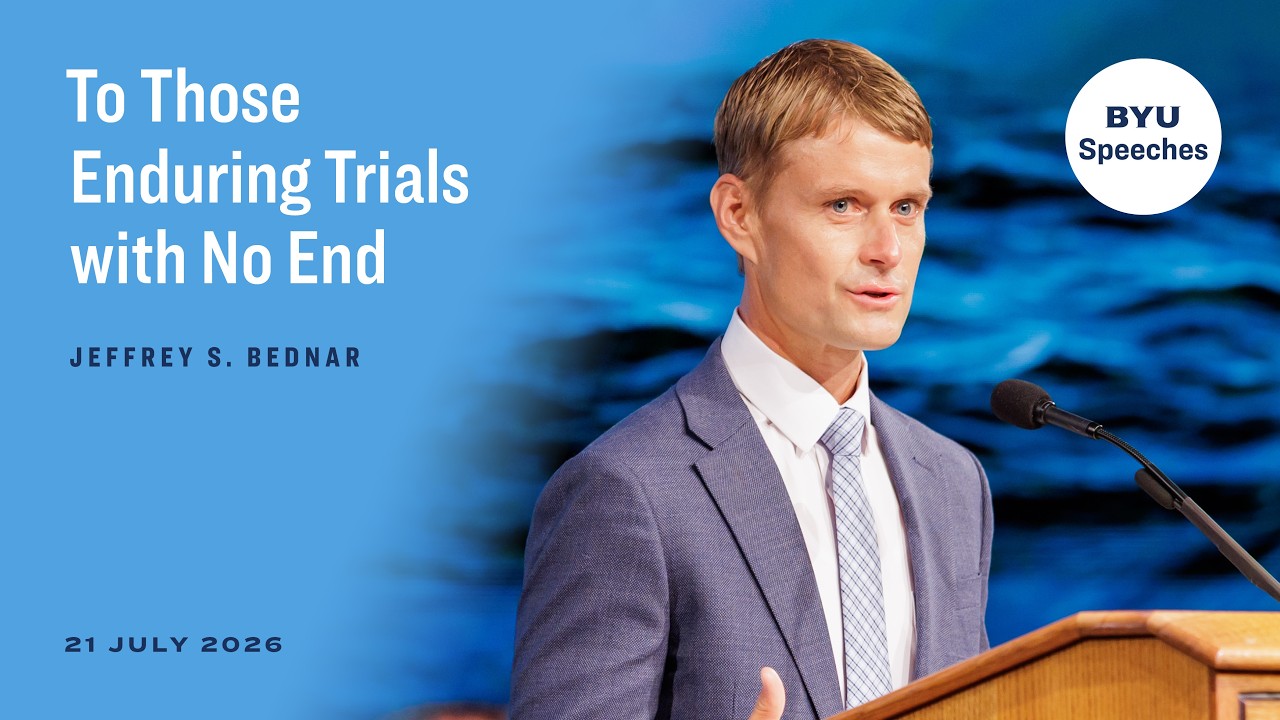
True disciples endure with Christ through every mortal storm—even those that may never cease in this life.
BYU has always been a part of my life, and the things that I’ve experienced here on this campus have transformed me.
This building alone—the Marriott Center— has hosted countless transformative moments in my life, including a date on January 7, 2007, when I asked a University of Utah student, Anne Bergstedt, to a BYU–Utah men’s basketball game. Thankfully, BYU won that night, so the night went better for me than it did for Anne. And I think we sat somewhere behind me in some really high seats. But sitting up there, I don’t think either of us could have imagined that we would someday get married, welcome seven children into our home, come back here to BYU, or ever have an opportunity to speak like this from this pulpit.
As I begin, you can already tell that I owe you a little bit of a warning. Elder Marvin J. Ashton once spoke of the spiritual gift of weeping.1 I have received that gift in abundance, and my heartstrings are directly connected to my tear ducts. When I feel love or gratitude or try to share things that are deeply personal to me, it can become really hard for me to speak.
For example, a newspaper photographer captured the moment I first saw my dad after his call as an apostle. As you can see in this photograph, I was not blessed with the companion gift of graceful crying. [A photo was shown.]
As I share some deeply personal lessons with you today, I may need to pause to compose myself. I ask for your prayers in those moments so that I can deliver the message I feel the Lord has put in my heart to share with you today.
A Trial with No End
More than 14 years ago, I had an experience that shook my foundation at the time. After navigating significant challenges in my PhD program, I finally found the faith to follow promptings that Anne had felt for some time: that we should have another baby. We were thrilled when we learned Anne was pregnant, but pregnancy was never easy for her. Within weeks she was once again curled around the toilet, surviving largely on baked potatoes covered with melted string cheese.
As we approached the 18-week ultrasound, we were excited to learn whether we were having a boy or a girl. Too poor—and probably too cheap—to hire a babysitter, we thought it would be a great idea to bring our two daughters, Elizabeth and Kate, to the appointment and imagined celebrating together when we learned whether they would be having a new brother or sister.
Soon after the ultrasound began, we were thrilled to learn that we were having a boy. But then the technician excused herself. A few moments later, a more experienced physician took over the imaging. I began watching Anne because, as a NICU nurse, she had witnessed many of the serious things that could go wrong with a developing baby.
The physician explained that our son’s organs appeared to have developed in a mirror-image pattern. His heart and stomach were on the right side of his body while his liver and appendix were on the left. We would later joke that our son had been created in the mirror image of God.
But the ultrasound also revealed abnormalities that raised serious concerns about our son’s spleen, kidneys, intestines, and brain. My heart sank as Anne burst into tears, confirming that this was frightening news. The pregnancy was classified as high-risk and would require constant monitoring for the duration of the pregnancy.
I had tried to be strong at the hospital, but when I got home, I knelt beside my bed and poured out my aching heart to God. I knew He was a God of miracles and could rebuke storms, so as this storm began to encompass me, I thought of the disciples on the Sea of Galilee, terrified by the storm surrounding them.
The disciples woke the sleeping Jesus, questioning His care, and cried, “Master, carest thou not that we perish?”2
I found myself asking a similar question: “Master, carest thou not about my son?”
While the Savior did not rebuke my son’s maladies, a quiet and unmistakable impression came into my mind and heart. It simply said, “Jeff, he is my son too.”
And then I experienced what the disciples had experienced: “Peace, be still.”3
That simple reminder changed my perspective. The fear did not immediately disappear, and uncertainty remained. But I suddenly was anchored by the reminder that the being I had always called Heavenly Father was, in fact, a father—not only to me but also to my son.
He knew him. He loved him. He would always be there for him—and for me.
That prompting brought profound peace as we continued navigating this stormy pregnancy.
Around this time I accepted an offer to join the faculty here at BYU, and we moved to Utah to prepare for our son’s arrival under the care of high-risk specialists at the University of Utah Hospital.
When our son was born, doctors did a variety of tests and determined that all of his organs were reversed but fully intact and functioning properly. With grateful hearts, we named him Samuel, which means “God has heard,” as a reminder that the Lord had heard and answered our prayers.
But five days later, everything changed. Anne noticed that Sam looked bluish gray; his coloring was not right. So he was rushed to the emergency room, where doctors placed him on oxygen and began more tests. A few days later, we received a diagnosis: primary ciliary dyskinesia, or PCD.
This genetic disorder affects the tiny hairlike structures responsible for clearing mucus from the body. Because Sam’s cilia don’t function properly, he lives with chronic ear and sinus infections and progressive lung damage. Those same cilia also help determine organ placement, which explains why his organs had formed in a mirror image. We quickly found ourselves in the hospital learning how to do airway-clearance treatments, which we have continued multiple times a day, every day of his life.
As we sat in that hospital room grieving and trying to understand what this diagnosis would mean for Sam’s future, I ashamedly wondered if we had chosen the name Samuel too early. Had God really heard? Had He really answered?
“Master, carest thou not about my son?”
I also realized that this trial was different. Most trials in my life had an end point. But suddenly we were facing a storm that would likely never be resolved in mortality. As we wrestled with all this in the hospital, a question settled deep into my heart: How do I endure to the end of a trial that has no end?
That question has repeatedly sent me to the scriptures and to the temple, and one doctrine that I am coming to understand and appreciate more fully through life’s trials is the doctrine of Christ.
The End of the Doctrine of Christ
I believe the phrase doctrine of Christ can be interpreted in at least two ways:
First, Christ is the author and the source of the doctrine of Christ. It is in fact His doctrine.
Second, Christ is the subject of the doctrine of Christ. It is doctrine about Him and His atoning sacrifice.
President Henry B. Eyring and other modern prophets have taught us that the doctrine of Christ “is that faith in the Lord Jesus Christ, repentance, baptism, receiving the gift of the Holy Ghost, and enduring to the end blesses all of God’s children.”4
For those who are endowed, we covenant in the temple to live and obey these principles when we accept “the law of the gospel of Jesus Christ.”5
For years I found it easy to connect the first four principles of the doctrine of Christ to the Savior:
1. Faith is faith in Jesus Christ.
2. Repentance is possible because of His Atonement.
3. Baptism symbolizes His death and Resurrection.
4. Confirmation brings us into His Church and connects us to the Holy Ghost through the ordinance of the sacrament as we remember Him and renew our baptismal covenants each week.
But I know I misunderstood the fifth principle—enduring to the end. I held the erroneous belief Elder Dale G. Renlund has cautioned against, that enduring to the end is a separate step in the doctrine of Christ—“as though we complete the first four elements and then hunker down, grit our teeth, and wait to die.”6 Notice that in this faulty mindset that I just described, there is no mention whatsoever of Jesus Christ.
However, facing trials with no end has helped me develop a deeper understanding of what “the end” really means. One common definition of the word end is “a stopping point,” which I often associated with enduring until a trial ceased. But I’ve increasingly come to appreciate the alternative definition of end as an outcome worked toward or a purpose.
For example, Joseph Smith taught, “Happiness is the object and design of our existence; and will be the end thereof, if we pursue the path that leads to it.”7 In this statement, “the end” is not referencing the stopping point of mortality but rather the ultimate end, outcome, or purpose God is trying to help us work toward and pursue throughout this life.
I believe Moroni most powerfully described “the end”—the outcome or purpose we are working toward—as he described being filled with charity and being prepared for the culminating moment of our spiritual lives when we recognize the Savior when He appears because “we shall be like him.”8
Elder David A. Bednar recently taught:
Enduring to the end is the joyous quest of a lifetime—a pressing forward with faith in Jesus Christ in a gradual process of trusting in and receiving help from our Savior to become more like Him.9
Enduring to the end, then, is not merely a final step in the doctrine of Christ. It is ultimately all about Jesus Christ and the process of becoming like Him. If that is “the end” or purpose we are working toward, listen to what Brigham Young said:
It is recorded that Jesus was made perfect through suffering. If He was made perfect through suffering, why should we imagine, for one moment, that we can be prepared to enter into the kingdom of rest with Him and the Father, without passing through similar ordeals?10
Elder Jeffrey R. Holland likewise taught that “salvation is not a cheap experience,” that “salvation never was easy”—requiring that we “spend at least a few moments [symbolically] in Gethsemane” and “take at least a step or two [symbolically] toward the summit of Calvary.”11 As a result, trials and suffering are a central part of mortality that fill us with charity and help us become like the Savior.
Framed in this way, enduring to the end requires that we allow suffering, disappointment, uncertainty, and heartbreak to shape us into disciples who think and love as Jesus Christ thinks and loves. And thankfully our Savior is not merely the destination of that journey of enduring to the end. He is an active participant in helping us through all our mortal storms!
Keep Rowing, Walk to Him, and Walk with Him
Another account of a powerful storm on the Sea of Galilee has become a profound illustration of that reality for me. While dutifully crossing the Sea of Galilee at the Savior’s command, His disciples again found themselves in a harsh storm. It turns out that striving to be obedient to the Savior’s commands does not preclude us from experiencing significant challenges!
Interestingly, the account in the Gospel of Mark says:
And when even [which means sunset] was come, the ship was in the midst of the sea, and [Jesus was] alone on the land.
And he saw them toiling in rowing; for the wind was contrary unto them.12
This description suggests that from the shore, around sunset, Jesus saw His disciples toiling in the waves. He knew their exact location and He knew their circumstances. But He did not immediately intervene. In fact, He let them continue rowing until the fourth watch of the night—which is between three and six in the morning. Christ then miraculously comes to their exact location, walking on the water—experiencing for Himself in that process the storm that was surrounding His apostles.
As Christ approaches the ship, the disciples fear, so Jesus says to them, “Be of good cheer: it is I; be not afraid.”13
Peter recognizes the Lord’s voice but curiously seeks further confirmation of His identity by asking the Lord to invite him onto the water. In the Gospel of Matthew, Peter says, “Lord, if it be thou, bid me come unto thee on the water.”14
Having rowed in the waves for hours, Peter surely knew the potential danger of stepping onto that stormy water. But he wanted to draw closer to the Savior, and he wanted to better come to know Him, even in the midst of that dangerous storm!
Jesus accepts Peter’s invitation. He says to Peter, “Come.”15
And Peter does! Peter steps out of the boat, and he walks on water—until fear sets in. As Peter starts focusing on the wind and the waves surrounding them, he begins to sink and cries, “Lord, save me.”16
And immediately with His outstretched hand, Jesus catches Peter and says to him, “O thou of little faith, wherefore didst thou doubt?”17
I always viewed that verse as a really strange chastisement toward a disciple who had just demonstrated the faith to walk on water until I coupled that verse with the Savior’s teachings about what can be accomplished by those with faith as little “as a grain of mustard seed.”18 As we learn in the New Testament, for those with “faith as a grain of mustard seed, . . . nothing shall be impossible unto [them].”19 With Peter’s little faith and Christ’s magnifying power, Peter had truly just done the impossible.
Hand now safely in hand, Jesus walks with Peter whatever distance was necessary back to the ship, and, according to Matthew’s account, it was not until they are back in the ship that the wind ceases.20
We know from the previous storms described in the scriptures that the Savior had power to instantaneously rebuke the difficult conditions that were surrounding them. However, in Peter’s case, an always-watchful Savior allowed hours of rowing before walking to Peter and with Peter through this unrelenting storm.
These accounts of Peter’s experience have helped me understand three things that enduring disciples do in their seemingly unending storms:
- They keep rowing.
- They draw closer to Christ in the storm.
- They walk with Him hand in hand through it, becoming ever more like Him in the process.
Enduring to the End Through Trials with No End
I’d like to share with you three examples of disciples I know who exemplify these principles of enduring to the end through trials with no end.
Andrew and Diana
The first is my former student Andrew and his wife, Diana. As young undergraduates, Andrew and Diana were thrilled to learn that they were expecting a baby girl. Nearly 33 weeks into the pregnancy, Diana went into sudden labor, and an emergency ultrasound revealed a rare condition causing fluid to build up throughout their daughter’s body.
Diana was life-flighted to a more advanced hospital while Andrew raced there by car. After hours of labor, seven hours of pushing, and an emergency C-section, their daughter Olivia was born with the faintest of heartbeats. Doctors revived this precious child briefly but soon returned with the devastating news that nothing more could be done.
I want to share Andrew’s testimony in his own words:
Throughout that time I felt so scared but never alone. The greatest piece of comfort was the knowledge that our Savior was there by our side to comfort us. We knew that because of His Atonement, when Olivia passed away, He was there to welcome her with open arms. I knew that she would never again have a battered, bruised, and imperfect body, but she would be glorified and perfected. I knew that the Savior had suffered this hardship for me. He had borne my afflictions and grief so that I would not be required to do so alone.
As sad a time as that was, I can’t remember ever feeling closer to my Savior. . . . Each of us really does choose to apply the Atonement in our lives, and when we do, our burdens are lifted and the future becomes much brighter.
Years later, Andrew told me:
Comparing myself to who I was prior to losing my daughter Olivia, I seem to be more aware of others and of their circumstances, and when trials come their way, I am more caring, compassionate, and loving toward them. It’s an amazing thing, really—something that I am very grateful for.
In Andrew and Diana’s case, their storm was not rebuked. But they kept rowing, and they continue rowing.
They drew close to the Lord in their storm, and they continue to draw close to the Lord.
They reached for the Savior’s hand, and they discovered that walking with Christ through this storm, coupled with their little faith, transformed their character and helped them carry a burden that no mortal parent could carry alone.
Brad and Tiffany
Brad and Tiffany Smith and their children are also incredible examples of enduring to the end in the midst of a trial with no end. After an intense dodgeball game with the youth of our ward, Brad felt soreness and numbness in his shoulder that didn’t go away. He thought it was just middle-age ailments. Then he started to experience stumbles and other quirky symptoms that made Brad suspicious that there was something more serious going on. Not long after Brad and Tiffany had moved to Arizona to find greater support for their daughter Abigail, who has Down syndrome, Brad was diagnosed with ALS—a truly tragic disease that robs the body of the ability to move and communicate while leaving the mind unaffected.
When Brad broke that news to me in 2018, he said, “I still have hope to be healed or for a less difficult diagnosis, but I also trust in the plan, . . . even when I’m not happy with the next steps in that plan.”
Brad hoped that the Savior would rebuke his disease, but if not, he was willing to keep rowing and walk with Him through it.
Over the last eight years, ALS has taken Brad’s ability to move and to speak, but it has not robbed him of his spiritual momentum or his voice. He now types with a Neuralink implant and reads his words using an AI voice that has been trained from recordings of his actual voice. I’d like to share with you a recording of Brad’s testimony in that voice that perfectly captures what it means to endure to the end with Jesus Christ, becoming like Jesus Christ.
ALS is taking away everything I am good at: speaking, typing, fixing things, hugging my wife and children. . . . Now that my disease has reduced my life to complete dependence on others, what am I worth? Well, I am still a good teacher. I love my Savior. I love the restored gospel of Jesus Christ. The gospel makes me happy. . . . I know that Jesus Christ is the Savior and Redeemer of all mankind. I know that He loves you and me—even when life gets hard. My testimony of Jesus Christ has given me a sense of perspective—an idea of where my current challenges fit in the broader story. With that perspective, I can look back on my past challenges. Somehow they do not seem as bad now as they once did. . . . I fully expect to look back on this disease and laugh, grateful for what this challenge helped me become.
Brad’s disease has never been rebuked. And day after day their storm rages on unrelentingly. Yet year after year, Brad and Tiffany and their children continue to row.
They continually draw closer to the Savior and reach for His hand.
And year after year, Christ helps them become more magnificent disciples of Him.
Anne Bergstedt Bednar
The final example is perhaps the most personal to me. I’d like to talk for a few minutes about my wife, Anne, who sat beside me in the rafters at that basketball game nearly 22 years ago and who sits by me today. Anne has rowed faithfully through every storm she and our family have ever faced.
On April 21, 2022, I took this picture and sent it to Anne as I prepared to come to the Marriott Center for graduation. [A picture of Jeff Bednar in academic regalia was shown.] I sat in the Marriott Center at commencement listening as Elder S. Mark Palmer described responding to the fact that his daughter had been diagnosed with a brain tumor:
[After pleading with the Lord,] I felt an answer that, no matter the outcome, I must go forward with faith and trust in Jesus Christ. All I could do was surrender my will to His. Eventually a sense of peace came, and my pleading prayer changed to a prayer of thanks. I thanked God for His love and for the blessings of the gospel in our lives.21
For reasons that at that time I didn’t yet understand, I felt prompted to pay close attention to Elder Palmer’s words. After returning to my office that day, I received a phone call from Anne. Through sobbing tears she said, “My lab report says I have cancer.”
You can imagine the fear that gripped our hearts, and within hours we found ourselves in a cancer clinic learning about what this journey would require. Yet days later, after this jarring diagnosis, Anne shared this testimony with our friends and with our family:
While this is an incredible shock to our little family, we also take great comfort in understanding a greater purpose to this life. We are all on our own personal, refining journeys to prepare us to meet God. While I am terrified, I feel grateful that I was among those who had the courage to follow our Savior in choosing to accept whatever challenges may come on my mortal journey here on earth. . . . In one of the many inspired text messages sent from a friend, I was reminded of the lyrics from one of my favorite Primary songs:
Verse 3:
I will trust in Jesus. I will hear His call.
He will never leave me, even when I fall.
Jesus gives me power, lifts and comforts me,
Helping me to live and grow eternally.
Chorus:
As I walk with Jesus to my home above,
He will bless me with His Spirit and fill me with His love,
Change my heart forever and help me clearly see.
I will walk with Jesus, and He will walk with me.22
I have watched Andrew and Diana draw closer to Christ through tragic loss. I have watched Brad, Tiffany, and their family take the Savior’s hand through a devastating disease. I have watched my wife walk with Christ and become more like Him through uncertainty that has no clear end. I have also watched countless students just like you persevere in similar ways through their own personal failures, their crippling doubts, and the incomprehensible trials that I know each of you has faced.
To each one of you I simply say:
- Keep rowing.
- Come unto Him.
- Reach for His hand.
- Walk with Him, one step at a time, as you become like Him.
True disciples endure with Christ through every mortal storm—even those storms that may never cease in this life.
Let me return to where I began. A former student asked me soon after Sam was born how I was able to stay patient and faithful through trials. These are the words I responded with many years ago:
I’d simply say this has become much easier as I have started to let go of an end to my adversity as the object of my faith and as I have adopted learning in my adversity as the object of my faith. I don’t pray anymore for Sam to be okay. . . . I’ve come to a new understanding of what it means for my son to be okay. To be okay does not mean he will have a life free from physical, mental, or emotional challenges with some happily-ever-after ending. His body, which I once viewed as limited, will likely be one of the most important vehicles to teach him and me and countless others priceless lessons that will shape our character to become more like the Savior’s. Now, as I look into his eyes, he is more than okay; he is perfect. His illness is not an adversary; it is a teacher. And my goal is to learn as much from him as possible and make sure that his disorder has its intended impact on him and me—to fit us to live with God again someday.
About 12 years have passed since I wrote those words to that student. And more than 13 years have passed since the Lord reminded me that He was Sam’s father too. Today I can testify to you that Samuel is perfectly named, and though his storm continues daily, he is a constant reminder to us that God does, in fact, hear and answer prayers—even if it’s not in the way that we had anticipated or hoped. In fact, rowing through this and other storms with no end has helped me and our family come to know with greater assurance than ever that each one of us is, in fact, a child of a loving Father. His greatest purpose for us is true happiness, which comes as we become ever more like Him and His Son, Jesus Christ. And these trials with no end are not adversaries—they are some of our greatest teachers, helping shape our character to become like Christ.
Through Jesus Christ, because of Jesus Christ, and with Jesus Christ, we can endure through all the storms of mortality—even the ones with seemingly no end—patiently working toward that ultimate end: recognizing Him when He comes again because, through His grace, we have become like Him.
- Keep rowing.
- Come unto Him in your storms.
- Reach for His hand.
- Walk with Him as you become like Him.
So, my dear students, as you encounter storms in life, always remember that trials with no mortal end do have an end. As you endure to that end, you are growing from little faith to greater faith and partnering with the Savior to build an enduring soul that will never fail. With your little faith and His magnifying power, “nothing shall be impossible” to you, even becoming like Him.
I leave that testimony with you in the name of Him whom we call “the beginning and the end,”23 the ultimate example of One who endured all things—even Jesus Christ, amen.
© Brigham Young University. All rights reserved.
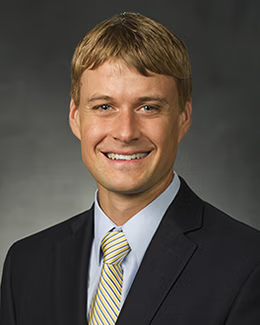
Jeffrey S. Bednar, associate professor of management in the BYU Marriott School of Business, delivered this devotional address on July 21, 2026.
Related Topics
Related Speeches