Steer by the Stars
BYU Academic Vice President
 Facebook
  Twitter/X
Like the sailor, we must hold our course by the stars, even when the contrary winds blow, as they surely will.
This is a poignant occasion for me. It is my final talk to the university leadership of Brigham Young University. It is also an important moment for the university as we gather today to discuss a draft of BYU’s Core Themes. And it is the last day of the semester as the campus prepares for the Christmas break. I have tried to select a topic for my presentation this morning that would fit all these aspects of this occasion. My topic is intended to provide a context for our announced purpose: to discuss a draft of BYU’s Core Themes. It is also intended to serve as a sort of last lecture for me as a BYU administrator. And it is intended to cohere to the Christmas season. I have chosen a subject that can be summed up in one phrase: “Steer by the Stars.”
The Star and the Wise Men
This title recalls, of course, the Wise Men in Matthew. The New Testament provides two narratives of Jesus’s birth: the story of shepherds in Luke and the story of Wise Men in Matthew. The first took place on the very night of Christ’s birth: “For unto you is born this dayin the city of David a Saviour, which is Christ the Lord.”1 The shepherds were directed by an angel to the manger, where they would find a newborn babe wrapped in swaddling clothes. The event took place before the circumcision and the offering of the pair of pigeons or turtledoves—the sacrifice permitted in Leviticus 12:6 for those who could not afford a sacrificial lamb. (Hence, we assume that Joseph and Mary were poor.) Note that there is no mention in Luke of a star at the manger guiding the shepherds.
Matthew, by contrast, recounts events that occurred not on the night of Jesus’s birth but sometime thereafter. He tells of the coming of Wise Men in search not of an infant but of a “young child.”2 They found the child not in a manger but in a house,3 evidently some time after the manger and perhaps even after the circumcision and the testimonies of Anna and of Simeon. (No wonder that Herod killed all those two years old and under.) The Wise Men’s search was guided by a star: “For we have seen his star in the east.”4
Most crèches and many carols conflate these stories: They have the shepherds following a star and the Wise Men laying gifts at the manger. The image of the Wise Men and the shepherds at the manger under a star is fixed deep in the popular imagination of Jesus’s birth.
When I was growing up, my family regularly mixed the stories up in our annual family Christmas pageant. My brothers and I always portrayed the Wise Men, who joined up with the shepherds at the manger. We dressed up in turbans and bathrobes, carried the girls’ perfume bottles and jewelry boxes, and marched in bobbing up and down as if riding on camels, singing, “We three kings of Orient are.”5 When we got to the line about “following yonder star,” we pointed up to one of the younger siblings on the stairs with a cardboard star around her face and a flashlight shining on her.
In fact, we know almost nothing about the Wise Men, though few, if any, scriptural narratives have invited so much fanciful speculation. What we do know is that they came from an eastern country beyond Herod’s realm and that they followed a star. We don’t know how many there were, what their names were, or even if they rode camels. But we know that they followed a star to find Christ. Nothing is said about the shepherds following a star, despite carols and crèches to the contrary. But the Wise Men followed a star.
It is the story of Wise Men following a star that provides a metaphor for my remarks. We, too, as wise men and women, need to steer our course by the stars.
Celestial Navigation: Being Guided by Stars
Until relatively recent times, those who traveled across deserts and trackless seas had to steer by the stars. This is still called celestial navigation. I like this name and the idea it represents. The stars provide fixed points in the sky against which one could and still can chart a certain course in the dark and across the unknown. Instruments like the quadrant, sextant, and astrolabe were used for this purpose.
The stars are valuable precisely because their place in the sky is fixed. You could tell exactly where you were because you knew exactly where they were. One used an astrolabe or similar device to calculate the distance from the horizon. The North Star (or polestar) established a fixed point around which the other stars moved.
Ideals as Stars
Ideals or goals function in this same way for us. They provide stars by which we can steer.
I like the way Shakespeare described this in an idealistic sonnet about love. Shakespeare compared the ideal of true love as the fixed star in the firmament:
Let me not to the marriage of true minds
Admit impediments. Love is not love
Which alters when it alteration finds . . . :
O, no! . . .
It is the star to every wandering bark,
Whose worth’s unknown, although his height be taken.6
Likewise, our ideals are also of inestimable worth to us, even if we never achieve them. They nonetheless guide our wandering barks (ships) on a difficult journey toward perfection. They provide fixed principles against which to measure our progress; they steer us heavenward.
Stars That Have Steered Me at BYU
Now let me share some of the stars that have steered my course at BYU. I am by temperament, as well as by conviction, an idealist. I have been inspired by the “idea of BYU” (to paraphrase John Henry Newman7) as much as or more than by the reality of BYU. As I have often told faculty and students, BYU is “a house of dreams.”8 It is built on vision as much as or more than on brick and mortar. Over the many years I have spent here, I have seen much of its failings and shortcomings in reality. Nevertheless, I remain loyal to and inspired by the dream, the idea of a “fully anointed university . . . about which” prophets have spoken.9 This dream is a star that draws wise men and women here to offer their gifts. They come here forsaking the kingdoms of the world—where tyrants like Herod hold sway—to worship a different King.
I will review some of the stars that I have followed. These are stars I commend to you in my departing advice as an administrator. In the illustration I note each one as a point on a five-point star.
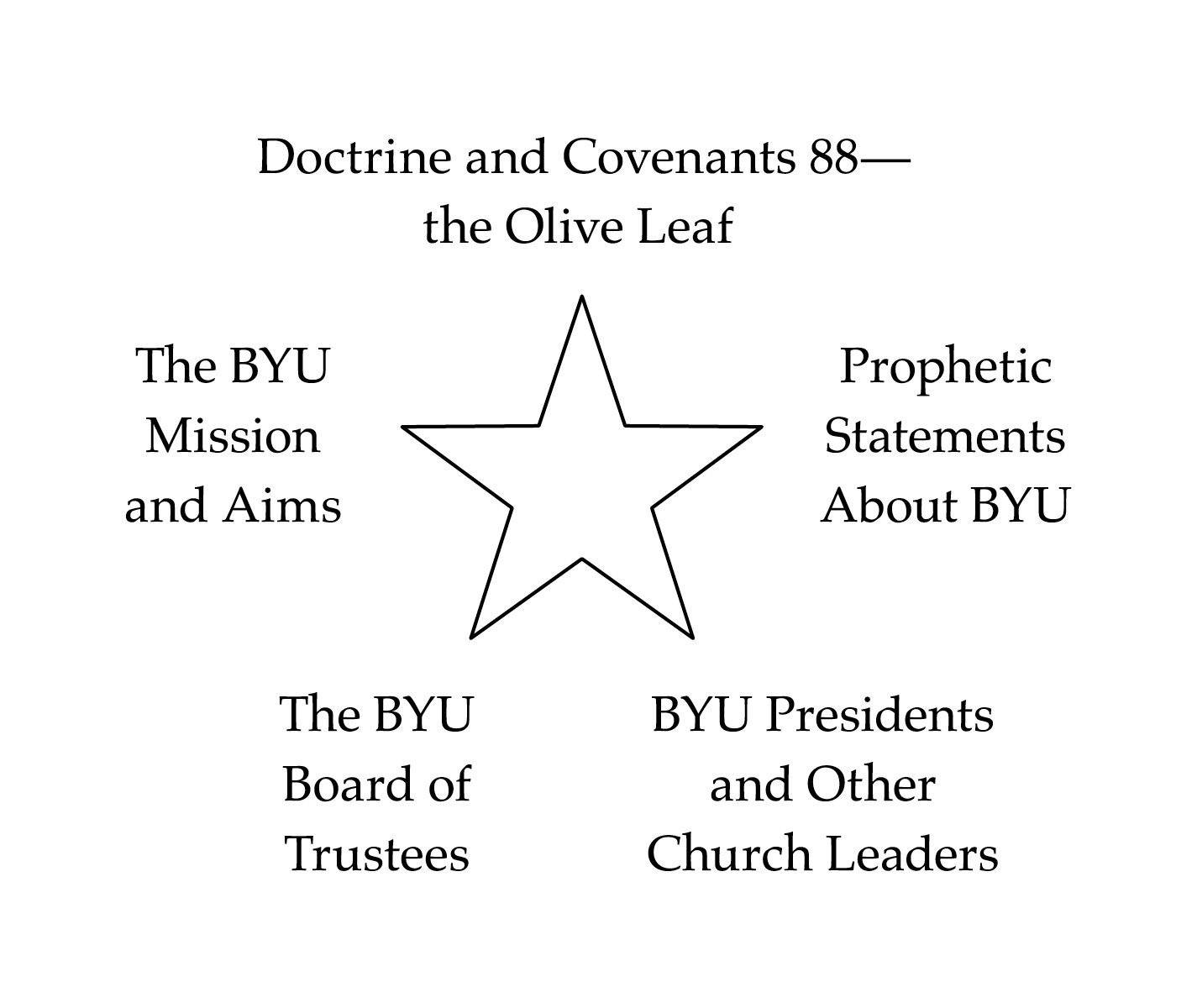
1. Doctrine and Covenants 88—the Olive Leaf
I have read and quoted more from the glorious revelation called the Olive Leaf than from any other single revelation. It was well described by then–BYU president Dallin H. Oaks as “the basic constitution of Church education.”10 I have sought to steer the university in my areas of stewardship by this revelation. I have also looked to other comparable core revelations in scripture to guide my course.
2. Prophetic Statements About BYU
I have been deeply impacted by statements from prophets about BYU. The two most influential for me have been J. Reuben Clark’s “Charted Course” address11 and Spencer W. Kimball’s second-century address.12 I commend them both as stars to steer by at BYU. President Boyd K. Packer once told me to read the former every year, which I have tried to do. I have also read President Kimball’s inspired talk given on the occasion of BYU’s centennial at least once a year, and generally much more often. I have also been deeply influenced by Brigham Young’s charge to Karl G. Maeser,13 which I come back to over and over again, and Brigham Young’s statements on education generally. I studied Brigham Young’s views extensively when I drafted the Aims of a BYU Education. You’ll note that each section begins with a quote from Brigham Young.14
3. BYU Presidents and Other Church Leaders
I have also been influenced by wise talks given by other General Authorities and by talks given by BYU’s presidents, past and present. When one reads and studies these, consistent themes about our mission are obvious, from the teachings of Karl G. Maeser to Cecil O. Samuelson. No one, for example, can read speeches by our presidents or the Brethren and be in any doubt that character education must remain central to BYU’s goals.
4. The BYU Board of Trustees
Just as we follow living prophets in the Church, at BYU we follow the counsel and direction of the current board of trustees, which consists of living prophets. I have learned by long experience how important this is. I still recall a time on campus when some chaffed at the supposed “intrusiveness” of the board in our business. I remember a conversation when I heard such a complaint as I drafted our Academic Freedom Policy. A faculty member wanted it to protect the university from its board. I said back to him, “You mean you want me to try to protect BYU against the counsel of prophets?” BYU must always steer by the star of the board’s inspired direction.
5. The BYU Mission and Aims
I have also tried to steer by the star of our statements of purpose as embodied in the Mission of Brigham Young University and the Aims of a BYU Education. I am very fond of these documents. They articulate valuable principles to guide our course. I remember when I was asked to serve as chair of the English Department. There was considerable skepticism and some hostility about my coming from the central administration back to the department as chair. People suspected I had a hidden agenda to implement. I told my colleagues that I had no hidden agenda, but I did have an agenda: It was to lead the department according to the mission and aims, as well as a few other core policy documents (such as the Rank and Status Policy and the Academic Freedom Policy). These documents still provide my agenda for BYU.
Conclusion
So my concluding advice to you is to steer by the stars. Always steer by the stars. I will soon leave BYU to serve a mission. I have tried to serve the university faithfully. I have tried to keep my eyes and the eyes of all those I could influence on the stars. I trust that you and subsequent leaders will continue to do so. I truly believe that, as Brigham Young told John Taylor in a dream, “Christ Himself [is] directing and [has] a care over this school.”15 I am always uncomfortable with the phrase “the Lord’s university”; it sounds arrogant, as if we have arrived, which we have decidedly not. But I do believe and have come to know through many experiences that the Lord truly does have a care of this place. As President Henry B. Eyring said, the Lord’s hand is on BYU—“a soft hand” nudging us along and helping us not stray too far off course.16
I know full well that BYU has many shortcomings; sometimes it does get off course. How can it not when it is full of imperfect people like me and like you? But remember that a sailor rarely sails a straight line to the goal. He must tack back and forth when he sails into the wind. Like the sailor, we must hold our course by the stars, even when the contrary winds blow, as they surely will. Our ideals are stars in the academic firmament that have guided and will yet guide wise men and women to this house of learning where the King can be honored and loved. May we steer by those stars that lead to the Savior.
© Brigham Young University. All rights reserved.
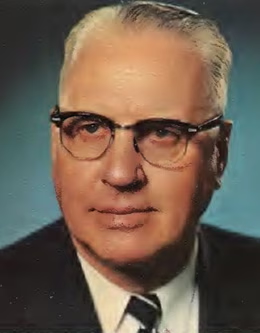
John S. Tanner was BYU academic vice president when he delivered this address at a BYU President’s Leadership Retreat on December 8, 2010.
Related Topics
Related Speeches