Spiritual Intelligence
of the Seventy
 Facebook
 Twitter/X


When obtained and maintained, spiritual intelligence will permeate through every aspect of your life: personal, professional, social, and how you serve in the Church and community. It will bring meaning and joy to everything you’re engaged in.
Dear fellow BYU friends, many things on this campus and at this university have changed since we were here during the ’80s. We have changed too. By the way, this is what we looked like when we lived at Wymount Terrace, just some blocks from the Marriott Center. [A photo was shown.]
The last time I remember being down here was more than 40 years ago when I was sweeping this floor while working as a custodian during a basketball game.
“The Glory of God Is Intelligence”
This was not the only floor on campus that I paid special attention to. Like many of you, I enjoyed going constantly to the Wilkinson Center. That was my favorite place on campus where I could rest, engage in conversations with friends, and enjoy a meal in the Cougareat. And every time I entered through the main door there, I would see the BYU logo on the floor with the inscription “The Glory of God Is Intelligence,” referring to Doctrine and Covenants 93:36. This scripture defines intelligence as “light and truth.”1
If the glory of God is measured by the degree of intelligence He has obtained, I reason that we must develop intelligence if we are to one day become perfect as He is and enjoy the same level of full joy that He possesses.
The word intelligence is very comprehensive and encompassing, and it has many definitions, depending on context and setting.
According to specialists, there are many types of intelligence. One type is logical or analytical intelligence that can be measured by an IQ test.
This analytical, logical intelligence is not necessarily permanent. It can grow or diminish, depending on individual effort. Those who spend more hours at the library or lab and pay attention during class are more likely to increase their intellectual capacity.
There are types of intelligence that are innate—such as artistic skill, musical abilities, or athletics—that can be enhanced through practice and discipline. There are so many opportunities to develop those on this magnificent campus!
Interpersonal or social intelligence allows one to feel confident and comfortable around any type of audience, group of people, or event. Everybody can develop this to a degree that is enough without losing character. This can take some effort to develop, but it will grow with practice. I can assure you that your professional and personal success will benefit from the capacity to build and maintain healthy relationships. Some will argue that this is the most important ingredient for developing a successful career.
The concept of emotional intelligence has been pretty much accepted for the last 30 years. Harvard PhD Dr. Daniel Goleman was the one who described it as the ability to recognize, understand, and manage our own emotions.2 Being emotionally stable is key to our personal, family, and professional lives—a real asset in an age of epidemic mental and emotional health issues.
Now there is artificial intelligence, which is about to change the way humanity approaches nearly everything. People are still divided on whether it will bring more solutions or problems to humankind, but one thought is unanimous: AI has arrived to stay, and there’s no turning back.
While it’s a very powerful tool, we must keep in mind that AI will never be the ultimate source of truth on matters such as our questions of the soul. Some of these questions are
- Where do I come from?
- Why am I here on this earth?
- Does this life have a purpose?
- Can I overcome my insecurities, imperfections, and bad inclinations?
Only Heavenly Father can provide those answers through His Son, Jesus Christ, and the Holy Ghost.
In fact, this is my main point here today. Knowledge, information, and resources are available in many universities around the world today, and all these relevant types of intelligence I mentioned can be obtained while you attend Brigham Young University.
But there is one kind of intelligence to which I am going to be referring today as “spiritual intelligence.” I would submit to you that this is the most important type of intelligence—one that is readily available at BYU because of its inspired mission and direction.
When obtained and maintained, spiritual intelligence will permeate through every aspect of your life—personal, professional, social—and influence how you serve in the Church and in your community. It will bring meaning and joy to everything you’re engaged in.
Don’t worry about being graded on a curve and being compared with others when in the pursuit of this. All those who accept and follow Jesus Christ will find that “it is by grace that we are saved [and perfected], after all we can do.”3
Jesus Christ is the Master Teacher of this class.
Many years ago, President Harold B. Lee spoke here at BYU about this subject, and he referred to it as “pure intelligence.”4 President Lee often used this quote from Joseph Smith:
A person may profit by noticing the first intimation of the spirit of revelation; for instance, when you feel pure intelligence flowing into you, it may give you sudden strokes of ideas, so that by noticing it, you may find it fulfilled the same day or soon; (i.e.) those things that were presented unto your minds by the Spirit of God, will come to pass; and thus by learning the Spirit of God and understanding it, you may grow into the principle of revelation, until you become perfect in Christ Jesus.5
Acquiring Spiritual Intelligence
How do we then acquire spiritual intelligence, or light and truth? By making intentional and deliberate decisions to qualify ourselves to receive and retain the Holy Ghost in our lives. With that, we are infused with knowledge and wisdom from on high that has far more value than any intelligence we obtain from other sources.
President Dallin H. Oaks—who I testify is a prophet of God—during his last talk in general conference said, “Never let your secular learning limit your spiritual horizons.”6
You may remember also that years ago President Oaks gave a remarkable talk entitled “Good, Better, Best.”7 Therefore, in the spirit of those teachings, we could reason:
- Good: Acquiring logical and analytical intelligence while in college is good, and this is what we would call a “higher education.”
- Better: If we add developing our innate intelligence, building social abilities, and honing our emotional capacities, we will have an even better skill set and experiences. We could call it a “superior education.”
- Best: If on top of all that we’re also able to develop what we’re calling today “spiritual intelligence,” we will obtain the very best—or an ideal—education.
Having an Understanding of and a Belief in God
How do we know if we’re on the right path to develop spiritual intelligence? We realize we are becoming spiritually intelligent beings when we become capable of recognizing that there is a God. Spiritual intelligence allows us to learn—not only through revelation but also through observation and reasoning—that there is a Heavenly Father.
Alma the Younger stated:
All things denote there is a God; yea, even the earth, and all things that are upon the face of it, yea, and its motion, yea, and also all the planets which move in their regular form do witness that there is a Supreme Creator.8
Perhaps this is why one of the slogans at the entrance to BYU is “The World Is Our Campus.” As we grow spiritual intelligence, we find evidence of God in some distinct ways in what we learn and study about our world.
Science and analytical intelligence can help us understand how the universe works. Spiritual intelligence can help us think about the Creation’s purpose and what it can teach us about Heavenly Father. People may look at the same evidence and come to different conclusions.
President Russell M. Nelson once asked the following question during a general conference address: “‘Could an explosion in a printing shop produce a dictionary?’ The likelihood is most remote.”9 This example invites us to think about the order and complexity of the Creation and to consider the hand of God in the world around us. Expanding our understanding and belief in God is spiritual intelligence.
Making and Keeping Covenants Will Bring Joy
We also know we are on the right path as we gain knowledge and experience that making and keeping covenants with God will bring a full joy.
Comprehending that making and keeping covenants with God during our baptism, the sacrament, and temple attendance and relying on His promises will cause us to receive the greatest blessings, both spiritual and temporal.
King Benjamin taught:
And moreover, I would desire that ye should consider on the blessed and happy state of those that keep the commandments of God. For behold, they are blessed in all things, both temporal and spiritual.10
During my time as a student here, I had a friend at BYU who was exemplary in believing the promises from keeping covenants. Right before the time to pay tuition for one semester, he had a financial setback and ended up not having enough money for tuition. But he managed to pay his tithing.
In those days, during the ’80s, we all came to stand in a line in the administration building and write a check to pay for tuition at the cashier counter. My friend was in that line, and while there he engaged in a conversation with the person right next to him, saying, “I don’t have enough money to pay for my tuition, but I have paid my tithing, and I trust the Lord will provide a way for me to do it.”
The young man who was talking to my friend became very surprised and anxious with this comment. “What? You came to this line without enough money? How can that be?”
The line kept advancing, and my friend was very calm, but the young man close to him became more and more anxious!
As they had almost arrived at the cashier, the young man couldn’t control his anxiety anymore and said, “Listen, I do have some extra money in my account. I will loan you the amount you need to pay for your tuition, okay?”
My friend readily accepted. The promises of keeping his covenants were fulfilled in a very unusual way!
The spiritual intelligence my friend displayed had higher intent than just having money to pay for tuition. What he really desired was to show to the Lord that he would show faith and do all he could to continue his education to acquire more knowledge and opportunities to improve his capacity to serve.
Please understand, my friend’s experience was miraculous. It was unusual. Faithful students who pay tithing may still have to wait, work more hours, or change plans to adapt. That does not mean they lack faith. The Lord has His own timetable and does not always grant our desires immediately.
What the Lord promises to those who keep their covenants is peace and assurance. I believe my friend would have accepted any outcome, knowing that he had fulfilled his part of the covenant and that, at some point, God would certainly do His part.
Acting on What We Are Learning
Thinking of this experience leads me to the next way we can find out if we are on the right path to developing spiritual intelligence. It’s when we realize that we can become God’s hands to bless humanity—in other words, if we’re acting on what we are learning.
Remember, we “enter [here] to learn [and] go forth to serve.”
A spiritually intelligent person will not wait for God to take care of things that He expects us to do.
I remember being with my wife on a flight from Rio de Janeiro to São Paulo—our two main cities in Brazil—while I was serving as a General Authority in our native country. We were about to depart from sunny, astoundingly beautiful Rio. My wife was sitting in the window seat, I was in the middle, and another woman sat on my other side. The woman kept mentioning to me that she was very much afraid of flying. I assured her that traveling by plane was very safe and not to worry.
As the plane took off and we had traveled for a while, the good sunny weather started to fade away, giving place to dark clouds that were causing the plane to shake. In fear, that woman had already held onto my arm three times when the turbulence increased.
By the time we were approaching the São Paulo airport, the woman desperately turned to me and said: “Sir, I can’t take it anymore. I’m so scared! Could I please hold your hand until we land at the airport?”
I completely froze! From the corner of my right eye, I checked to see if my wife was witnessing all this. She was not only paying attention but also savoring this experience and was waiting to see my reaction.
Seeing my discomfort and our friend’s fear, my wife responded with spiritual intelligence—she extended her hand to that woman and said, “I will hold your hand till we land.”
A feeling of calmness and safety filled the atmosphere. I had told her not to worry; my wife had shown her that she was not alone. Spiritual intelligence given by the Holy Ghost will prompt us to act and to not only say but do things for people!
Changing Our Nature Through Christ
Another sign that we’re on the way to evolve into more spiritual intelligence is when we recognize that through God’s power and the Atonement of His Son, Jesus Christ, our natures can be changed, and we can change the conditions around us.
There are certain temporary realities in this life we cannot change. Remember when I mentioned how my wife and I had physically changed since we were here at BYU, and I showed you our picture? Watching our appearance change as we get older is a reality of this mortal experience.
A while ago I was at a devotional for young single adults. Before the meeting started, I was shaking some hands.
One sister asked me, “So who are you, and why are you greeting everyone?”
When I explained to her that I was the speaker for that devotional, she reacted: “Oh, it’s you. But you look so different from the picture in the ad!”
That was another way of saying, “You look terrible!”
I remember when that official picture was taken at Church headquarters almost 10 years ago when I was called as a General Authority.
My wife looked at it and told the photographer, “I don’t like this picture, could you take another one?”
He said to her, “Don’t worry—10 years from now you will love this picture!”
Well, honey, it’s been nearly 10 years now. You probably agree with him. But don’t worry, resurrection will take care of that!
We cannot change our temporary physical mortal condition. Some of us also carry burdens we did not choose, such as illness, disability, depression, or anxiety. Having these burdens does not mean we lack faith. The Savior understands them. If we choose to enter the virtuous cycle of exercising faith in Christ and His Atonement, repent continually, make covenants, and endure to the end, we will experience “a mighty change [of ] heart.”11
This desire to change will help as we battle our bad habits, impulses, addictions, and strong opinions and strive to be cleansed from all our sins. A change of heart does not remove the struggle. It means our desires begin to turn toward Him, and He is patient with us as they do. As we find in Mosiah, we will “have no more disposition to do evil, but to do good continually.”12
Accepting and Understanding the Need for a Savior
So finally, we know we have become spiritually intelligent when we accept and understand the need for a Savior and Redeemer and that—again—we cannot solve our problems and achieve our full potential through our own efforts alone. Our Heavenly Father “so loved the world, that he gave his only begotten Son,”13 Jesus Christ, to perform the infinite Atonement so we can, eventually, become perfect in and through Him.
Remember, of all the great professors at this amazing university, it is the Master Teacher who can help us attain spiritual intelligence. It is our Savior and Redeemer, Jesus Christ, of whom I testify today.
In one of His most important classes on spiritual intelligence, Christ asked and replied: “What manner of men ought ye to be? Verily I say unto you, even as I am.”14
The invitation for all of us is to take advantage of every opportunity to develop our spiritual intelligence, which will allow us to know and be bound to God, Jesus Christ, and the Holy Ghost. I testify that is the only way to fulfill the measure of our creation and achieve full joy in our existence.
In the name of Jesus Christ, amen.
© by Intellectual Reserve, Inc. All rights reserved.

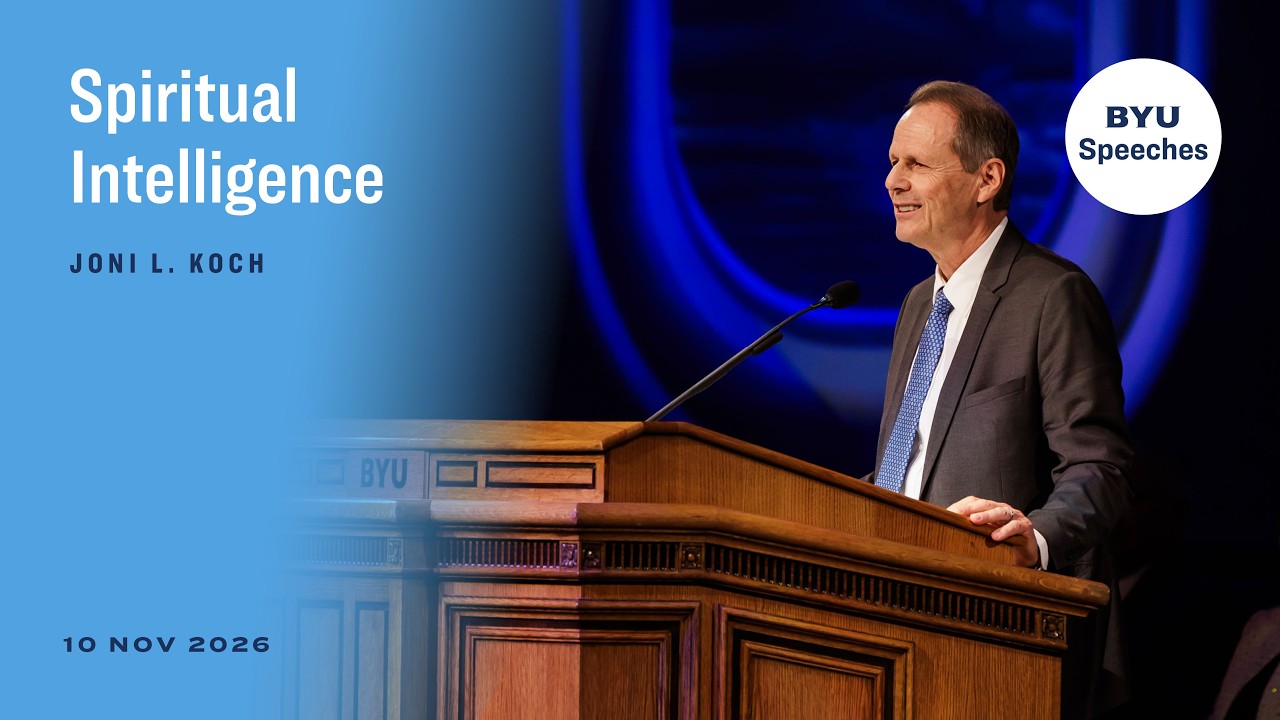
Joni L. Koch, a General Authority Seventy of The Church of Jesus Christ of Latter-day Saints, delivered this devotional address on November 10, 2026.
Related Topics
Related Speeches