





Speech link copied
Joseph’s School
Justin Collings
BYU Academic Vice President
August 25, 2025
BYU Academic Vice President
August 25, 2025


The revelations of the Restoration contain the master concepts for all of our disciplines.
Dear friends, beloved colleagues: Welcome back! It is a thrill to be with you and an honor to be one among you. There is no other university like this university, and there is no other faculty like this faculty. Thank you for your inspiring response to our campus-wide student success initiative, which we discussed in our all-faculty meeting back in April.1
Something special is happening on this campus, and it is happening in no small measure because of you. As President C. Shane Reese and Elder Clark G. Gilbert both noted this morning, 87 percent of our most recent graduating class reported that their time at BYU strengthened their faith in the Lord Jesus Christ.2 This reflects remarkable growth in recent years—growth of a kind that you simply do not see in organizations of our size over so short a span. We still have room to grow, but I anticipate similar growth in the years to come. There might always be a few students we don’t quite reach, but it is increasingly difficult to pass through our portals and under the influence of our faculty without being transformed by the experience. Thank you for allowing our students to stretch their minds on the expanse of your learning and to warm their hands by the fire of your faith.
Seven score and ten years ago, a living prophet brought forth in these valleys a new academy, conceived in revelation and dedicated to the proposition that “the glory of God is intelligence.”3 President Gordon B. Hinckley said:
This institution is unique. It is remarkable. It is a continuing experiment on a great premise that a large and complex university can be first class academically while nurturing an environment of faith in God and the practice of Christian principles. You are testing whether academic excellence and belief in the Divine can walk hand in hand. And the wonderful thing is that you are succeeding in showing that this is possible—not only that it is possible, but that it is desirable, and that the products of this effort show in your lives qualities not otherwise attainable.4
Colleagues and friends, I see in your lives irrefutable evidence of qualities unattainable without the unique combination of reason and revelation, discipline and discipleship, and capacity and consecration that are the hallmark of this university—of our storied past and our inspiring present, of our double heritage and our prophetic destiny. Thank you for being who you are and doing what you do.
I confess that I think about these university conference messages all year long. For today’s talk, I felt that I had received my errand from the Lord sometime around last September. Never in my life have I done as much to prepare for a talk as I have this year for this one. Even so, I am afraid that the product has fallen far short of my aim. But I pray that the Holy Ghost will make up the vast difference between what today’s topic deserves and what I will be able to deliver. I pray for the language and spirit and strength to communicate the deep feelings of my heart regarding the Restoration of the gospel of Jesus Christ and regarding this university, “the Good Ship BYU,”5 to whose towering mast we have resolutely nailed the Restoration’s colors.6
On May 12, 1844, just forty-six days before he was murdered by a Carthage mob, the Prophet Joseph Smith declared:
It is the testimony that I want that I am God’s servant and this people his people. . . .
I calculate to be one of the instruments of setting up the kingdom of Daniel by the word of the Lord, and I intend to revolutionize the whole world. . . .
. . . I never told you I was perfect, but there is no error in the revelations which I have taught.7
Seven weeks earlier, Joseph observed that his influence among the Saints came “in consequence of the power of truth in the doctrines which I have been an instrument in the hands of God of presenting unto them.”8
My purpose today is to bear precisely the witness that Joseph said he wanted—that he is God’s Prophet and we are God’s people—and to highlight “the power of truth” in Restoration doctrine, which will in time “revolutionize the whole world” and herald the glorious advent of the millennial Prince of Peace.
In this sesquicentennial year, we are rightly concerned with honoring our BYU founders and forebears. Today I honor our first and foremost founder, the Prophet Joseph Smith. I hope to underscore Joseph’s soaring vision for learning and teaching, knowledge and intelligence, light and truth, study and faith. I hope to encourage us all—in our teaching, scholarship, and citizenship—to drink deeply from the Restoration’s fountain and to radiate its light into the academy and into the world.
Along the way I hope to highlight interconnected themes from the Prophet’s remarkable ministry: the character of God and the divinity of Christ, knowledge and intelligence, light and truth, revelation and Zion, temple and school. I hope our tongues will taste these truths9—that our minds will stretch10 and our spirits soar. I hope we can join in the unity of faith—that we can savor Joseph’s witness of the Resurrected Christ, that our hearts will rise in worship as we “shout praises unto the Holy One of Israel.”11
“My first object,” Joseph declared, “is to find out the character of the true God. . . . I want you all to know God,” he said, “to be familiar with him,”12 and to comprehend “the excellencies [of] his character.”13
That character comprises “glory, honor, power, majesty, might, dominion, truth, justice, judgment, mercy, and an infinity of fulness.”14 Before the earth was made—before the Creation or the Fall or even the Council in Heaven—our Heavenly Father surveyed His spirit children and, in an effusion of mercy and grace, resolved to lift us all as high as we might be willing to rise. Joseph said:
God himself, find[ing] himself in the midst of spirits and glory, because he was greater, . . . saw proper to institute laws whereby the rest could have a privilege to advance like himself.15
Our Father pledged this purpose with an adamantine vow. As Joseph taught:
Everlasting covenant was made between three personages before the organization of this earth . . . [:] God the first, the Creator; God the second, the Redeemer; and God the third, the Witness or Testator.16
“God is gratified,” Joseph said, “in [the] salvation [and] exaltation of his creations.”17 He “made provisions before the world was for every creature in [it]”18—including “provision that every spirit in the eternal world can be ferreted out and saved.”19 “God is good,” Joseph taught, “and all his acts [are] for the benefit of [His children].”20 “He doeth not anything save it be for the benefit of the world; for he loveth the world.”21
In a similar spirit, everything we do on this campus should be for the blessing of our students and the benefit of the world. We understand “that education is a part of being about our Father’s business.”22 Our declared mission “is to assist individuals in their quest for perfection and eternal life.”23 That is the essence of our student success initiative. It is the animating purpose of everything that we do.
The quest for perfection and eternal life depends indispensably on “the merits, and mercy, and grace of the Holy Messiah.”24 Joseph declared that the apostolic witness of the Savior’s Atonement and Resurrection constitutes “the fundamental principles of our religion” and that “all other things are only appendages to these, which pertain to our religion.”25 Joseph taught:
Through the atonement of Christ and the resurrection and obedience to the gospel, we shall again “be conformed to the image of [God’s] Son,” Jesus Christ; then we shall have attained to the image, glory, and character of God.26
At BYU, we are unalterably committed to character education in this thick, theological sense.
To succeed in [our] mission the university must provide an environment . . . sustained by those moral virtues which characterize the life and teachings of the Son of God. . . .
. . . Any education is inadequate which does not emphasize that His is the only name given under heaven whereby mankind can be saved.27
One of Joseph’s revelations explains that Jesus forged His peerless character by growing “from grace to grace, until he received [His Father’s] fulness.”28 Stunningly, the revelation then invites us all to do the same.29
The restored gospel is a gospel of growth. Its revelations trumpet the “power to become.”30 The Lord told Joseph:
Man was also in the beginning with God. Intelligence, or the light of truth, was not created or made, neither indeed can be.
All truth is independent in that sphere in which God has placed it, to act for itself, as all intelligence also. . . .
The glory of God is intelligence, or, in other words, light and truth.31
Knowledge. Intelligence. Light. Truth. These exalting watchwords suffuse the Prophet’s teachings:
Intelligence in Joseph’s theology meant more than cognitive capacity. It denoted the purpose and potential of all the children of God. “The mind of man,” said Joseph, “is as immortal as God himself.”36
All mind[s are] susceptible of improvement. The relationship we have with God places us in a situation to advance in knowledge. God has power to institute laws to instruct the weaker intelligences that they may be exalted with himself. This is good doctrine. It tastes good.37
By divine design, the quest for knowledge is stretching and expansive. Joseph said:
The things of God are of deep import, and time and experience and careful and ponderous and solemn thoughts can only find them out. Thy mind, O man, if thou wilt lead a soul unto salvation, must stretch as high as the utmost heavens and search into and contemplate . . . the darkest abyss and . . . the . . . eternal expanse. [Thou] must commune with God.38
Joseph promised the faithful:
Your minds will expand wider and wider until you can circumscribe the earth and the heavens and reach forth into eternity [to] contemplate the mighty acts of Jehovah in all their variety and glory.39
God . . . created man with a mind capable of instruction and a faculty which may be enlarged in proportion to the heed and diligence given to the light communicated from heaven to the intellect; and . . . the nearer man approaches perfection, the more conspicuous are his views, and the greater his enjoyments.40
Joseph loved the “taste” of truth,41 and he prized “knowledge for its righteous power.”42 “Truth is mighty,” he wrote, “and will prevail.”43 “The first and fundamental principle of our holy religion is . . . to embrace all and every item of truth without limitation or without being circumscribed . . . by the creeds or . . . notions of men.”44 “One [of] the grand fundamental principles of [the restored gospel] is to receive truth, let it come from where it may.”45
In this sesquicentennial year, I pray that the quickening spirit of the Restoration will energize our labors with a buoyant, brilliant yearning. May we seek and savor truth in all its dimensions and all its domains.
For the Prophet Joseph, the consuming quest for truth was inseparable from the spirit of revelation. Revelation formed the bedrock of the true and living Church. “Upon this rock I will build my church,” Jesus said.46
“What rock[?]” Joseph asked. “Revelation.”47
Describing the Church’s core beliefs, Joseph reflected “that all other considerations were contained in the gift of the Holy Ghost.”48 “Salvation cannot come without revelation,” he said. “It is in vain for anyone to minister without it.”49 I submit that the same applies to teaching and research and learning at this university. “And the Spirit shall be given unto you by the prayer of faith; and if ye receive not the Spirit ye shall not teach.”50
Joseph spent his life receiving the Spirit and in the process produced more pages of scripture than any prophet before or since. Of the Book of Mormon, Joseph told the Twelve (who were joined on that occasion by my third-great-grandfather Joseph Fielding, who had just returned from a mission to England) that it “was the most correct of any book on earth and the keystone of our religion, and a man would get nearer to God by abiding by its precepts than [by those of] any other book.”51 I pray that the Book of Mormon will become increasingly the keystone of our campus.
Joseph loved to learn, and he loathed every limit on learning’s domain. “I want to come up into the presence of God and learn all things,” he said. “But the creeds set up stakes and say, ‘Hitherto shalt thou come and no further.’”52 All his life, Joseph resolutely strove to go further. “If we have [received] or can receive a portion of knowledge from God by immediate revelation,” he said, “by the same source we can receive all knowledge.”53 “One truth revealed from heaven,” he added, “is worth all the sectarian notions in existence.”54
The quest for truth demanded diligent labor. Joseph’s revelations commanded the Saints to “seek . . . out of the best books words of wisdom; [to] seek learning, even by study and also by faith”55; “and to obtain a knowledge of history, and of countries, and of kingdoms, of laws of God and man.”56 Saints must “study and learn, and become acquainted with all good books, and with languages, tongues, and people.”57 They must teach and learn
of things both in heaven and in the earth, and under the earth; things which have been, things which are, things which must shortly come to pass; things which are at home, things which are abroad; the wars and the perplexities of the nations.58
For Joseph, learning from books was necessary but not sufficient. Revelation remained the corollary and capstone of diligent study. “[I] thank God I have got this book,” he said, referring to an old, multilingual Bible, “and I thank him more for the gift of the Holy Ghost.”59 Joseph prized books but warned that “reading the experience of others, or the revelations given to them, can never give us a comprehensive view of our condition and true relation to God.”60 “Could you gaze in[to] heaven [for] five minutes,” he mused, “you would know more than . . . by read[ing] all that ever was written on the subject.”61
Joseph insisted that revelation is for everyone. “No [one],” he said, “can receive the Holy Ghost without receiving revelations. The Holy Ghost is a revelator.”62 “God is not a respecter of persons. We all have the same privilege. Come to God. Weary him until he blesses you.”63 “God hath not revealed anything to Joseph,” he promised, “but what he will make known unto the Twelve, and even the least Saint may know all things as fast as he is able to hear them.”64 “Could we all come together with one heart and one mind in perfect faith, the veil might as well be rent today as next week or any other time.”65
Thankfully, Joseph provided practical guidance on growing into the principle of revelation. He described the Spirit’s influence as “pure intelligence . . . expanding the mind, enlightening the understanding, and storing the intellect with present knowledge.”66 He observed that
a person may profit by noticing the first intimation of the spirit of revelation. For instance, when you feel pure intelligence flowing unto you, it may give you sudden strokes of ideas, [and] by noticing it you may find it fulfilled the same day or soon [thereafter.] . . . And thus by learning the Spirit of God and understanding it, you may grow into the principle of revelation until you become perfect in Christ Jesus.67
Friends and colleagues, I believe that growing into the principle of revelation is indispensable to “becoming BYU.”68 This Restoration university must, like the restored Church itself, be built upon the rock of revelation. Our living prophet, President Russell M. Nelson, has said:
Our Savior and Redeemer, Jesus Christ, will perform some of His mightiest works between now and when He comes again. We will see miraculous indications that God the Father and His Son, Jesus Christ, preside over this Church in majesty and glory. But in coming days, it will not be possible to survive spiritually without the guiding, directing, comforting, and constant influence of the Holy Ghost.69
I believe that some of those mighty works will transpire on this campus. They will come as we answer our prime directive to teach every subject by the Spirit of God. They will come as we claim this promise from President Spencer W. Kimball:
We expect the natural unfolding of knowledge to occur as a result of scholarship, but there will always be that added dimension that the Lord can provide when we are qualified to receive and [God] chooses to speak.70
President Kimball then quoted Joseph’s prophecy of “a time to come in the which nothing shall be withheld, whether there be one God or many gods, they shall be manifest”—a time when “all thrones and dominions, principalities and powers, shall be revealed and set forth upon all who have endured valiantly for the gospel of Jesus Christ.”71
In this sesquicentennial year, may we cultivate the spirit of revelation. May we herald and hasten the promised day when “nothing shall be withheld.” May we claim in our day President Kimball’s promise “that the scriptures contain the master concepts for mankind.”72 I believe that we will find those master concepts in the scriptures the Lord revealed through the Prophet Joseph Smith. I believe that the revelations of the Restoration contain the master concepts for all of our disciplines. May we immerse ourselves in those master concepts. Then, “with authority and excellence” and “in the language of scholarship,”73 may we radiate the Restoration’s light into the academy and into the world.
Few themes run as powerfully and persistently through Joseph’s revelations as does the theme of Zion. The revelations call explicitly for “a school in Zion.”74 At BYU we strive to build a school that is not only in Zion but of Zion—a covenant community where all who learn and labor strive to become “pure in heart”75 and “of one heart and one mind” with “no poor among [us].”76
Joseph taught that human beings are designed with eternal relationships in mind. We are formed and fitted to forge enduring bonds. God convened His spirit children in heavenly council, Joseph said, “to form them tabernacles so that He might gender the spirit and the tabernacle together so as to create sympathy for their fellow man.”77
This astonishing insight illuminates other Restoration truths:
What if we at BYU were to take these Restoration insights and run with them? Could our scholars and students do even more to probe how the children of God are primed—biologically, socially, culturally, spiritually—to forge enduring bonds? Beyond this particular topic, could we not, in every discipline, gather the scattered gems of the Restoration and savor what they have to teach? President Nelson’s pioneering heart research was prodded by two key passages in the Doctrine and Covenants.82 Might we not garner similar insights from similar sources with a similarly transformative impact?
Unsurprisingly, given his gregarious disposition and social theology, Joseph cared deeply about relationships. Our BYU mission statement declares: “All relationships within the BYU community should reflect devout love of God and a loving, genuine concern for the welfare of our neighbor.”83 Joseph wanted a society sweetened by such relationships—a society sanctified by kindness and purified by compassion.
There must be no gossiping or evil-speaking in Zion, he warned: “There is no salvation in believing an evil [report] against our neighbor.”84 “To be righteous is to be just and merciful. If a man fails in kindness, justice, and mercy, he will be damned,”85 or stopped in his spiritual progress. Joseph observed:
It is one evidence that men are unacquainted with the principle of godliness to behold [their] contraction of feeling and lack of charity. The power and glory of godliness is spread out on a broad principle to throw out the mantle of charity.86
Charity, for Joseph, was both the means and the product of drawing closer to God. “The nearer we get to our Heavenly Father,” he said, “the more are we disposed to look with compassion on perishing souls—to take them upon our shoulders and cast their sins behind our back.”87
Charity, on Joseph’s telling, fueled unity, which for Joseph was not just a social principle; it was a cosmic decree:
The [principle] by which the world can be governed is the principle of two or three being united. . . . The sun, moon, and planets roll on that principle. If God the Father, the Son, and the Holy Ghost were to disagree, the worlds would clash together in an instant.88
“If ye are not one,” the Lord warned, “ye are not mine.”89 “Unity is power,” the Prophet taught.90 “By union of feeling we obtain power with God.”91
Unity, Joseph taught, feeds on friendship. Joseph prized his friendships enormously and was deeply moved by gestures of grace. “Friendship,” he said, “is the grand fundamental principle of [the restored gospel]”—a principle destined “to revolutionize . . . the world.”92 He also said:
Nothing is so much calculated to lead people to forsake sin as to take them by the hand and watch over them with tenderness. When persons manifest the least kindness and love to me, O what power it has over my mind, while the opposite course has a tendency to harrow up all the harsh feelings and depress the human mind.93
Less than a week before his death, Joseph told the Saints, “If it was not for the tender bonds of love that [bind] me to you, my friends and brethren, death would be to me as sweet as honey.”94 “The only thing I am afraid of,” he mused, “is that I will not live long enough to enjoy the society of . . . my friends as long as I want to.”95 Nothing in Restoration theology thrilled Joseph’s soul quite like the assurance of a Resurrection rendezvous with those he loved the most.
Now, when I look out over this mighty group and think of you, my faculty colleagues and friends, I am moved to paraphrase these additional words of the Prophet Joseph Smith: “I delight in the society of my friends and [colleagues] and pray that the blessings of heaven and earth may be multiplied upon [your] heads.”96
In this sesquicentennial year, may we nurture the bonds of friendship that bind us to one another. May we reconnect with an old friend and find a new friend. Where needed, may we repair a ruptured friendship or bestow the balm of forgiveness. May we answer our living prophet’s repeated calls for peacemakers.97
Zion, in Joseph’s theology, required two core institutions: a temple and a school. The prophetic vision for both was set forth in the same revelation, one of Joseph’s grandest: “The olive leaf,”98 section 88 of the Doctrine and Covenants, which President Dallin H. Oaks once called “the basic constitution of Church education.”99 This revelation prescribed a sweeping curriculum and charged learners to sanctify themselves,100 to “teach one another,”101 to seek wisdom from the best books,102 and to “seek learning . . . by study and also by faith.”103 It also called for a holy house—“a house of prayer, a house of fasting, a house of faith, a house of learning, a house of glory, a house of order, a house of God.”104 The temple, of course, must be such a house, but so, I submit, must the school.
Joseph’s own life experience united temple and school. During the fall of 1835 and the winter of 1836, while he was engrossed in final preparations for the house of the Lord in Kirtland, Joseph read and studied as never before, including at the Kirtland Hebrew School, where he was a strong and assiduous student.
Joseph’s journal for November 11, 1835, records: “Attended school during school hours.” And then: “Returned home and spent the evening around my fireside, teaching my family the science of grammar.”105 The next day, Joseph gathered Church leaders to impart soaring instructions about the endowment of power, the solemn assembly, and the washing of feet. “You need an endowment, brethren,” he said, “that you may be prepared and able to overcome all things.”106 The Prophet then predicted: “All who are prepared and are sufficiently pure to abide the presence of the Savior will see him in the solemn assembly.”107 A staggering promise. And then, the very next day: “Attended school during school hours.”108
And so it went throughout that memorable winter—soaring heavenly disclosures and stirring prophetic teachings, interwoven with the joyful labor of language study.
On November 20, 1835, Oliver Cowdery returned to Kirtland from a trip to New York. He brought with him, Joseph recorded, “a quantity of Hebrew books for the benefit of the school. He presented me with a Hebrew Bible, lexicon, and grammar, also a Greek lexicon and Webster’s English lexicon.”109
Joseph was delighted. He could hardly wait to dig in. He spent the next day “examining [his] books and studying the Hebrew alphabet.”110 Six days later, he was “much afflicted with [a] cold,” so he “spent the day in reading Hebrew at home.”111
On December 22: “Continued my studies. O may God give me learning, even language, and [endow] me with qualifications to magnify his name while I live.”112 The next day, Joseph’s thirtieth birthday, he celebrated “in the forenoon at home studying the Greek language.”113
On January 4, 1836, Joseph held an evening chapel meeting “to make arrangements for a singing school”114—the ancestor, I suggest, of the BYU School of Music.
On January 19, Joseph hailed the Hebrew school’s progress:
The Lord blessed us in our studies. . . . It seems as if the Lord opens our minds in a marvelous manner to understand his word in the original language, and my prayer is that God will speedily [endow] us with a knowledge of all languages and tongues, that his servants may go forth for the last time to bind up the law and seal up the testimony.115
Two days later, Joseph received a sequence of heavenly visions, one of which is now canonized as section 137 of the Doctrine and Covenants.116 Then the very next morning, he was back at school, though apparently slightly distracted. He and his classmates gathered at the usual hour but spent some time marveling at the previous evening’s manifestations and visions.117
All of this happened, I should note, before the group’s Hebrew instructor, Joshua Seixas, had even arrived in Kirtland.118
Joseph clearly relished his studies. “My soul delights in reading the word of the Lord in the original,” he enthused on February 17, “and I am determined to pursue the study of languages until I shall become master of them, if I am permitted to live long enough.”119 That last clause hints at troubling premonitions.
In any event, this season of language study and temple preparation was never one of irenic calm. Joseph agonized over the temple’s cost and the burden of preparing the Saints for the manifestations to come. On January 30 he recorded:
I returned to my house being weary with continual anxiety and labor in putting all the authorities in [order] and in striving to purify them for the solemn assembly according to the commandment of the Lord.120
On March 27, the day of the temple dedication, Joseph offered the prayer whose text he had previously received by revelation121—a prayer that President Nelson has urged us to study today.122 At the dedicatory services, the heavens parted and the veil drew back.123 A week later, on Easter Sunday, April 3, Joseph and Oliver Cowdery saw the resurrected Savior and received keys of power from Moses, Elias, and Elijah.124 Between these Pentecostal outpourings, the Hebrew school wrapped up its work. On Tuesday, Joseph “attended school”—the final session with Professor Seixas.125 In the evening, the Saints gathered in the temple for sacred ordinances. “The Holy Spirit rested down upon us,” Joseph recorded, “and we continued in the Lord’s house all night, prophesying and giving glory to God.”126
The celestial outpourings of early 1836 proved prelude to a season of severe trials—an economic panic, the collapse of the Kirtland Safety Society, widespread apostasy, renewed persecution in Missouri, the 1838 “war of extermination,”127 the Hawn’s Mill Massacre, Liberty Jail, and a frozen flight across the Mississippi and into Illinois.
Yet Joseph never relinquished the tie between temple and school. And he never abandoned the dream of a great city of Zion crowned by these complementary jewels. Indeed, that dream grew increasingly ambitious and daring. On January 15, 1841, Joseph and his counselors in the First Presidency announced their bold intentions:
The “University of the City of Nauvoo” will enable us to teach our children wisdom—to instruct them in all knowledge and learning in the arts, sciences, and learned professions. We hope to make this institution one of the great lights of the world and by and through it to diffuse that kind of knowledge which will be of practical utility and for the public good and also for private and individual happiness.128
Four months later, the First Presidency summoned all Saints to gather to Nauvoo. They declared:
This is important and should be attended to by all who feel an interest in the prosperity of this the cornerstone of Zion. Here the temple must be raised [and] the university be built.129
Joseph and his counselors affirmed that the temple and the university, along with other key buildings, were “necessary for the great work of the last days.”130 When the Board of Regents of the University of the City of Nauvoo was formed in 1841, it included the Prophet Joseph Smith and the entire First Presidency, as well as leading bishops in the Church. After Joseph’s death in 1844, the board included President Brigham Young and other members of the Quorum of the Twelve Apostles. The Lord thus established from the very beginning that Zion’s university must enjoy prophetic guidance.131
Joseph, of course, never saw Nauvoo’s temple completed or its university built. But the dream of a great Restoration university—one that would stand worthily alongside the temple of our God—lived on. Indeed, it lives on still. Fittingly, it carries the name of Joseph’s earnest pupil and mighty successor. Joseph’s soaring educational vision—a vision of light and learning, knowledge and truth, temple and school, study and faith—is, I submit, the most precious part of our patrimony here at BYU. “Take away the Book of Mormon and the revelations,” Joseph asked, “and where is our religion? We have none.”132 I submit that the same is true of our school. We would not exist and we would have no reason to exist without the revelations of the Restoration and the living oracles of God.
At the dawn of this sesquicentennial year, may we here highly resolve to become the school that Joseph foresaw—a university founded on the unshakable rock of revelation; secured by the sacred keystone of the Book of Mormon; crowned by the glorious capstone of the Doctrine and Covenants; “founded, supported, and guided by The Church of Jesus Christ of Latter-day Saints”133; and “enlightened by living prophets and sustained by those moral virtues which characterize the life and teachings of the Son of God.”134 May we strive as never before to become the “Christ-centered, prophetically directed university of prophecy”135—“the fully anointed university of the Lord about which so much has been spoken in the past.”136
Colleagues and friends: In a way that I cannot fully describe but that I hope the Spirit will sear into our minds and hearts and souls, I believe that the Lord would have us lean ever more fully into our unique identity as the great university of the Restoration. I believe the Lord would have us do everything in our power to ensure that every BYU student graduates with an unwavering witness that the Father and the Son appeared to the boy Joseph Smith and that Joseph spent the rest of his life—under Their direction and endowed with Their authority and power—revealing the knowledge of Christ to an ominously darkening world.
Accordingly, I invite all of us in this sesquicentennial year to bear just such a witness to our students—at least once in every course. I invite us to pray fervently for every student to receive such a witness of his or her own—a witness that will never be dimmed by time nor dented by the Prophet’s detractors.
When Joseph knelt among the trees,
The hopes of all the centuries
Crescendoed into one
As from a fierce, effulgent flame
The Father spake the farm boy’s name
And introduced His Son.
When Joseph pleaded through the night,
Moroni came and, clothed in might,
Revealed the plates of gold.
The Baptist, Peter, James, and John
With keys of power proclaimed the dawn
By prophets long foretold.
When Joseph built a house of God
And sent swift messengers abroad
With tidings of glad things,
The Lord restored His sealing power
And set a watchman on the tower
To hail the King of Kings.
When Joseph bled in Carthage Jail,
His spirit slipped beyond the veil
Into the realms of grace,
Where once again, as in his youth,
Amid a blaze of light and truth,
He saw his Father’s face.137
Joseph said:
It is my meditation all the day and more than my meat and drink to know how I shall make the Saints of God to comprehend the visions that roll like an overflowing surge before my mind.138
I bear witness of that beautiful, abundant, sublime, and overflowing surge. I bear witness of the Lord Jesus Christ, who is its divine and inexhaustible source—the Fount of every blessing and the Giver of all good things.
I testify that Joseph Smith is God’s Prophet, as is President Russell M. Nelson, and that this people is God’s people. I pray that in His good time and by His good grace we may become His university. In the incomparable name of Jesus Christ, amen.
© Brigham Young University. All rights reserved.
Notes
Quotations from The Joseph Smith Papers (JSP) of The Church of Jesus Christ of Latter-day Saints (josephsmithpapers.org) have been standardized and modernized for clarity and readability.
1. See Justin Collings, “Imparting Our Double Heritage to Students,” BYU all-faculty meeting address, 28 April 2025.
2. See C. Shane Reese, “Making Every Effort: Patience, Professionalism, and Spirituality,” BYU university conference address, 25 August 2025; and Clark G. Gilbert, “Being Deliberate in the Second Half of the Second Century of Brigham Young University,” BYU university conference address, 25 August 2025.
3. Doctrine and Covenants 93:36; see Jeffrey R. Holland, “A School in Zion,” BYU annual university conference address, 22 August 1988.
4. Gordon B. Hinckley, “Trust and Accountability,” BYU devotional address, 13 October 1992.
5. Jeffrey R. Holland, “Nailing Our Colors to the Mast,” BYU devotional address, 10 September 1985.
6. See Karl G. Maeser, “Final Address” (4 January 1892), The Normal 1, no. 10 (15 January 1892): 82; see also Holland, “Nailing Our Colors.”
7. Joseph Smith, Discourse, 12 May 1844, as Reported by Thomas Bullock, JSP (Documents, 1844), 1–2.
8. Joseph Smith, Discourse, 24 March 1844–B, as Reported by Wilford Woodruff, JSP (Documents, 1844), 217.
9. See Joseph Smith, Discourse, 7 April 1844, as Reported by Wilford Woodruff, JSP (Documents, 1844), 137; also Joseph Smith, Discourse, 7 April 1844, as Published in Times and Seasons, JSP (Documents, 1844), 615; published in Smith, “Conference Minutes” (7 April 1844), Times and Seasons 5, no. 15 (15 August 1844): 615.
10. See Joseph Smith, Letter to the Church and Edward Partridge, 20 March 1839, JSP (Documents, 1839), 12.
11. 2 Nephi 31:13.
12. Joseph Smith, Discourse, 7 April 1844, as Reported by Thomas Bullock, JSP (Documents, 1844), 15–16.
13. Joseph Smith, Third Lecture on Faith, in Doctrine and Covenants, 1835 ed., JSP (Revelations and Translations, Published Revelations), 40 (verse 21; see also verses 23–24).
14. Doctrine and Covenants 109:77.
15. Smith, Discourse, 7 April 1844, as Published in Times and Seasons, 615; published in Smith, “Conference Minutes,” Times and Seasons, 615; see also Joseph Smith, Discourse, 7 April 1844, as Reported by William Clayton, JSP (Documents, 1844), 16–17.
16. Joseph Smith, Discourse, circa May 1841, as Reported by William Clayton, JSP (Documents, 1841), 10–11.
17. Joseph Smith, Discourse, 7 April 1844, as Reported by Willard Richards, JSP (Documents, 1844), 68.
18. Joseph Smith, Discourse, 7 April 1844, as Reported by Willard Richards, 70.
19. Smith, Discourse, 7 April 1844, as Published in Times and Seasons, 616; published in Smith, “Conference Minutes,” Times and Seasons, 616.
20. Joseph Smith, Discourse, circa 28 March 1841, JSP (Documents, 1841), 18.
21. 2 Nephi 26:24; see verse 33.
22. Spencer W. Kimball, “The Second Century of Brigham Young University,” BYU devotional address, 10 October 1975; see Luke 2:49.
23. The Mission of Brigham Young University (4 November 1981).
24. 2 Nephi 2:8.
25. Joseph Smith, Elders’ Journal, July 1838, JSP (Documents, 1838), 44; published in Joseph Smith, “Far West, MO. July, 1838,” Elders’ Journal 1, no. 3 (July 1838): 44.
26. Joseph Smith, Discourse, between 11 June and 23 July 1843, JSP (Documents, 1843), 12; quoting Romans 8:29.
27. Mission of BYU.
28. Doctrine and Covenants 93:13; see verses 16–17.
29. See Doctrine and Covenants 93:19–20.
30. Doctrine and Covenants 11:30; 39:4; 42:52.
31. Doctrine and Covenants 93:29–30, 36.
32. Doctrine and Covenants 131:6.
33. Joseph Smith, Discourse, 21 May 1843, as Reported by Howard Coray, JSP (Documents, 1843), 40.
34. Joseph Smith, Discourse, 14 May 1843, JSP (Documents, 1843), 30.
35. Doctrine and Covenants 130:18; see verse 19.
36. Smith, Discourse, 7 April 1844, as Reported by Thomas Bullock, 18.
37. Smith, Discourse, 7 April 1844, as Reported by Wilford Woodruff, 137.
38. Smith, Letter to the Church and Edward Partridge, 12.
39. Joseph Smith, Letter to Orson Hyde and John E. Page, 14 May 1840, JSP (Documents, 1840), 146.
40. Joseph Smith, Letter to the Church, circa February 1834, JSP (Documents, 1834), 135; published in “The Elders of the Church in Kirtland, to Their Brethren Abroad,” The Evening and the Morning Star 2, no. 17 (February 1834): 135.
41. Smith, Discourse, 7 April 1844, as Reported by Wilford Woodruff, 137; also Smith, Discourse, 7 April 1844, as Published in Times and Seasons, 615; published in Smith, “Conference Minutes,” Times and Seasons, 615.
42. George Q. Cannon, The Life of Joseph Smith, the Prophet (Salt Lake City: Juvenile Instructor Office, 1888), 189.
43. Joseph Smith, Letter to James Arlington Bennet, 13 November 1843, JSP (Documents, 1843), 2[a].
44. Joseph Smith, Letter to Isaac Galland, 22 March 1839, JSP (Documents, 1839), 54; published in Smith, “Copy of a Letter from J. Smith Jr. to Mr. Galland,” Times and Seasons 1, no. 4 (February 1840), 54.
45. Joseph Smith, Discourse, 9 July 1843, JSP (Documents, 1843), 302.
46. Matthew 16:18; quoted in Joseph Smith, Discourse, 22 January 1843, as Reported by Wilford Woodruff, JSP (Documents, 1843), 7.
47. Smith, Discourse, 22 January 1843, as Reported by Wilford Woodruff, 8.
48. Joseph Smith, Letter to Hyrum Smith and Nauvoo High Council, 5 December 1839, JSP (Documents, 1839), 88.
49. Joseph Smith, Discourse, between circa 26 June and circa 4 August 1839–A, as Reported by Willard Richards, JSP (Documents, 1839), 68.
50. Doctrine and Covenants 42:14.
51. Wilford Woodruff, quoting Joseph Smith in Remarks, 28 November 1841, JSP (Documents, 1841), 112; see also Introduction to the Book of Mormon.
52. Joseph Smith, Discourse, 15 October 1843, JSP (Documents, 1843), 128–29.
53. Joseph Smith, Discourse, 21 January 1844, JSP (Documents, 1844), 181.
54. Joseph Smith, Discourse, 10 March 1844, as Reported by Wilford Woodruff, JSP (Documents, 1844), 209.
55. Doctrine and Covenants 88:118.
56. Doctrine and Covenants 93:53.
57. Doctrine and Covenants 90:15.
58. Doctrine and Covenants 88:79; see verse 78.
59. Smith, Discourse, 7 April 1844, as Reported by Thomas Bullock, 17.
60. Joseph Smith, Discourse, 9 October 1843, as Reported by Gustavus Hills, JSP (Documents, 1843), 331; published in Smith, “Minutes of a Special Conference,” Times and Seasons 4, no. 21 (15 September 1843): 331.
61. Joseph Smith, Discourse, 9 October 1843, as Reported by Willard Richards, JSP (Documents, 1843), 121.
62. Smith, Discourse, 15 October 1843, 130.
63. Joseph Smith, Discourse, between circa 26 June and circa 4 August 1839–C, as Reported by Willard Richards, JSP (Documents, 1839), 78–79.
64. Joseph Smith, Discourse, between circa 26 June and circa 2 July 1839, as Reported by Wilford Woodruff, JSP (Documents, 1839), 29.
65. Joseph Smith, Minutes, 25–26 October 1831, JSP (Documents, 1831), 11.
66. Smith, Discourse, between circa 26 June and circa 2 July 1839, as Reported by Wilford Woodruff, 30.
67. Joseph Smith, Discourse, between circa 26 June and circa 2 July 1839, as Reported by Willard Richards, JSP (Documents, 1839), 21–22.
68. C. Shane Reese, “Becoming BYU: An Inaugural Response,” address delivered at his inauguration as BYU president, 19 September 2023.
69. Russell M. Nelson, “Revelation for the Church, Revelation for Our Lives,” Ensign, May 2018.
70. Kimball, “Second Century.”
71. Doctrine and Covenants 121:28–29; quoted in Kimball, “Second Century.”
72. Kimball, “Second Century.”
73. Kimball, “Second Century.”
74. Doctrine and Covenants 97:3.
75. Doctrine and Covenants 97:21.
76. Moses 7:18.
77. Joseph Smith, Discourse, circa 28 March 1841, JSP (Documents, 1841), 18.
78. Doctrine and Covenants 88:15.
79. Doctrine and Covenants 93:33; see verse 34.
80. Doctrine and Covenants 130:2.
81. 2 Nephi 2:25.
82. The two passages were Doctrine and Covenants 88:36, 38 and Doctrine and Covenants 130:21; see Russell M. Nelson, “Begin with the End in Mind,” BYU devotional address, 30 September 1984.
83. Mission of BYU.
84. Smith, Discourse, 12 May 1844, as Reported by Thomas Bullock, 1.
85. Smith, Discourse, 21 May 1843, as Reported by Howard Coray, 37.
86. Joseph Smith, Discourse, 9 June 1842, JSP (Documents, 1842), 62.
87. Smith, Discourse, 9 June 1842, 62.
88. Joseph Smith, Discourse, 11 April 1844-A, JSP (Documents, 1844), 106.
89. Doctrine and Covenants 38:27.
90. Joseph Smith, Letter to John Taylor and Wilford Woodruff, between circa November and circa 20 December 1843, JSP (Documents, 1843), 377; emphasis in original; published in Smith, “To the Saints,” Times and Seasons 4, no. 24 (1 November 1843): 377.
91. Smith, Discourse, 9 June 1842, 61.
92. Joseph Smith, Discourse, 23 July 1843, as Reported by Willard Richards, JSP (Documents, 1843), 13.
93. Smith, Discourse, 9 June 1842, 62.
94. Joseph Smith, Appendix: Discourses, 22 June and 23 or 24 June 1844, as Recorded in Fullmer, Letterbook, JSP (Appendix Items in Documents, 1844), 85.
95. Joseph Smith, Discourse, 11 April 1844-B, JSP (Documents, 1844), 118–19 [119–20].
96. Joseph Smith, Journal, 1835–1836, 11 January 1836, JSP (Journals, 1832–1839), 103.
97. See Russell M. Nelson, “Peacemakers Needed,” Liahona, May 2023; also Nelson, “Confidence in the Presence of God,” Liahona, May 2025.
98. Joseph Smith, Letter to William W. Phelps, 11 January 1833, JSP (Documents, 1833), 18; see also heading of Doctrine and Covenants 88.
99. Dallin H. Oaks, “A House of Faith,” BYU annual university conference address, 31 August 1977.
100. See Doctrine and Covenants 88:68, 74.
101. Doctrine and Covenants 88:77, 118.
102. See Doctrine and Covenants 88:118.
103. Doctrine and Covenants 88:118.
104. Doctrine and Covenants 88:119.
105. Smith, Journal, 11 November 1835, 30.
106. Joseph Smith, Discourse, 12 November 1835, JSP (Documents, 1835), 34.
107. Smith, Discourse, 12 November 1835, 35.
108. Smith, Journal, 13 November 1835, 35.
109. Smith, Journal, 20 November 1835, 47.
110. Smith, Journal, 21 November 1835, 47.
111. Smith, Journal, 27 November 1835, 50.
112. Smith, Journal, 22 December 1835, 88.
113. Smith, Journal, 23 December 1835, 88.
114. Smith, Journal, 4 January 1836, 99.
115. Smith, Journal, 19 January 1836, 131.
116. See Smith, Journal, 21 January 1836, 136–37; see also heading of Doctrine and Covenants 137.
117. See Smith, Journal, 22 January 1836, 140.
118. Joshua Seixas taught Hebrew in Kirtland, Ohio, from January 26 to March 29, 1836. See “Seixas, Joshua: Biography,” JSP (Reference: People).
119. Smith, Journal, 17 February 1836, 157.
120. Smith, Journal, 30 January 1836, 148–49.
121. See Doctrine and Covenants 109.
122. See Russell M. Nelson, “Rejoice in the Gift of Priesthood Keys,” Liahona, May 2024.
123. See Smith, Journal, 27 March 1836, 185.
124. See Doctrine and Covenants 110.
125. Smith, Journal, 29 March 1836, 185.
126. Smith, Journal, 29 March 1836, 187.
127. Sidney Rigdon, Appendix 3: Discourse, circa 4 July 1838, JSP (Appendix Items in Documents, 1838), 12.
128. Joseph Smith, Sidney Rigdon, and Hyrum Smith, Proclamation, 15 January 1841, JSP (Documents, 1841), 274; published in Smith, Rigdon, and Smith, “A Proclamation, to the Saints Scattered Abroad,” Times and Seasons 2, no. 6 (15 January 1841): 274.
129. Joseph Smith, Letter to the Saints Abroad, 24 May 1841, JSP (Documents, 1841), 434; published in Smith, “To the Saints Abroad,” Times and Seasons 2, no. 15 (1 June 1841): 434.
130. Smith, “Letter to the Saints Abroad,” 24 May 1841, 434; published in Smith, “To the Saints Abroad,” Times and Seasons (1 June 1841): 434.
131. I am indebted for this insight to Anthony Sweat, chair of the BYU Department of Church History and Doctrine.
132. Joseph Smith, Minutes and Discourse, 21 April 1834, JSP (Documents, 1834), 44.
133. Mission of BYU.
134. Mission of BYU.
135. C. Shane Reese, “Developing Eyes to See,” BYU devotional address, 9 January 2024; see also Reese, “Perspective: Becoming BYU,” Opinion, Deseret News, 11 December 2023, deseret.com/opinion/2023/12/11/23997519/c-shane-reese-what-byu-must-become.
136. Kimball, “Second Century.”
137. Justin Collings, “Brother Joseph” (forthcoming in BYU Studies).
138. Joseph Smith, Discourse, 16 April 1843, as Reported by Willard Richards, JSP (Documents, 1843), 144.
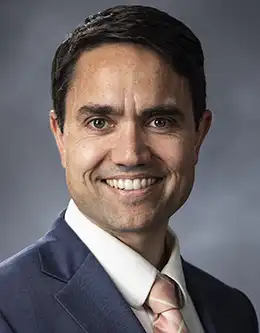
Justin Collings, BYU academic vice president, delivered this address in the faculty session of university conference on August 25, 2025.

