Gratitude in Scholarly Life
 Facebook
  Twitter/X

This is a difficult moment in many ways. Goodbyes are always hard, even though we are looking to new horizons. I couldn’t help noticing though, and perhaps you did too, that earlier I hooded the doctoral candidates, and now I am speaking, and later on I will probably be folding the chairs. We are a little shorthanded around here this summer, and I am glad to do that. In fact, I am more comfortable doing that than I am doing this.
I have been here for twenty-three years—longer than all of you graduates, though some of you have apparently been trying to match my record. We are trying to take care of that. I had not expected to have this assignment to mark my formal departure, though I had wondered if the university might, at this point, retire my telephone number. Do we ever do that?
Although I regard myself first, last, and always as a faculty member, half of my professional life at BYU has been spent in some form of what students call “the administration.” People in every institution need something to blame, and the administration serves that purpose here. And as we have often heard it said, we should be forever grateful that we don’t get as much administration as we pay for. Speaking of gratitude, I am sure that most of you are feeling grateful today, spelled r-e-l-i-e-f—grateful that you have finished this phase of your education, grateful to have the last exam finished, and grateful to have made it at all.
The Scholarly Life
The gratitude I feel today is different from that, though I, too, am making at least a partial break with this institution. Twenty-seven years ago, I stood where some of you stand: on the threshold of a doctoral program, having made the decision that would forever change the course of my life. It was more than a decision to enter the doctoral program in English at the University of Wisconsin; it was a decision to pursue the “scholarly life”—whatever that meant.
I knew that my professors were “scholars.” Their names, after all, were on the books and articles I saw in the library, and they regularly read papers at scholarly conferences. They were also insightful, stimulating teachers. Beyond that, the scholar’s life was something of a mystery to me. All I knew, really, was that I loved the written word passionately, that I loved to learn, and that I loved the classroom. And in order to put those loves together and fashion a life from them, I needed this thing called a PhD. It was the best decision I have ever made, and now I can hardly imagine that any other life—except perhaps that of a wealthy playgirl, of course—would have suited me.
Oddly enough, I still don’t know whether or not I am what people call a “scholar.” The term still eludes me, but I think now that it has something to do with the getting of wisdom. All I really know is that I have aged, as you will. I have found libraries as well as classrooms to be joyous places, and I have not thought of libraries as study halls for at least twenty-seven years.
Some time ago, the poet E. E. Cummings paid tribute to two of his early teachers, describing them as “predicates who are utterly in love with their subject; and who, because they would gladly die for it, are living for it gladly.”1 This was eminently true of my great scholar-teachers—Merton Sealts, Madeleine Doran, Walter Rideout, and others—and it was, and is, true of me. I think that being in love with one subject and loving it enough to keep learning it is the consummate secret of scholarship or teaching.
In those years at Wisconsin I also learned that, aside from hiking a red rock canyon or hitting a tennis ball, there is no greater happiness for me than putting black words on yellow paper. This has been the process by which I have generated ideas, by which I have learned to think, and by which I have clarified the tangles and puddles that a piece of stirring, elusive literature leaves in my brain. Writing is also the process that brings order to a thousand fragments of jigsawed material buried in documents, letters, and books—the treasures of a library worthy of the name. If this is the scholarly life, I guess I have lived it almost without knowing it. It was just one of those things that happened because I found my heart’s territory.
The Fields We Have Not Sown
But in a larger sense, it did not just happen. Like you, all of my life I have reaped where I have not sown. Others have worked and sacrificed to open doors I have merely walked through. The same is true for you.
I think of Alice Louise Reynolds, who, while serving as a dedicated English teacher at BYU, also edited the Relief Society Magazine and spearheaded a drive to increase BYU’s library holdings. It was through her tireless work that our library acquired a major collection and began to achieve some respectability. A couple of years ago, I ran across her handwritten catalog of the books acquired during that drive. I found there titles that have been helpful in my own studies.
There is a good deal of interest in women’s concerns on the campus just now, as there has been at various times in the past. In this too, women like you and me did not arrive solely on our own power, nor did we come to a world of hopelessly closed doors and minds. Women such as Alice Louise Reynolds—and, after her, Orea Tanner, Florence Jepperson Madsen, Virginia Cutler, Leona Holbrook, and others—plowed and planted the fields we have harvested.
Alice was the first woman to teach a college-level course at Brigham Young Academy (that was in 1894) and the first woman to become a full professor at BYU. Yet the advancement of her own career seemed less important to her than creating opportunities for others. She served as a delegate at national and international meetings of a number of women’s organizations, among them the National American Woman Suffrage Association, the General Federation of Women’s Clubs, and the League of Women Voters. Here was a woman so beloved that literary clubs sprang up in her name among former students, female and male, all across the country. She was a predicate in love with her subject.
Your debts, my young friends, are numberless too, though I have been acquiring mine longer. You can construct your own list. Truly, as King Benjamin pointed out, we are all beggars,2 and we need to remember that we are. In our perception of all that needs changing, and indeed many things always do; in our complaints about workloads or wrongs, real and imagined; in our relentless push to get ahead in this world, may we also consider the magnitude of our debt, and may we heal ourselves and others with a miraculous thing called gratitude.
The Dehumanizing Effects of Ingratitude
In a story called “June Recital,” Eudora Welty wrote of a rebellious but wonderfully gifted young woman named Virgie Rainey who once took piano lessons from an aging German musician named Miss Eckhart. The old woman loved Virgie because of her gift, and Virgie scorned her teacher because she was young and headstrong and Miss Eckhart was vulnerable. After every recital, at which the other children performed miserably (and we have all been there, haven’t we?) and Virgie Rainey performed brilliantly, the stiff, exacting old woman was heard to say, as she said after Virgie’s lessons, “Virgie Rainey, danke schoen”3—“Virgie Rainey, thank you.” The other children picked up the phrase, singsonging it and attaching it to Virgie’s name: “Virgie Rainey Danke schoen.”4 The old woman was grateful to have just one pupil with music in her hands and her soul.
In the end, the two, teacher and pupil, meet by chance after several years—the old woman now a demented inmate of the county home, the girl even more headstrong and careless. Cassie Morrison, the story’s recording consciousness, observed the crossing of their paths:
There was a meeting of glances between the teacher and her old pupil, that Cassie knew. She could not be sure that Miss Eckhart’s eyes closed once in recall—they had looked so wide-open at everything alike. The meeting amounted only to Virgie Rainey’s passing by, in plain fact. She clicked by Miss Eckhart and she clicked straight through the middle of the Rook party, without a word or the pause of a moment.5
This is how Cassie interpreted the incident:
What she was certain of was the distance those two had gone, as if all along they had been making a trip. . . . It had changed them. They were deliberately terrible. They looked at each other and neither wished to speak. They did not even horrify each other. No one could touch them now, either.
Danke schoen . . . That much was out in the open. Gratitude—like rescue—was simply no more. It was not only past; it was outworn and cast away. Both Miss Eckhart and Virgie Rainey were human beings terribly at large, roaming on the face of the earth. And there were others of them—human beings, roaming, like lost beasts.6
I think Eudora Welty was right in suggesting that ingratitude and selfish cruelty dehumanize and isolate us. If we think only in terms of what we want from someone, or from BYU or some other institution, or from life for that matter—what it owes us or must do for us—we have cast away the gratitude that might have saved us from overweening pride or ambition or isolation from those we could have loved. We, too, might become lost beasts.
The Heart of BYU
For a good many years now as graduate dean, I have participated in the hooding of the doctoral candidates at these graduation exercises. The hooding has, perhaps, a different meaning for me than it does for you who have received the coveted hoods. For me, it is a reminder that graduate work has long been a professional center for me, both as a teacher and an administrator. I am grateful that BYU serves and is served by graduate students, by people like you sitting before me today. Most commencement addresses focus on undergraduates and their achievements. I now deliberately focus on this other group of gowned folks, more gaunt, more used, more knowing, and perhaps more blessing and more blessed.
Some kinds of scholarly work can be done solo; some simply cannot. The two books I have in process now could not have been started, much less finished, without graduate students. They have searched out obscure materials, found the unfindable in rare old books and documents, driven the reference desk and Interlibrary Loan people crazy, and made possible what is coming together as a rather amazing collection of material that will illuminate the work and the broad cultural context of one of America’s greatest writers. And as we have laughed and cried our way through the mess I got us into, they have discovered that research is the route not only to madness and an early grave but also to discovery, to understanding, to patience, to growth, to sound teaching, and, yes, to gratitude for the happiness of learning.
The graduate students who have kept my work afloat and my brain alive over the years have seen the task as more than a job. Bless them! They have cared about it, sacrificed for it, gone the extra mile time after time for it and for me, as so many of you have for others. And I love them for it. They are colleagues in the work. I sense, too—I know, in fact—that they are better teachers of freshmen than I am, and in three or four or five years, some of them will be back as full-time faculty members indebted to yet another crop of graduate students.
Truly, when we count the costs of educating graduate students, we should count what it would cost if they were not here. We should count, of course, what it would cost to hire faculty to teach the eight hundred classes and several hundred labs they teach each semester. But more than that, we should count the cost of books that would not be written, of discoveries that would not be made in the laboratory or in the field, of music and dance that would not be composed, of paintings that would remain unpainted, of undergraduates who would not be mentored and stimulated by the graduate students’ youthful enthusiasm, and of potential faculty members who would never enter the academy. These students are at the heart of what we are about here. In fact, in many instances, they are the heart.
Those of you who are out there and have worked with me in graduate work in my studies and research in recent years, I want you to know that I regard you as the heroes of the academic enterprise—the trench soldiers. The late Joseph Campbell described the true hero figure in any culture as one who lives for something other than herself or himself.7 By Campbell’s definition, these extraordinary human beings called graduate students are indeed heroes. The business of research is sometimes tedious but almost never dull.
I remember that a couple of months ago, Diane, a graduate student, was trying to verify the content of an inscription reportedly bolted to the outside wall of an old Quebec cathedral. Having exhausted all of our library’s resources (and our librarians), she placed a telephone call to the church rectory in Quebec. The ancient voice on the other end greeted her inquiry with these words, in French, of course: “The plaque? Why do you care about the plaque? Don’t you want to know about the ship?”
She asked, in perfect French, “What ship?”
“Why, the one hanging from the ceiling in the cathedral,” he replied.
If you were to make your way to the cramped and crammed little office in the Lee Library where my academic work goes on, largely without me these days, you would see posted on our honor board—along with other side-splitting memorabilia of the current enterprise—a picture of the cathedral’s interior with a seventeenth-century sailing vessel secured high among the arched beams.
The Destiny of BYU
With all my heart I believe BYU is a better place because we are engaged in the discovery of new knowledge and new understanding and the applications of old knowledge. I believe that such an enterprise has a ripple effect throughout the campus, invigorating students and faculty alike. But there is another aspect of BYU for which I am even more grateful, and that is the fact that here we also believe in and are engaged in the study of revealed knowledge. In that matter, we cannot even begin to measure our debt.
I firmly believe that each of us should be different as a result of having walked through these halls and sat in these classrooms. They are made of wood and steel and plaster, like halls and classrooms and universities everywhere, but they are also made of intangibles called faith and sacrifice and gratitude. The bricks in these buildings, the books in the library, the specimens in the laboratories, and the paints on the palette have been purchased for you—invested in you—by the faithful tithe payers who believe that in such a place, indeed, even the times tables are taught in the light of the restored gospel of Jesus Christ.8 We owe those believers our deepest commitment to sacred truth—in the classroom, the library, the laboratory, the studio, the office, and the dormitory.
This is not just another university. It cannot be. It must not be. What we should be debating, I think, is not the research mission of this place as opposed to its teaching mission. What we should be debating is how best to instill gospel light into both our teaching and our research, how best to tell each other of our faith, and how best to make this campus shine as a beacon on a hill and draw truth seekers to its gates. What we should be considering is how best to show our gratitude for those past and present who have paid for our comfort with their labor, for our opportunities with their sacrifice.
If today some of you graduates are feeling grateful to be getting out of BYU, consider the gratitude you should feel that you were privileged to get into BYU and, perhaps even more, that this special place got into you, as I hope it did. I do not pretend that BYU is a perfect institution, but it is a worthy and a wonderful one. I do know that it has a destiny beyond what any of you at this moment imagines; prophets have foreseen it. And if you and I care enough to set aside worldly glitter and petty self-interests to become sowers as well as reapers in an academy of faith, that destiny will unfold. Thank you.
© Brigham Young University. All rights reserved.
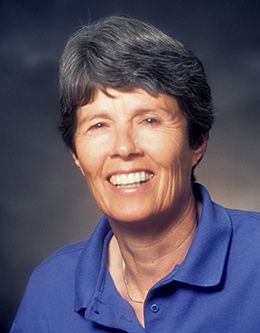
Marilyn Arnold, dean of BYU Graduate Studies and professor of English, delivered this commencement address on August 13, 1992.
Related Topics
Related Speeches