





Education is about more than just a job or a degree. It is about developing the whole person—mind, spirit, and character.
Good morning. On this date 12 years ago, I started my career at this amazing university, and how blessed I have been.
I am humbled to be asked to speak to you all today. When Vice President Keith Vorkink was extending the invitation for me to speak at this devotional, President Reese just happened to stop by Keith’s office. As we were discussing the invitation, the president shared the following advice with me: “Don’t let your fear take away from cherishing the opportunity to receive personal revelation.” I am thankful for his inspiring words of support and guidance. He and Keith are a great support and inspiration to me.
This time of preparation has been an incredible personal and spiritual journey as I have pondered and sought inspiration to know what the Lord would have me share with you today. The idea that kept coming to my mind was how much love our Father in Heaven and our Lord Jesus Christ have for each of us. Oftentimes They manifest Their love through divinely directed people who shape our lives in ways that we couldn’t have imagined. This type of divine intervention has been a recurring theme in my life, though I often didn’t recognize it at the time.
I want to acknowledge and thank my wife, Dana, and my family for their unwavering love and support. They have been a great blessing in my life and have taught me so much in my roles as husband, father, and now grandfather.
One of the people the Lord placed in the divinely directed journey of my life is my son Michael. Michael was born 28 years ago with a life-threatening condition as well as with Down syndrome. He did survive, but at the age of three, he was also diagnosed with autism. Michael is a great blessing to our family, and every day he teaches us about God’s love and helps us “think celestial.”1 Michael is nonverbal, but he shows his passion for life and his love through his kind eyes, warm hugs, and engaging smile. He is one of those angels that the Lord put into my life to touch my heart and help me understand the blessing of serving and loving unconditionally. I look forward to the day when we reunite on the other side of the veil and I can converse with him and hear him share his love for the Savior and our family.
Today I would like to remind all of us that “God is our loving Father in Heaven, and He loves all His children perfectly, including you. He loved us before we ever loved Him, and evidence of His love for [us] is everywhere,”2 including at BYU. My hope and desire is that my comments today will help you reflect on His love, especially how it is manifested through His desire for us to grow through study and faith, thanks to the blessings of this inspired university of the Lord.
Gift of a BYU Education
Since returning to BYU, I have come to understand the importance of education and lifelong learning, as they are crucial aspects of the restored gospel of Jesus Christ. This is something I didn’t fully understand or appreciate as a young person at BYU.
In studying about education in the scriptures and the words of our Church leaders, I’ve found some important principles.
The Prophet Joseph Smith taught, “The glory of God is intelligence, or, in other words, light and truth.”3 This teaching establishes a direct link between God’s nature and the concept of intelligence. As children of God, we believe we have the potential to become like Him, and this process of becoming includes the acquisition of knowledge, light, and truth. Education is a vital component as we strive to reach our full potential.
As members of the Savior’s Church, we also believe that knowledge gained in this life is not lost at death but has eternal value. In the Doctrine and Covenants we read:
Whatever principle of intelligence we attain unto in this life, it will rise with us in the resurrection.
And if a person gains more knowledge and intelligence in this life through his diligence and obedience than another, he will have so much the advantage in the world to come.4
The scriptures and modern prophets also consistently emphasize that seeking an education is a religious responsibility. President Russell M. Nelson taught this at a BYU–Idaho devotional in 2010:
Your mind is precious! It is sacred. Therefore, the education of one’s mind is also sacred. Indeed, education is a religious responsibility. . . .
Our Creator expects His children everywhere to gain an education as a personal endeavor.5
A core tenet of Christ’s doctrine is that education is not just for personal benefit but for the purpose of serving others and becoming self-reliant. President Nelson stated, “We educate our minds so that one day we can render service of worth to somebody else.”6
This view frames education as a tool for building God’s kingdom and blessing His children. Knowledge and skills acquired through education—whether learning a trade, earning a degree, or simply gaining a new skill—increase an individual’s capacity to provide for themselves and their families and to serve in their communities and the Church.
Church leaders have taught that education is about more than just a job or a degree. It is about developing the whole person—mind, spirit, and character.
President Ezra Taft Benson said, “Preparing for life means building personal integrity, developing a sound sense of values, increasing the capacity and willingness to serve.”7 This comprehensive approach to education highlights its role in fostering personal integrity, moral strength, and a deeper appreciation for life, all of which are central to a righteous and meaningful existence.
In support of our intellectual and spiritual progression, The Church of Jesus Christ of Latter-day Saints places a strong emphasis on education, viewing it as a means for personal and spiritual growth.
Elder Clark G. Gilbert stated:
Because of the Lord’s love for young people, the Church invests significant resources into a diverse system of educational offerings. Each CES [Church Educational System]school or program is unique in its approach and in whom it is designed to serve.8
Currently, enrollment in the Church Educational System—which includes Seminaries and Institutes of Religion, BYU–Pathway Worldwide, Ensign College, BYU–Hawaii, BYU–Idaho, and BYU—approaches one million students. Each of these institutions has a unique and divine origin and a mission to bless its students and alumni through inspired teaching and faith-building activities.
Today, you all have the blessing of being here at Brigham Young University, the flagship of the Church Educational System.
Elder Kim B. Clark, an emeritus General Authority Seventy and former commissioner of the Church Educational System, stated:
We often talk of BYU as the flagship of CES. And so it is. It is a remarkable institution. A flagship must be excellent in what it does, [but]it belongs to the battle group. Its areas of excellence are defined by the needs, mission, and purpose of the battle group. It is not a ship unto itself.
Elder Clark continued:
A flagship university in CES must defer to the Lord, the Spirit, and the prophets of the Lord; make sure that its areas of excellence are aligned with the needs of the Church; and take action to use its expertise and its standing to build up, defend, and protect the Church. BYU is not just affiliated with the Church; it is an institution of the Church. It is the flagship of the Church’s system for education.9
Brigham Young University’s mission “is to assist individuals in their quest for perfection and eternal life.”10
Over the past five years, in preparation for celebrating BYU’s 150th anniversary, we have been studying and pondering the prophetic words of President Spencer W. Kimball’s BYU devotional talk “The Second Century of Brigham Young University.” President Kimball’s prophetic direction and other messages from Church leaders inspired us to develop the following brand narrative for BYU, which is titled “For the Benefit of the World.”
We believe a world yearning for hope and joy needs the graduates of Brigham Young University. As disciples of Jesus Christ, BYU graduates are motivated by love for God and His children. BYU graduates are directed by living prophets and prepared to serve, lift, and lead. This preparation demands a unique university model: at BYU, belief enhances inquiry, study amplifies faith, and revelation leads to deeper understanding.
At BYU, helping students to develop their full divine potential is central to both our teaching and our scholarship. As the flagship higher education institution of The Church of Jesus Christ of Latter-day Saints, BYU strives to emit a unique light for the benefit of the world—a light that will enable BYU to be counted among the exceptional universities in the world and an essential example for the world.11
This statement highlights key attributes of BYU that make it unique in the world of higher education, reemphasizing President Kimball’s prophetic direction.
As we now celebrate BYU’s 150th anniversary and embark on the second half of its second century, what an excellent time it is to be here and to be part of this amazing prophetic work and to feel of the great love that the Savior has for this university.
A Divinely Directed Journey
I would now like to reflect on God’s love for each of you. We all have a unique journey that has brought us to this beautiful campus. Some of you represent multiple generations of family members who have come to BYU, while others may be first-generation college students. Some of you may be new to the Church or belong to another faith tradition. Whatever your journey may look like, a common thread between all of our journeys is that the love of our Heavenly Father and His Son, Jesus Christ, guided us here. You are here for a divine purpose. You are in a place where people love you and want you to succeed.
I want to share my journey back to the gospel of Jesus Christ and then eventually to BYU—not once, but twice—and how the Savior’s love, channeled through divinely directed people, guided me to this sacred place. I grew up in a family without any historical connection to or knowledge of BYU, so BYU had never been in my educational plan.
My parents were amazing people and great examples of unconditional love and service. My dad joined the Church in his 20s. My mom was baptized in her youth through the influence of her grandmother; however, the gospel wasn’t a part of her homelife growing up. As my parents started their family, their knowledge of the gospel was limited. Our family attended church until I was 10, when we moved to an area with very few members and our ward was in another town. Without a close connection to ward members, our family drifted away from Church activity and the gospel.
During my youth, my focus was academics and playing sports. As I headed into my senior year of high school, my dream was to attend a local university and play football. Neither of my parents had attended college, but they were very supportive of my dream. Everything was going according to my plan. I had a very successful football season, was accepted to the local university, and was recruited to play football.
However, the Lord had a different path for me to follow. He had inspired a young bishop, Bishop David Terry, to notice me on his list of inactive young men. I have no doubt the Lord put him in my life at this critical time to help guide me toward the gospel and a new path—a path that would touch my soul and change my life forever.
I was surprised one day when Bishop Terry called and asked if I would accept a calling to be one of his assistants in the priests quorum. I didn’t know what he was talking about, but before I knew it, I had accepted the assignment. My parents had always taught me that if you are asked to do something good, you say yes. I was ordained a priest, and each Sunday I would drive to the next town for church to assist the bishop with the quorum activities and to bless the sacrament. I didn’t know any of the other youth in the ward. They all attended a different high school.
The bishop then received another piece of inspiration and challenged me to get my patriarchal blessing. Again, I didn’t fully understand the purpose of receiving a patriarchal blessing, but I agreed to do it. At that time I had no idea how a few words spoken by that patriarch would impact my life.
A few Sundays later I drove to the patriarch’s home. I had never met Brother Horch and was still wondering about the importance of receiving the blessing. As I sat there with his hands on my head, I listened intently to his words. I heard him say, “You will have the opportunity to spend two years serving your Heavenly Father as a missionary, and you will feel the blessings of the Lord poured out on you and those who are near and dear to you.”
I thought, “I don’t even know that much about the Church. How could I ever be a missionary?” I kept saying to myself, “A mission is not in my plans, regardless of what my blessing says.”
I was not happy with this new revelation regarding my future. I desperately wanted to forget the whole thing and move on with my life, but for some reason I couldn’t get it out of my mind.
Six months passed. I had been attending church, but I had not yet accepted the invitation to serve a mission. I had so many reasons why it didn’t make sense for me. With only a couple of weeks before the start of fall football practice, I had an unusual experience at work as I was reading the Book of Mormon one morning before the workday began. I was approached by an older coworker who asked what I was doing. I told him I was reading the scriptures. When he realized it was not the Bible but the Book of Mormon, he quickly informed me that the book was not from God and that I should not be reading it.
I was surprised by his harsh reaction, but in that moment I received a strong impression that I needed to change my plan and that I must go on a mission and follow the Lord’s plan for me. The thought overwhelmed me to the point that when I arrived home from work that day, I told my parents I had to go on a mission and that attending the local university would not help prepare me. My coworker didn’t realize it, but he was the critical piece in pushing me one step closer to the Lord and a mission.
The next question was which college I should attend while preparing for a mission. I didn’t know much about nor had I applied to BYU, so that wasn’t an option at that time. However, I had heard about Ricks College, so the following weekend my supportive and loving parents and I drove from western Washington to Rexburg, Idaho, to register me for fall classes. Just a few weeks later I began classes, marking the start of my journey in the Church Educational System. The year flew by, and I had the opportunity to meet incredible faculty and students who helped me grow my testimony of the gospel. I was able to associate with other young people who were also preparing to serve missions, and by the end of the school year I had submitted my mission papers and received my call.
The Lord was with me and my family every step of the way. While I was at Ricks College, the promises in my patriarchal blessing regarding my family, “those near and dear to me,” started to unfold. The stake established a new branch in the town where my family lived, and my dad was called into the branch presidency. When I arrived home from college, I had the privilege of being the first missionary to serve from this newly formed branch.
My mission to Southern California was a very meaningful experience, helping me grow my understanding of the gospel of Jesus Christ and experience the blessing of serving others. It deepened my faith and prepared me for the next stage of my spiritual and educational development. Additionally, while I was serving, my brother-in-law joined the Church, and he and my sister were sealed in the temple. After I completed my mission, our family had the opportunity to be sealed as an eternal family. I returned to Ricks College, walked onto the football team, and resumed my schooling. Each day it was a blessing to be around faculty and fellow students who loved the Lord.
Upon receiving my associate’s degree, I was inspired to transfer to BYU to further my spiritual and educational development. Even though I knew it was a special place, I didn’t realize just how special it was. Similar to my experience at Ricks College, at BYU I was introduced to amazing and loving people who continued to shape me and my testimony, preparing me for my future journey in life. During my senior year I was blessed to meet my wife, Dana, in our ward at the Riviera, and we were married a few weeks after graduation before moving to St. Louis for my first job. Upon leaving BYU, I felt well prepared spiritually, intellectually, and professionally. I appreciated my experience at BYU but never thought I would return.
But as they say, never say never—especially when the Lord has work for you to do. Twenty-five years later I retired after an enriching career with a large global tech company. Another company recruited me to Arizona, where Dana and I began to build our retirement home. Everything was falling into place as we worked through the transition. But for some reason the Lord had something else in mind for me.
Our family had been in Arizona for just over a year, and something about our “perfect” plan felt off. That year I also was diagnosed with cancer. Reflecting on that time, I see the Lord was preparing me for a significant change in the direction of my life. As I was going through this challenging period, I met a friend of my mother-in-law who had worked at the University of Arizona. She asked if I had ever considered working in higher education. That idea had never crossed my mind, but I felt prompted to explore job opportunities at BYU and found an exciting position in the BYU Marriott School of Business. I was still recovering from cancer surgery but felt directed to travel to Provo and meet with Dean Lee T. Perry in person. As soon as I met with Lee, I knew I needed to be at BYU. Fortunately, he felt the same and took a chance on me. Lee was another special person who the Lord put in my life to help me return to BYU.
It was not the first time I had met Lee. I had had the opportunity to take a class from then-Professor Perry as an undergraduate student. He was a new, young faculty member at BYU and brought great energy and passion to his class. Who would have known that this inspiring young professor would one day play a significant role in my life? Lee ended up being a great mentor to me as I began this new second career that offered me an opportunity to give back and to learn the important role BYU plays in developing disciples of Jesus Christ.
It was a major transition to BYU after years at a big corporation where the primary focus was driving business results; the pace and purpose were very different. Starting meetings with prayer, openly bearing testimony, and discussing the gospel while at work was unique, exciting, and refreshing. Over the past 12 years, I have also cherished the opportunity to mentor and work with amazing young people, watching them grow and develop.
With perspective I lacked as a young person, I now understand that the Lord led me back to BYU not only to recognize the important role of this sacred university but also to assist in the great work of developing disciples of Jesus Christ. I encourage each of you to ponder and reflect on the Lord’s loving guidance in your personal journey to BYU and on the purposes He has for you while you are here.
I love what Elder Dieter F. Uchtdorf shared in his most recent general conference talk:
You are a blessed being of light, the spirit child of an infinite God! And you bear within you a potential beyond your own capacity to imagine.. . .
Your origin story is divine, and so is your destiny. You left heaven to come here, but heaven has never leftyou!
You are anything but ordinary.
You are gifted!12
Conclusion
In closing, I would like to leave you with a few things I have learned over the past many years since that day when a kind, loving bishop took the time to reach out to a young man and help him on the path of discipleship:
- Heavenly Father and His Beloved Son love you unconditionally.
- The gospel of Jesus Christ is true.
- You can know of God’s love by studying the scriptures and praying diligently.
- Have faith in your patriarchal blessing.
- The Lord guides BYU and the other CES schools through His living prophets.
- You are in a place here at BYU where people love you and want you to succeed.
- You have an opportunity here to connect with many faculty, staff members, fellow students, and amazing alumni. The next person you meet might open doors for you that will change your life.
I bear witness of our beloved Heavenly Father, our Savior Jesus Christ, and Their perfect knowledge and love for each of us. As you strive to do your part, They are there to guide you along your life’s path. I have witnessed this in my life and strive to be the kind of person who can assist others on their journey. I love this university—and my office door is always open if you need help while here at BYU.
In the name of Jesus Christ, amen.
© Brigham Young University. All rights reserved.
Notes
1. Russell M. Nelson, “Think Celestial!” Liahona, November 2023.
2. “God’s Love,” Come unto Christ, churchofjesuschrist.org/comeuntochrist/believe/god/gods-love. See also 1 John 4:19.
3. Doctrine and Covenants 93:36.
4. Doctrine and Covenants 130:18–19.
5. Russell M. Nelson, “Education—A Religious Responsibility,” BYU–Idaho devotional address, 26 January 2010.
6. Russell M. Nelson, “The Message: Focus on Values,” New Era, February 2013.
7. Ezra Taft Benson, TETB, 297.
8. Clark G. Gilbert, “Schools in Zion,” By Study and by Faith, Church Educational System, 2025, alumni.byu.edu/studyandfaith.
9. Kim B. Clark, memo to President Dallin H. Oaks, 12 April 2017; quoted in Dallin H. Oaks, “Challenges to the Mission of Brigham Young University,” BYU leadership conference address, 21 April 2017. President Marion G. Romney called Brigham Young University “the flagship of our Church Educational System” (“Why the J. Reuben Clark Law School?” dedicatory address and prayer of the J. Reuben Clark Law Building, 5 September 1975). A month later, in his BYU centennial address “The Second Century of Brigham Young University” on October 10, 1975, President Spencer W. Kimball referred to this designation of “the flagship” and also cited his own 1967 description of BYU as a ship: “The BYU must keep its vessel seaworthy. It must take out all old planks as they decay and put in new and stronger timber in their place. It must sail on and on and on” (Kimball, “Education for Eternity,” address to BYU faculty and staff, 12 September 1967).
10. Mission of Brigham Young University (4 November 1981).
11. “For the Benefit of the World,” BYU Brand Core Message (10 August 2022).
12. Dieter F. Uchtdorf, “Do Your Part with All Your Heart,” Liahona, November 2025.
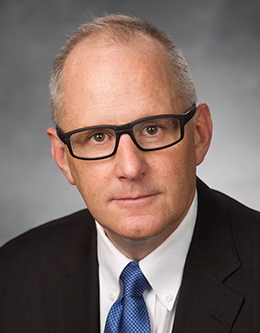
Michael L. Roberts, managing director of BYU Alumni and External Relations, delivered this devotional address on October 21, 2025.