The Disciple-Scholar
of the Quorum of the Twelve Apostles
 Facebook
  Twitter/X
To be a disciple-scholar in our time is a call to high adventure! Just as one’s quest for knowledge should be unending, so too should be the quest for greater love, meekness, and patience.
Not long after I became commissioner of Church education, way back in 1970, I asked if I might briefly teach an honors class at BYU. I had been teaching an honors class at the University of Utah on American political ideas and wanted to see how the U and the Y students compared. I found what I expected—that the BYU students were every bit as bright and enjoyable as were the students at the University of Utah. There was only one difference: At a state university, and quite properly, I could not inject gospel concepts into my teaching, such as pertained to the nature of man and therefore to what kind of government is best for man and so forth. This may seem a small point, but in fact the opportunity for the infusion of gospel concepts confers a major advantage associated with being a disciple-scholar—of which there will be some illustrations to follow.
Honorable Individuals: Commendable but Not Celestial
I call your attention to the scripture which describes the terrestrial kingdom as including the “honorable [individuals] of the earth.”1 What so many honorable individuals do is certainly useful and even commendable. But their focus is not on the celestial, and hence they may be “taken in” by the world and “are not valiant in the testimony of Jesus.”2
Given all of your talents and opportunities, I hope you will not settle for being among the honorable men and women of the earth. Furthermore, along with your many gifts and talents, you have been given much; hence “much is required.”3 The word is required, not the words “hoped for,” “expected,” or the phrase “it would be nice if . . .”
My regard is for what you now are but also for what you have the power to become. This causes me to speak to you of overarching and undergirding things. For instance, the distinguishing and facilitating quality of meekness will be noted more than once in these remarks. How you treat those around you, below you, and behind you in life will matter greatly in your lives.
No Conflict Between Faith and Learning
The Lord sees no conflict between faith and learning in a broad curriculum:
That you may be instructed more perfectly in theory, in principle, in doctrine, in the law of the gospel, in all things that pertain unto the kingdom of God, that are expedient for you to understand;
Of things both in heaven and in the earth, and under the earth; things which have been, things which are, things which must shortly come to pass; things which are at home, things which are abroad; the wars and the perplexities of the nations, and the judgments which are on the land; and a knowledge also of countries and of kingdoms. . . .
And as all have not faith, seek ye diligently and teach one another words of wisdom; yea, seek ye out of the best books words of wisdom; seek learning, even by study and also by faith.4
The scriptures see faith and learning as mutually facilitating, not separate processes. Robert Frost’s line “something there is that doesn’t love a wall”5 is applicable regarding a wall between mind and spirit.
Are All Truths of Equal Importance?
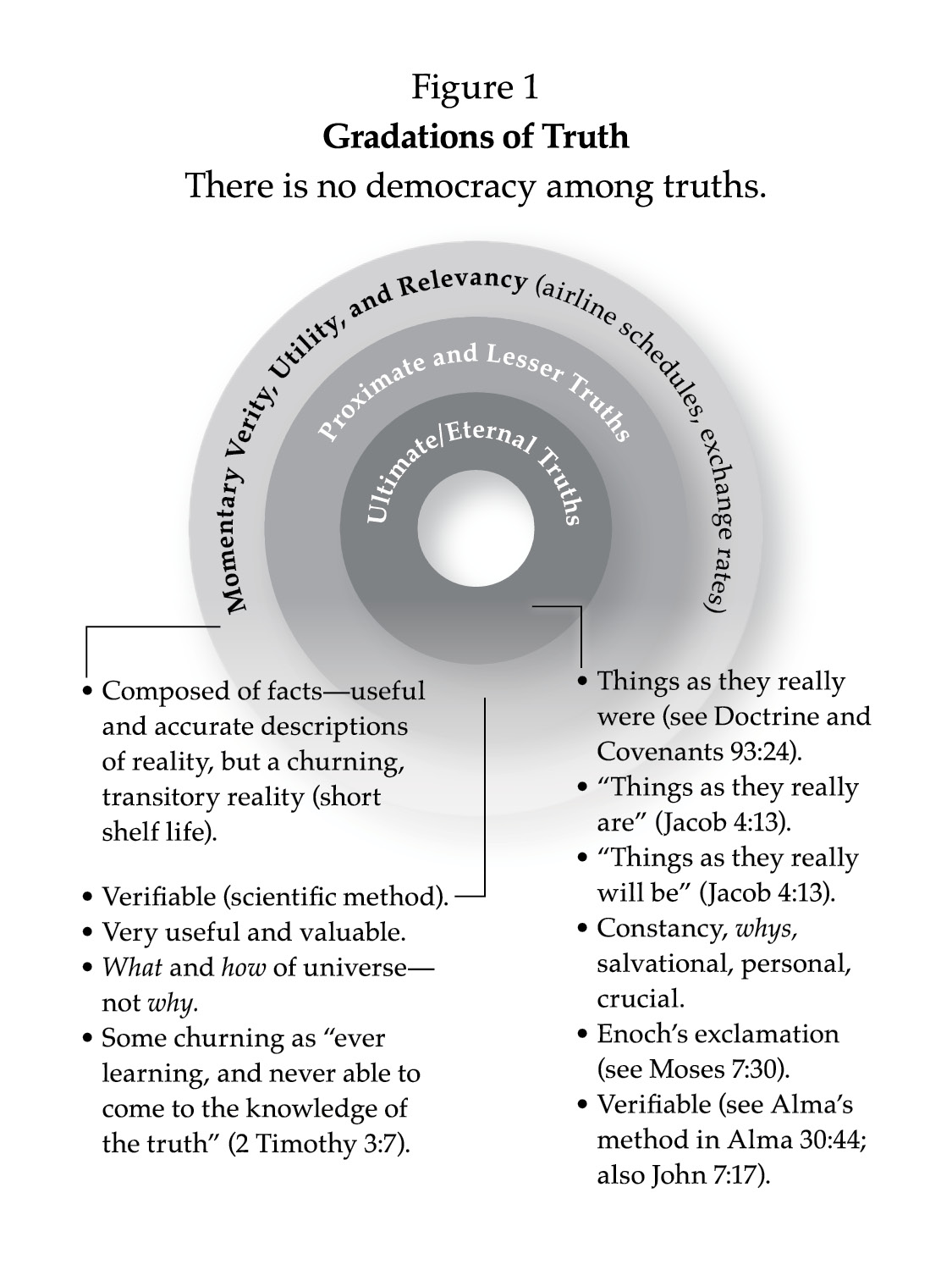
Since truth is highly and rightly valued in the learning process, please allow me to present a few concepts, along with an accompanying illustration (figure 1), about the gradations of truth. These points may seem obvious, but it is so easy to look “beyond the mark.”6
The restored gospel of Jesus Christ gives us a different view of truth. To begin with, there is no democracy among truths. They are not of equal significance. These gradations might be represented geometrically by a wide, layered circle. The outer layer of the circle would include truths which are accurate descriptions of reality. These facts, such as airline schedules and exchange rates, have only a momentary utility and relevancy, a short shelf life. They are useful, and they cannot be ignored, but they are simply not on the same footing as other kinds of truth. You could supply your own and better illustrations.
The next concentric circle inward would include more important truths. These are proximate and important truths, however—not ultimate truths. Some of these, for instance, are verifiable by the very serviceable scientific method. These truths can be very useful and valuable. For instance, in the realm of astrophysics they tell us much about the what and how of the universe, but they cannot (and do not even presume to) tell us why it exists.
In this same middle circle—the suburbs, so to speak—there is a churning and revising among some of these truths. Life in the suburbs may mean one can be “ever learning” but still “never able to come to the knowledge of the truth.”7 Even so, these truths are important and valued.
In the very center of the circle of truth lie “the deep things of God.”8 These come to us only by revelation from God, and they clearly have a greater significance than other truths and fleeting facts.
These truths concern things as they really were, really are, and really will be.9 There is constancy, not churning, among these strategic truths. These truths, for instance, are revealed from God and tell us why the universe exists. They are also very personal and crucial, such as is contained in Enoch’s exclamation.10 They represent the highest order of truth.
These truths are likewise verifiable. Jesus described how: “If any man will do his will, he shall know of the doctrine, whether it be of God, or whether I speak of myself.”11
Prioritizing Truths
Thus we constantly need to distinguish between the truths which are useful and those which are crucial and between truths which are important and those which are eternal. The restored gospel gives us this special sense of proportion.
Stephen W. Hawking, displaying that meekness which is found in great scientists, said: “Although science may solve the problem of how the universe began, it cannot answer the question: Why does the universe bother to exist? I don’t know the answer to that.”12
Hawking also raised some ultimate questions pertaining to the innermost zone of figure 1. He wrote:
What is the nature of the universe? What is our place in it and where did it and we come from? Why is it the way it is? . . .
. . . If we do discover a complete theory, . . . then we shall all . . . be able to take part in the discussion of the question of why it is that we and the universe exist. If we find the answer to that, it would be the ultimate triumph of human reason—for then we would know the mind of God.13
Such questions are answered only by revelation, not solely by reason. Certain high-grade knowledge, as Paul taught, is “spiritually discerned.”14 Only when mind and spirit combine can we penetrate the inner realm.
Nephi lamented over those who “will not search knowledge, nor understand great knowledge.”15 Clearly he was referring to a particular gradation of knowledge. Jesus lamented that some had lost “the key of knowledge.”16 Joseph Smith translated the word key as “the fullness of the scriptures.”17
Yes, we are nourished in many helpful ways by certain facts and feelings, but as Jacques Maritain observed:
Poetry (like metaphysics) is spiritual nourishment; but of a savor which has been created and which is insufficient. There is but one eternal nourishment. Unhappy [are] you who think yourselves ambitious, and who whet your appetites for anything less than the . . . [divinity] of Christ.
It is a mortal error to expect from poetry the supersubstantial nourishment of man.18
Scholarship as a Form of Worship
For a disciple of Jesus Christ, academic scholarship is a form of worship. It is actually another dimension of consecration. Hence one who seeks to be a disciple-scholar will take both scholarship and discipleship seriously—and, likewise, gospel covenants. For the disciple-scholar, the first and second great commandments frame and prioritize life. How else could one worship God with all of one’s “heart, might, mind and strength”?19 Adoration of God leads to emulation of Him and of Jesus: “Therefore, what manner of men ought ye to be? Verily I say unto you, even as I am.”20
So much tutoring is required, however, in order for the disciple to become “as a child, submissive, meek, humble, patient, full of love, willing to submit to all things which the Lord seeth fit to inflict upon him, even as a child doth submit to his father.”21
The disciple-scholar also understands what kind of community he or she should help to build. Its citizens openly and genuinely desire to be called God’s people. They are not secret disciples but “bear one another’s burdens, . . . mourn with those that mourn; . . . comfort those . . . in need of comfort,” and witness for “God at all times and in all things, and in all places.”22 Hubris, including intellectual pride, reflects the ways of hell, not of heaven! No wonder a true community of scholars would qualify to be part of a larger community of Saints.
The disciple-scholar also understands Jesus’s style of leadership, which includes persuasion, long-suffering, gentleness, meekness, love unfeigned, kindness, pure knowledge—all being achieved without hypocrisy and guile.23 There again, wholeness and meekness are emphasized.
Consecrated Scholarship
The attribute of knowledge reflects more than the accumulation of assorted, uneven facts. It is “pure,” and it is also not something apart; rather, it is closely associated with all other redeeming virtues.24
Jesus is “the way, the truth, and the life.”25 Since He has “received a fulness of truth,”26 we rightly seek to “have the mind of Christ.”27 If we keep His commandments, the promise is that we will receive “truth and light, until [we are] glorified in truth and [know] all things.”28 Would either a true scholar or disciple settle for less?
In writing of C. S. Lewis, Paul L. Holmer wrote, “We can also say that in living right, we will also think right.”29
Consecrated scholarship thus converges the life both of the mind and of the spirit!
Christ and the Creation
Restoration theology is expansive, not constraining. We do not face the problems Copernicus faced, when many mistakenly believed that the earth was the center of the universe.
For instance, through revelations we learn that Jesus played a remarkable role even premortally. Yet, given His stunning past, He was so meek! Under the direction of the Father, before His birth at Bethlehem, Jesus was actually the creating Lord of the universe. Clearly, God the Father is not the God of merely one planet!
Putting our planet in perspective, Hawking wrote, “The earth is a medium-sized planet orbiting around an average star in the outer suburbs of an ordinary spiral galaxy, which is itself only one of about a million million galaxies in the observable universe.”30
Figure 2 shows the placement of our comparatively tiny solar system in the suburbs of the Milky Way galaxy.


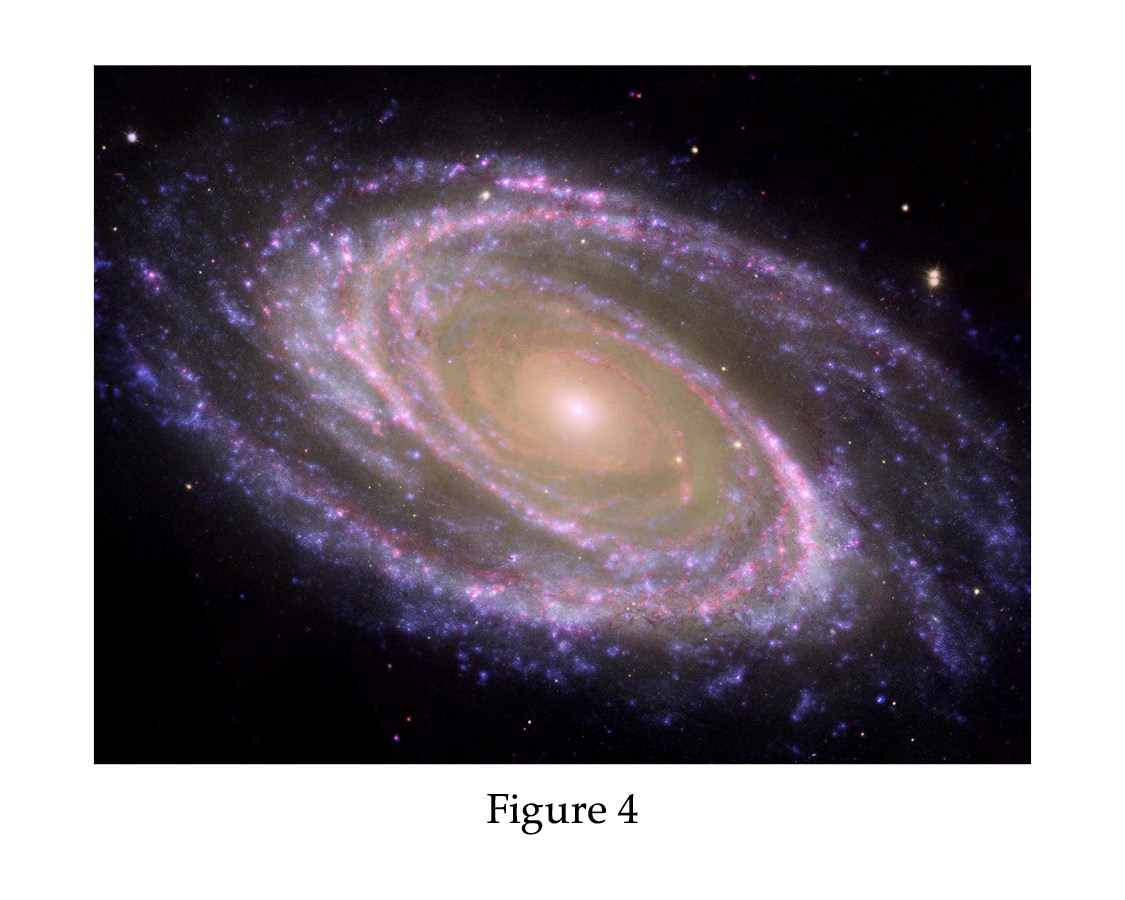
Figure 3 is the brightest portion of our “ordinary” Milky Way galaxy. This breathtaking view brings to mind the Lord’s words about His having created “worlds without number.”31
Figure 4 is a spiral galaxy—much like our galaxy, with millions of stars. This recalls the divine words that “there is no end to my works.”32
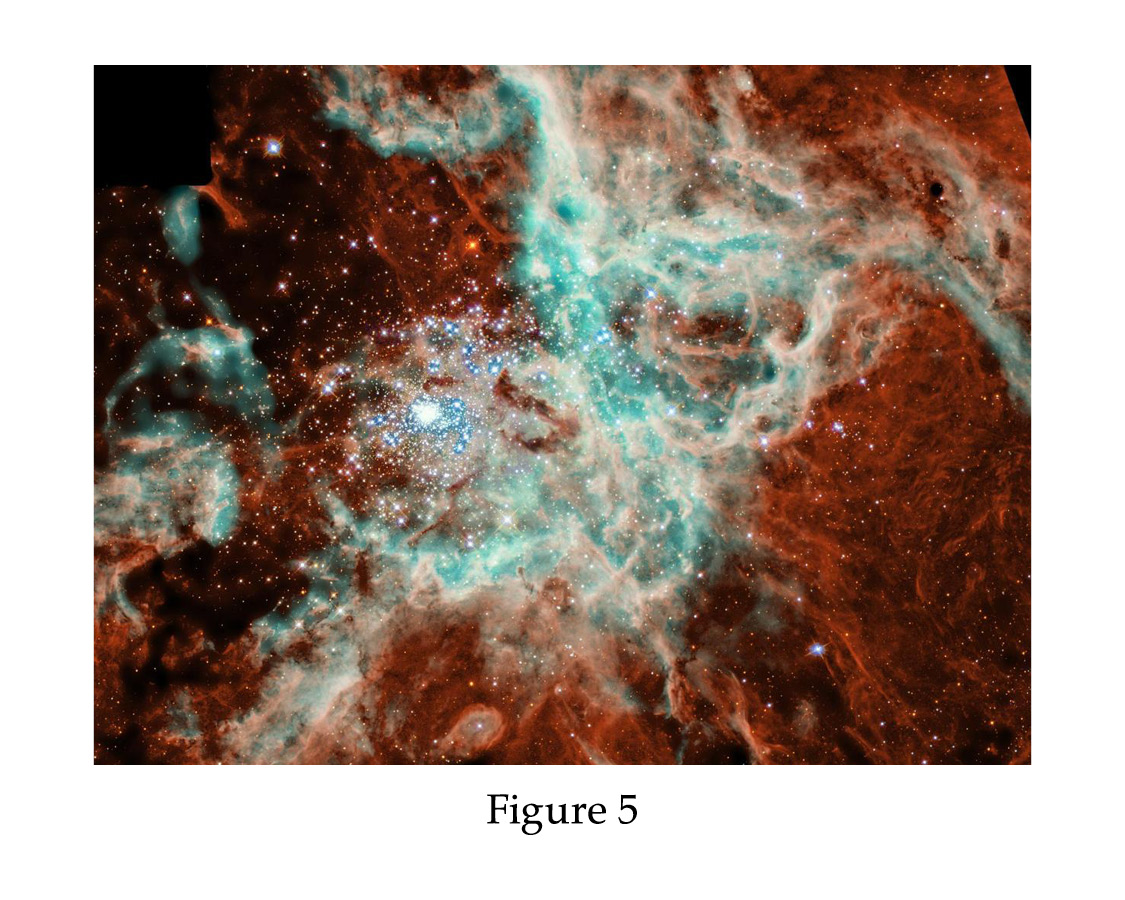
Figure 5 is the Doradus Nebula. If it were as close to us as is very distant Orion, it would cover one-fourth of the night sky. Think of the words about how God’s creations “cannot be numbered unto man; but they are numbered unto [Him].”33
Figure 6 is called Baade’s Window. These myriad stars in just one region of the Milky Way galaxy recall the words
and the stars . . . give their light, as they roll upon their wings. . . .
. . . And any man who hath seen any or the least of these hath seen God moving in his majesty and power.34
When we contemplate the stunning vastness, it is wise to remember: “Behold, . . . all things are created and made to bear record of me.”35 Alma similarly declared, “All things denote there is a God; . . . all the planets which move in their regular form do witness that there is a Supreme Creator.”36 It is a witnessing and overwhelming universe!
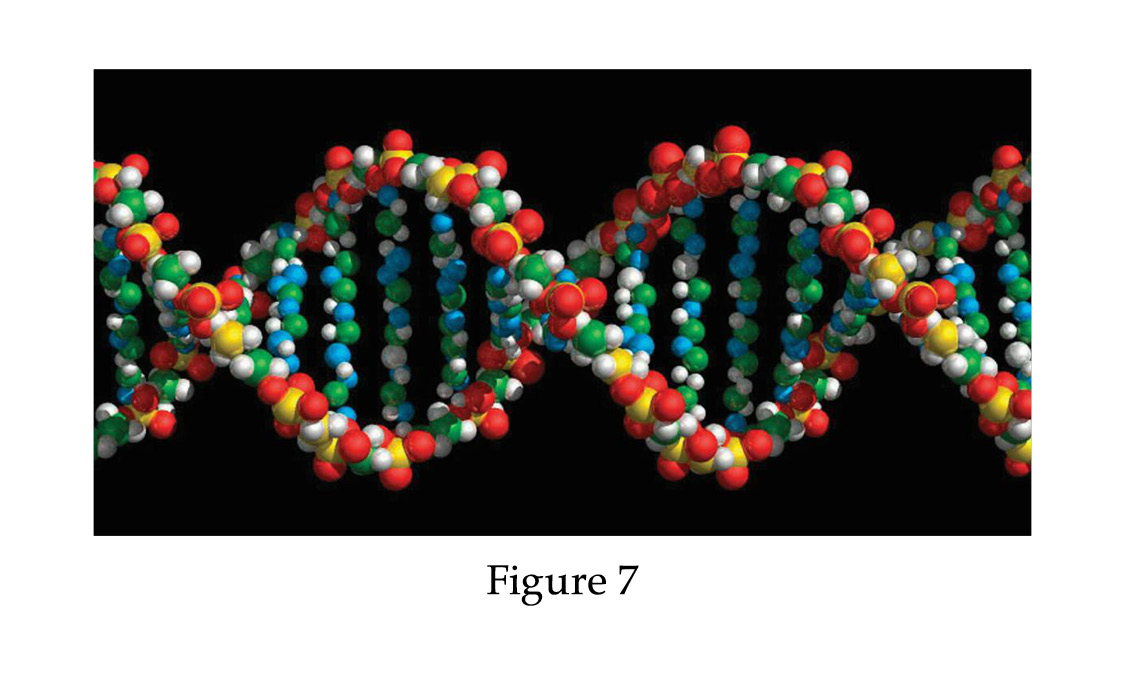
At the other end of the spectrum of size we also see divine design in the tiny but significant DNA molecule. This molecule (figure 7), which performs so many large chores, is formed by a double, intertwined helix.

It is instructive that the Lord told Moses, “But only an account of this earth, and the inhabitants thereof, give I unto you.”37 Even so, the Lord has told us some soaring, salvational things: “That by [Christ] . . . the worlds are and were created, and the inhabitants thereof are begotten sons and daughters unto God.”38
Truly, “the heavens declare the glory of God; and the firmament sheweth his handywork,”39 including the announcing star of Bethlehem.
Amid such cosmic vastness overseen by God and Jesus, however, we can also have faith in Their loving personal-ness.
Does the Creator of the Universe Care About Us Individually?
We want to be assured that God is there but also to know what He is like. We yearn to know what His and life’s purposes are. Does He really know us and really care about us individually? The reassuring reality was confirmed in Enoch’s exclamation:
And were it possible that man could number the particles of the earth, yea, millions of earths like this, it would not be a beginning to the number of thy creations; and thy curtains are stretched out still; and yet thou art there, and thy bosom is there; and also thou art just; thou art merciful and kind forever.40
The most important thing for meek Enoch to know was not how many worlds there were but that God was really there! Moreover, Enoch also learned that God is just, true, and merciful.41 We have an exemplifying Lord. Will we, however, follow His example?
When meek Enoch was first called by the Lord of the universe, he was unsure of himself:
And when Enoch had heard these words, he bowed himself to the earth, before the Lord, and spake before the Lord, saying: Why is it that I have found favor in thy sight, and am but a lad, and all the people hate me; for I am slow of speech; wherefore am I thy servant?42
Yet much later meek Enoch had so deepened his discipleship that he actually came to know “that he pleased God.”43 Imagine the satisfaction of that knowledge!
Jesus gives such striking attention to individuals, such as to a woman from Samaria:
The woman saith unto him, I know that Messias cometh, which is called Christ: when he is come, he will tell us all things.
Jesus saith unto her, I that speak unto thee am he.44
Jesus disclosed His true identity to an audience of one.
After His Resurrection, Jesus, the Lord of the universe, visited Paul in a castle jail: “And the night following the Lord stood by him, and said, Be of good cheer, Paul: for as thou hast testified of me in Jerusalem, so must thou bear witness also at Rome.”45 Another audience of one!
It shouldn’t surprise us that God gives so much individual attention to humans or to the divine design in the tiny DNA molecule. “God is in the details”—of the galaxies, of the DNA molecule, but, even more important, He is in the details of our lives.
Primary Attribute of the Disciple-Scholar: Meekness
There is as much vastness in the theology of the Restoration as in the stretching universe. “There is space there”46 for the full intellectual stretching of any serious disciple. There is room “enough and to spare”47 for all the behavioral development one is willing to undertake. No wonder, therefore, personal wholeness is required in discipleship. Genius without meekness is not enough to qualify for discipleship.
The portions of the key attributes lacking in each of us vary from person to person. It is meekness which facilitates working on what is lacking. For instance, the rich, righteous young man, otherwise clearly a high achiever, who came to Jesus asking what he might do to have eternal life was told, “One thing thou lackest.”48 His lack was not of marketplace acumen or of honesty in business affairs; instead, he lacked meekness. This, alas, kept him from doing that customized thing which Jesus asked him to do—sell all that he had, give to the poor, and come follow Him. The young man lacked consecration.
Oliver Cowdery, who devotedly helped the Restoration in so many other ways, couldn’t translate as he had hoped. He apparently lacked intellectual diligence, thinking all he had to do was ask.49 Also, he “did not continue as [he] commenced”;50 he also “feared, and the time is past,”51 said the Lord.How many times in life do opportunities pass us by for want of meekness, never to return?
Moses was meek enough but needed to make a major change in his leadership style—for both his and the people’s sake. He was advised by Jethro to delegate—not only in order to be a more effective leader but also so he could better serve others by focusing on the things that mattered most in his ministry. “And thou shalt teach them ordinances and laws, and shalt shew them the way wherein they must walk, and the work that they must do.”52
Moses changed. No wonder he was referred to in the scriptures as “very meek, above all the men which were upon the face of the earth.”53
Peter was courageous and, understandably, thought he would never desert Jesus. Later, in an excruciating exchange, a lack of full faith was underscored. This brought back Jesus’s invitation to a humbled Peter—that when Peter was fully converted, he was to strengthen his brethren.54 So often the invitation to greater consecration comes by means of painful, personal experiences.
As Michael Polanyi noted, “To learn by example is to submit to authority.”55
Ponder what Brigham Young said of his tutorial relationship with Joseph Smith:
An angel never watched [Joseph] closer than I did, and that is what has given me the knowledge I have today. I treasure it up, and ask the Father, in the name of Jesus, to help my memory when information is wanted.56
Let me shift for a few minutes to the secular scene. In the opinion of Clement Attlee, Winston Churchill was England’s greatest wartime leader ever. Nevertheless, Churchill often neglected and was insensitive to his wartime coalition cabinet colleagues, including Attlee. At times Churchill put on a one-man show. In frustration, Attlee, deputy prime minister, once wrote a sharp letter to Churchill: “I should have thought that you would have reposed some confidence in your Cabinet colleagues, but on the contrary you exhibit a very scanty respect for their views.”57 Attlee then spelled out an irrefutable bill of particulars. Churchill was “thunderstruck” and indignantly checked the feedback with Lord Beaverbrook, his wife, and another friend—all of whom quickly and candidly confirmed its accuracy.58
Winston Churchill was wise in many respects, however. He presciently chose as the motto for his last volume of World War II history these words: “How the Great Democracies Triumphed, and So Were Able to Resume the Follies Which Had So Nearly Cost Them Their Life.”59
One great individual who had considerable meekness was George Washington. Of him, his biographer wrote, “In all history few men who possessed unassailable power have used that power so gently and self-effacingly for what their best instincts told them was the welfare of their neighbors and all mankind.”60
“Washington’s was the charisma of competence,” wrote Richard Norton Smith.61 Unlike Churchill, Washington was not an orator, and he knew it, saying, “With me, it has always been a maxim, rather to let my designs appear from my works than by my expressions.”62
We are in a period in which so many are fascinated by charisma or seek for empowerment. Power to do what, however? This is the relevant question. Clever and evil, Hitler and Stalin (along with their combined henchmen) certainly had vast power. They helped to account for the premature losses of life in Greater Europe between 1930 and 1953 of an estimated forty to fifty million people—as a result of wars and famine, massacres, purges, and exterminations.63 This man-made destructiveness is “without precedent in human history”!64
What Fyodor Dostoevsky wrote about power in Notes from the House of the Dead surely applies, and not alone to Hitler and Stalin:
Whoever has experienced the power, the complete ability, to humiliate another human being . . . with the most extreme humiliation, willy-nilly loses power over his own sensations. Tyranny is a habit, it has a capacity for development, it develops finally into a disease. . . . Blood and power are intoxicating. . . . The [human being] and the citizen die within the tyrant forever; return to human dignity, to repentance, to regeneration, becomes almost impossible.65
Hitler had a certain charisma, all right, which Washington did not. But what about consequences?
Lincoln wrote of the incessant strivings for glory, especially among the talented:
It is to deny, what the history of the world tells us is true, to suppose that men of ambition and talents will not continue to spring up amongst us. . . . Towering genius disdains a beaten path. It seeks regions hitherto unexplored. It sees no distinction in adding story to story, upon the monuments of fame, erected to the memory of others. It denies that it is glory enough to serve under any chief. It scorns to tread in the footsteps of any predecessor, however illustrious. It thirsts and burns for distinction; and, if possible, it will have it, whether at the expense of emancipating slaves, or enslaving freemen.66
Power is safest, therefore, with those most Christlike, and heaven’s power is accessible only to such individuals. No wonder the Lord warns us that power and authority, as used by the natural man, are abused by “almost all”!67
Thomas Merton noted Mahatma Gandhi’s searching question: “How can he who thinks he possesses absolute truth be fraternal?”68 Obviously, the answer is for truth to company with love and meekness—as exemplified for us in the character of Jesus.
Do we have adequate faith in Jesus’s character and in His Atonement to strive genuinely to become more like Him, including in meekness?
The “Great and Spacious Building”
Do you remember the “great and spacious building”69 in the Book of Mormon? The trendy, self-congratulating multitudes were “politically correct” as they unmeekly mocked and pointed at those who clung to the gospel’s iron rod. A few whose hands had once grasped the iron rod ended up in the great and spacious building pointing fingers of scorn at former friends. Strange as it seems, the scriptures do not indicate that these individuals let go of the iron rod for any objective reasons or because they were in truth intellectually persuaded by the views of those in the great and spacious building. They were simply ashamed and embarrassed to be separated from the worldly multitudes, whose contempt they would not endure: “And after they had partaken of the fruit of the tree they did cast their eyes about as if they were ashamed.”70
No wonder Jesus, who “endured the cross, despising the shame,”71 asks us to do likewise.72 Jesus “gave no heed” to temptations either.73
There is a certain security which comes of spiritual wholeness. Thomas More’s words to his mortal judges reflected both his integrity and his generosity. Having been sentenced to die, he said to his judges:
Like the Blessed Apostle St. Paul, as we read in the Acts of the Apostles, was present, and consented to the death of St. Stephen, and kept their clothes that stoned him to death, and yet be they now both twain Holy Saints in heaven, and shall continue there friends for ever, so I verily trust and shall therefore right heartily pray, that though your lordships have now here in earth been judges to my condemnation, we may yet hereafter in heaven merrily all meet together, to our everlasting salvation.74
Thomas More gave no heed to the contempt in which he was held by his accusers but was not contemptuous of them.
The Path to Discipleship
The sooner we are on the way to serious discipleship, therefore, the sooner the needed spiritual and personal reinforcements and intellectual reassurances will come to us personally. If one chooses to live out his life without God, however, it will be as if he had been sentenced to remain a permanent resident in an airport transit lounge—consigned there, briefly and expectantly, to mingle with the ever-changing, lonely crowds. Somehow, in that forlorn situation, even being granted a cot and a hotplate in the corner of the transit lounge would not ease either the sense of anomie or futility.
Someday, in the search for wholeness in thought and behavior, we shall see much more clearly how “orthodoxy . . . is our reward, not solely our goad.”75
Genius is safest when it is accompanied by meekness. Competency is most useful when accompanied by humility. The qualities of love, mercy, patience, meekness, and spiritual submissiveness are portable. These—to the degree developed—will go with us through the veil of death; they will also rise with us in the Resurrection.
No matter how many talents or gifts we now have, God will still seek to remodel us, if we will let Him. Borrowing a parable from George MacDonald, C. S. Lewis wrote of such painful remodeling:
Imagine yourself as a living house. God comes in to rebuild that house. At first, perhaps, you can understand what He is doing. He is getting the drains right and stopping the leaks in the roof and so on: you knew that those jobs needed doing and so you are not surprised. But presently he starts knocking the house about in a way that hurts abominably and does not seem to make sense. What on earth is He up to? The explanation is that He is building quite a different house from the one you thought of—throwing out a new wing here, putting on an extra floor there, running up towers, making courtyards. You thought you were going to be made into a decent little cottage: but He is building a palace.76
Long before becoming a General Authority, I remarked on how in the world some academic men and women are blind in one eye. These are quick to see dangers coming from the one direction but not from other directions. Only the eyes of faith permit us to see “things as they really are, and . . . things as they really will be.”77 The disciple-scholar is concerned with knowing and responding to such reality. He also values history. But history, by itself, has its limitations, as Churchill observed:
History with its flickering lamp stumbles along the trail of the past, trying to reconstruct its scenes, to revive its echoes, and kindle with pale gleams the passion of former days. . . . The only guide to a man is his conscience; the only shield to his memory is the rectitude and sincerity of his actions. It is very imprudent to walk through life without this shield, because we are so often mocked by the failure of our hopes and the upsetting of our calculations; but with this shield, however the fates may play, we march always in the ranks of honour.78
The Holy Ghost, which gift the disciple has, provides precious proportion. Otherwise, as Owen Barfield wrote, there occurs “a whisper / Which Memory will warehouse as a shout.”79
To be a disciple-scholar in our time is a call to high adventure! Just as one’s quest for knowledge should be unending, so too should be the quest for greater love, meekness, and patience.
Consecration and the Disciple-Scholar
In considering consecration, it is well to remember that under this principle nothing is held back—whether turf, attitude, or hobbies. One’s will is to be “swallowed up in the will of [God]”—just as occurred with Jesus.80
Though I have spoken of the disciple-scholar, in the end all the hyphenated words come off. We are finally disciples—men and women of Christ.81
But is consecration asking too much? It is certainly asking more than but a few finally achieve. It certainly involves a submission to authority, but what an Authority!
When we consecrate, individuality is actually enhanced, not lost. Our quirks and impurities go, but who would want to come into the Inner Court trailing such obsolete trinkets anyway? Besides, it is easier to be a character than to have character!
Why is it all so slow? Because God will not impose upon us.
In opting for discipleship, we have nothing to fear but the disapproval of the natural man and his like-minded, preoccupied friends—with their pointing fingers.
Most forms of holding back are rooted in pride or are prompted by the mistaken notion that somehow we are diminished by submission to God. Actually, the greater the submission, the greater the expansion!
Where will the journey take us? “Unto a perfect man, unto the measure of the stature of the fulness of Christ.”82 One who “continueth in God, receiveth more light; and that light groweth brighter and brighter until the perfect day.”83 There isn’t any shortcut. The straight and narrow is the quickest and most direct way. It is also the only way!
Will there be perplexities? Yes, indeed. “I know that [God] loveth his children; nevertheless, I do not know the meaning of all things.”84 Indeed, we too will not always know the “meaning” of things happening to us and around us. Therefore, whatever knowledge we may have, we still need to have faith to see us through those puzzling moments. Because of past verifying experiences, we can know that we have proven God “in days that are past,”85 thus giving us faith for the challenges of the present.
God bless you who are in the vanguard of special spirits in these the last days. In the name of Jesus Christ, amen.
© by Intellectual Reserve, Inc. All rights reserved.
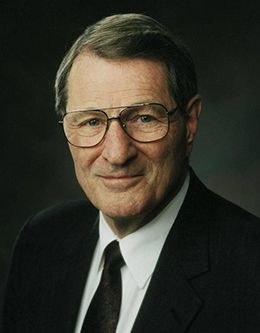
Neal A. Maxwell was a member of the Quorum of the Twelve Apostles of The Church of Jesus Christ of Latter-day Saints when he delivered this BYU Honors Program lecture on January 27, 1994.
Related Topics
Related Speeches