Peace and Rest—Even Now
of the Quorum of the Twelve Apostles
 Facebook
  Twitter/X

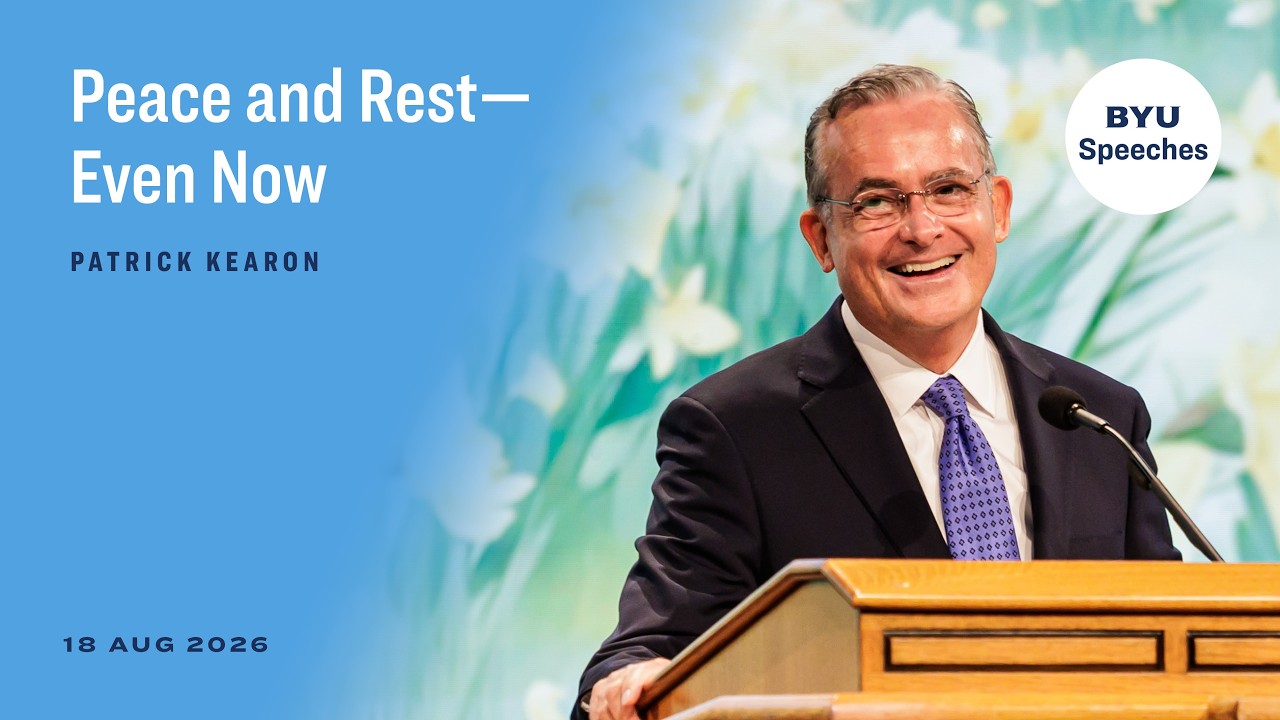
A truth I hope will sink deeply into your soul is that your best is certainly good enough, that you are loved more than you can imagine, and that it isn’t your achievements that define you, far less that determine anything about your worth or how you are seen by your Father in Heaven and His Son.
Part 1—We Are in a Great Hurry
Goals and What They Are For
I recently gave a talk to mission leaders gathered at the Provo MTC. The subject was setting goals and making plans—a critically important component of a missionary’s ability to achieve their missionary purpose. I told them that the missionary tool Preach My Gospel promises:
Learning to set goals and make plans can bless you throughout your life. It can help you make and keep covenants with God, serve faithfully in the Church, pursue education, grow in your employment, and build a strong family.1
And it is true. This kind of focus and drive to achieve is a significant part of what helps us to develop in a competitive world and is a characteristic of our culture as members of The Church of Jesus Christ of Latter-day Saints. We strive to “be anxiously engaged in a good cause . . . and bring to pass much righteousness”2 as we “put [our] shoulder to the wheel.”3
Which Brings Me to You
Which brings me to you! Your very presence here at BYU Education Week defines you by several measures as a high achiever, perhaps even an overachiever. Here you are for a few days with literally 1,000 classes to choose from! You have elected to spend your sparse spare time in the very worthy pursuit of continuing education and seeking further light and knowledge. You may have been described before in your life as a chronic overachiever. You know who you are!
Too frequently this push to achieve goes past healthy limits, and we begin to tie our self-worth to our productivity and success.
So it is to all of you—and the overachieving friend you have brought with you—to whom I would like to direct my remarks.
Here is a verse you might reflect upon:
But when he saw the multitudes, he was moved with compassion on them, because they fainted, and were scattered abroad, as sheep having no shepherd.4
Well, fortunately you do have shepherds. But you are a multitude that is striving hard, and sometimes you feel faint, tired, and scattered. You are hardworking, earnest, faithful, and devoted. Your Good Shepherd is moved with compassion for you!
He knows that some of you wonder if your best can ever be good enough—that you ache to know if you’re doing enough, if you’re helping enough, if you’re achieving enough. He understands that you wonder if you can really fulfil our Father’s hopes or foreordained mission for you.
A truth I hope will sink deeply into your soul is that your best is certainly good enough, that you are loved more than you can imagine, and that it isn’t your achievements that define you, far less that determine anything about your worth or how you are seen by your Father in Heaven and by His Son.
What Rises with Us
One of our people’s earliest symbols was the beehive with all of the imagery of industry and production evoked there. And we are a driven people, motivated by our understanding of our place in a grand and beautiful plan and with a desire to improve ourselves and leave behind a better world for those who follow us.
And yes,
whatever principle of intelligence we attain unto in this life, it will rise with us in the resurrection.
And if a person gains more knowledge and intelligence . . . through his diligence and obedience than another, he will have so much the advantage in the world to come.5
Lifelong learning is a prophetic directive and religious responsibility. And then there is so much more that rises with us. So much more that is more challenging to quantify, to weigh, or to measure—but certainly our gentleness, our meekness, our patience, and our pure love.
What the Hurry Costs
Yes, goals, plans, industry, and achievement all have a place in our mortal journey, and I wouldn’t change a thing I said to those missionaries. But let’s consider a balancing principle.
Four professors from the University of Arizona, the Wharton School, Northwestern University, and Harvard Business School once wrote an actual warning label for goal setting in a paper titled “Goals Gone Wild.” Goals do help us achieve more, they said, but they can also make us ignore the work that isn’t measured in the goal, take unwise chances to hit a target, compete where we should collaborate, and chase the reward until the joy has gone out of it.6
And other researchers have found something worse. When people began measuring an activity—some call it the Fitbit Paradox—they did do more of it: they walked more, they read more, but they enjoyed it less! Measuring output turned an enjoyable activity into work.7
Have we experienced something similar where too much focus on our to-do lists and achievements reduces our peace? And yet are we still not comfortable turning the dial down a little and taking a breath? How uncomfortable are we when a job or assignment is incomplete? Can we not rest until everything is done?
A Basilica That Is Not Finished
I read an interesting article recently by Melissa Kirsch. Let me share a part of it:
When the architect Antoni Gaudí died at the age of 73 on June 10, 1926, the Sagrada Familia, the soaring basilica in Barcelona that he worked on for more than 40 years, was only fractionally complete. Construction has been continual and contentious over the intervening 100 years. . . .
But still, La Sagrada Familia is not complete, and construction will continue for years to come. This is as Gaudí expected; he did not intend for it to be finished in his lifetime. “My client is in no hurry,” he is reputed to have said. . . .
This kind of patience is essential when one is building cathedrals, but leaving things unfinished doesn’t jibe with our productivity-fixated culture. . . . We’re in spectacular hurries to get things done, to optimize and perfect and polish off so we can move on to the next. We like our projects shipped, our Apple Watch rings closed. . . .
. . . I told someone recently that I needed some worry resolved in order to be OK, and that until it was, I might experience moments of happiness, but I wouldn’t truly rest. I realized immediately how silly this sounded. I’d put living on hold until I’d solved this problem. But the time during which the problem is unresolved is life, too. We do this all the time: suspend living until some future moment when work is done, closure is achieved, some desired state is attained. . . .
. . . There’s virtue in being done with things, but we spend a far greater amount of our lives in the making and toiling and striving it takes to get there. We might try to get more comfortable with the process.8
Our praise for—and delight in—personal accomplishment keeps our eyes focused on us: our efforts, our lessons, our hustle. This puts us at the centre of the story that our Saviour is meant to occupy—and relying on ourselves and not on Him.
It may not always be clear to us how far our focus has turned to our own achievements. But we know the discomfort we feel when we find ourselves in the company of one who has become a living curriculum vitae of themselves—a breathing bio of barely veiled clues of their professed triumphs and achievements. Even greater discomfort comes when we recognise this behaviour in ourselves as we quietly itch to give our own clues to our accomplishments.
A Feather
Let’s look at what we may be losing.
We recently had an experience with a young granddaughter who was surrounded by her lovely toys, and then a feather landed on the floor from a nearby cushion. With the help of AI, we have been able to recreate this moment. [A video was shown.]
For 15 minutes she squealed with delight as she repeatedly blew the feather into the air, fascinated by its meandering swoops and swirls. For 15 minutes! Her thrill at this most simple of pleasures brought joy to all of us observing this beautiful moment.
What happened to our daydreams? What happened to those precious moments we had kneeling on the ground staring at a tiny ant just going about her exhaustingly industrious business while we wondered what all that running around was about?
We observe children being pushed and hyper-motivated from a very young age, whether it be in academics, sport, or music. Might we be squeezing out the wondered, the time to dream, the time to marvel—not only for those children but also for the pressured and pressurising parents?
The quest to achieve goals is particularly tantalising because so much of this striving can be good. We are children of God made to create and progress and grow. But achievement for the sake of achieving does not result in a lasting peace.
“Slow Down”
In my previous calling I was reporting to and interacting with President M. Russell Ballard on a regular basis. I so enjoyed those interactions. Some of the things that I needed to address with him could be complicated and challenging.
After one such meeting, I received a message from President Ballard. There was no script. There was simply a link to a video of the Norwegian soprano Sissel Kyrkjebø singing “Slow Down.”
This was so unexpected. It took my breath away. President Ballard was extraordinarily focused in his tasks. But he had taken the time to suggest to me that I needed to slow down, take a breath, and turn to my Saviour.
Here is Sissel singing “Slow Down.” [The video was shown of Sissel’s performance.]
In the time of tribulation
When I’m feeling so unsure
When things are pressing in about me
Comes a gentle voice, so still, so pure
Slow down, slow down, be still, my child
Be still and wait
On the Spirit of the Lord
Slow down and hear His voice
And know that He is God
And know that He is God9
Please, please slow down. Be still and wait for the Spirit of the Lord. Please slow down and hear His voice and know that He is God.
From the earliest history of the Restoration comes a principle one of the early Saints recalled learning from the Prophet Joseph Smith.10 Truman G. Madsen later summarized this principle: “If a man has a bow and keeps it constantly strung tight, it will soon lose its spring. The bow must be unstrung.”11
Are you constantly strung tight? If so, you will soon lose your spring. You must be occasionally unstrung!
We need goals, we need plans. They keep us focused on things that really matter. They have a place. But is it right that they consume us and that we apply that kind of focus and pressure to every element of our lives?
Can we be at peace just being peaceful?
Part 2—He Was Not
The Saviour was focused on the most important mission and ministry of all eternity. How do we see Him interweaving His life-giving work with peace and quiet contemplation? How does He model for us the mix of ministry and meditation, service and stillness, labour and rest?
He was not in a hurry, and He took time to reflect and to rest. Let us learn from Him.
He Withdrew
In the Gospel of Luke we read that as the Lord’s fame grew “and great multitudes came,” Jesus “withdrew himself into the wilderness, and prayed.”12 After feeding the five thousand, the Saviour went into a mountain alone to pray.13
He Tried to Give His Friends Rest, and It Was Taken from Him
Luke is not telling us about one retreat the Saviour once took; he is telling us what the Saviour did again and again, all through His ministry.
“Come ye yourselves apart into a desert place, and rest a while,” He told the Twelve, “for there were many coming and going, and they had no leisure so much as to eat.”14 And then the people saw them departing and ran ahead on foot and got there first. The rest Jesus had planned for them never happened. And Mark tells us that when Jesus came out and saw the crowd waiting, He “was moved with compassion toward them.”15
He had His rest interrupted, and yet He did not resent them for it. Some of you know exactly what that feels like.
He Slept Through a Storm
The Saviour was resting, asleep in the back of the boat on a pillow, when He was awakened by His terrified disciples. He spoke simple words to quiet the violent storm on the Sea of Galilee. “Peace, be still.”16 And then He asked, “Why are you so afraid? Have you still no faith?”17
Oh, how that pulls at our souls. How many times must we learn the same lesson over and over again? My storms are often of my own making. I whip myself up and forget that the Master of all the elements is right at my side with power to calm, resolve, repair, enlighten, and heal. And He brings with Him forgiveness, comfort, grace, and, yes, healing.
And Then He Gave a Commandment About It
“Consider the lilies of the field, how they grow.”18 The word translated “consider” is a remarkable one. The underlying Greek word means to study a thing thoroughly, to examine it with real care—and it appears nowhere else in the New Testament. Of everything our Lord might have set us to study closely, He chose here a wildflower.
Martha and Mary
It seems that our discipleship, in fact, needs both service and stillness. Let’s look at Martha and Mary. Now don’t worry, this is going to end well.
The usual telling is that Martha was caught up in worldly things while Mary attended to the Saviour: sacred against secular, and Jesus commends the one who chose the sacred.
It wasn’t like that. Martha was also involved in sacred work—the sacred work of her loving ministry to the Messiah, whom she has invited into her home! The Greek word there behind “serving” is diakonia, the New Testament word for “ministry” and the root of the word deacon.19 So Luke does not say Martha was distracted from ministry by worldly tasks but that her service is pulling her apart! And you might relate to that.
Two details in the Greek really matter and are easy for us to miss in English. “Cumbered about”20 is periespato, from perispaō, which means “to drag around from every side.” This is not something Martha is doing; it is something being done to her. And the root word behind “troubled” means commotion, tumult, or riot. Martha is not busy with many things. She is in tumult. But it is all for Him!
This is a story about a hardworking disciple. It is a story about the sort of high-achieving person who gives up a vacation to come to Education Week!
What Loving God Looks Like
So what is the problem with this service?
Well, this story appears in an interesting place in Luke. Shortly before this story about Mary and Martha, a lawyer asks what he must do to inherit eternal life and is brought to the two great commandments.21 And then Luke includes two events in his narrative back-to-back: the parable of the good Samaritan, which shows what loving your neighbour looks like,22 and this interaction of Mary and Martha, which shows what loving God looks like.
Ask a room such as this one to picture in their minds what loving God with all one’s heart, might, mind, and strength looks like, and I suspect many of us would see ourselves doing something—serving, building, teaching, organising, sleeves rolled up. Might and strength are not restful words!
But Luke gives us Mary as a model of what it means to love God—a woman sitting on the floor listening.
Working for Him Without Being with Him
Look at what Martha’s afternoon has done to her. She asks, “Lord, dost thou not care?”23 She has spent hours serving Him, but she comes out of it wondering whether He loves her! That is what happens if our service competes with our communion with Him.
One way to think of this might be that Martha is doing a great deal for Jesus and not enough with Him.
She does not ask Him what He would like from her. She tells Him, “Bid her therefore that she help me.”24
I hope this paints the picture. Luke has given us the two sisters: Martha was being dragged about—worried and overworked—by her ministry! Mary was listening. We should see that Mary is not shirking, and she is not idle. She is the contrast to Martha. She had sat down at Jesus’s feet, still and ready. Sitting and attending are necessary parts of discipleship, and for many of us that is harder than hands-on service.
Which is what makes Jesus’s gentle guidance to Martha so powerful: “But one thing is needful: and Mary hath chosen that good part, which shall not be taken away from her.”25
We will also sometimes need to get the food made and the interviews done, but let’s do that after we have made time to sit and focus on the Saviour’s words. We want to be the disciple who does the one thing that is needful: sit and listen to Jesus. As we learn of Him, we will see more clearly and selectively what He would have us do and become.
And when it comes to doing and becoming, if we have taken the time, created the space, slowed down to the point where we can listen to the Saviour, the doing and becoming will be far less frenetic and much more blessed with His peace.
Here you are at Education Week, having left your work and your demands behind. You have set these days apart to figuratively sit at the feet of the Saviour. You are choosing to slow down and do the one thing that is needful.
Slow Motion
Some things are better in slow motion, even when years have been spent practicing and refining to perform at very high speed.
The Red Arrows are the Royal Air Force aerobatic team who came to the United States in June to mark 250 years of independence. The kind of flying we see represents decades of training and practice, flying in close formation at speeds between 300 and 400 miles an hour. But this display is somehow more impressive in slow motion. [A video was shown of the Red Arrows performing with red, white, and blue smoke flowing behind them.]
This is another invitation to you to slow down.
Part 3—He Invites Us to Share His Peace and Rest, Even Now
The Sabbath
The Sabbath is rich in opportunities to slow down, to balance, or to retrain our focus.
“And God blessed the seventh day, and sanctified it: because that in it he had rested from all his work which God created and made.”26
The Jewish theologian Abraham Joshua Heschel made an observation about that verse that impressed me deeply. “Now what was the first holy object in the history of the world?” he asked. “Was it a mountain? Was it an altar?”27 It was neither. The first time scripture sets anything apart as holy, it is a day. And what made that day holy was that God rested.
God commanded men and women—made in His image and destined to become like Him—to rest. They were to remember, to give thanks, and to rest. This is part of what makes the day—and the people who follow this commandment—holy. Think about that: One important element of holiness, so integral that it is one of the Ten Commandments, is resting on the Lord’s holy day.
Do you have a demanding calling that makes Sabbath rest difficult? Well, so do I. But I have found it is a matter of definition. What do you seek from your Sabbath rest? What constitutes rest for you? Could you dedicate some deliberate Sabbath rest time on another day of the week?
For myself, I thrill as I’m blessed by taking the sacrament. I love to pray outside, if I can, in the early morning. I find rest as I marvel at God’s Creation. After my Sabbath service, I can enjoy a daydream and a nap—too often on a plane. If I’m at home, the sofa can feel pretty delicious. And those rare Sabbath meals with family are precious.
President Dallin H. Oaks, in his first interview after being set apart as president of the Church, said, “You have a Heavenly Father who loves you, who has created you to return to live with heavenly parents, to enjoy the choicest blessings that God has for [any of His children].”28 The Sabbath can become a wonderful way to experience a foretaste of those blessings every week.
“The Slow Work of God”
Pierre Teilhard de Chardin was a French Jesuit priest, scientist, and philosopher. He served as a stretcher-bearer on the Western Front during the First World War and knew profound pain and hardship. In a letter to his cousin dated July 4, 1915—written from the war—he said this:
Above all, trust in the slow work of God. . . . Only God could say what this new spirit gradually forming within you will be. Give our Lord the benefit of believing that his hand is leading you . . . and accept . . . the anxiety of feeling yourself in suspense and incomplete.29
God’s work in us is often slow—very slow—because we are not always quick to learn and to change. Can we allow ourselves to be a work in progress and incomplete, trusting in God’s timing and in our own inherent ability to grow?
“Cheerfully Do”—and Then “Stand Still”
The Lord’s own counsel holds both halves of this together in a single verse: “Let us cheerfully do all things that lie in our power; and then may we stand still, with the utmost assurance, to see the salvation of God.”30
We are to cheerfully do everything in our power and then stand still, slow down, be at rest and at peace, even in our incompleteness. And God will come through. He always does.
If I have a wish for you, it is that you find peace in your actual life—not the life you think you would have if you were able to finish your to-do list, have three extra hours in a day, and finally achieve your goals. My wish is that you and I might slow down and turn more easily and comfortingly to Christ and bask in His promised peace.
Isaiah put it this way: “In returning and rest shall ye be saved; in quietness and in confidence shall be your strength.”31
All right, my overachievers! Here is your to-do list. [An illustration was shown of a to-do list waiting to be filled in.]
No, there is no to-do list!
One Thing We Don’t Achieve Ourselves
The theme of the 2026 BYU Education Week is Moroni 7:47. Read it together with the verse before it:
Wherefore, cleave unto charity, which is the greatest of all, for all things must fail—
But charity is the pure love of Christ, and it endureth forever; and whoso is found possessed of it at the last day, it shall be well with him.32
“All things must fail.” Every project you are behind on, every list you finally finish, every achievement any of us has spent ourselves on in the end will not last forever. Only charity endures forever—and it ascends with us!
And Mormon does not leave us guessing about how a person comes to be possessed of such a thing. The very next verse tells us:
Wherefore, my beloved brethren, pray unto the Father with all the energy of heart, that ye may be filled with this love, which he hath bestowed upon all who are true followers of his Son, Jesus Christ.33
Look at those words. We “pray.” We are “filled”—by Him. He bestows. Not one of them is a word for “achievement.”
I am not saying that charity asks nothing of us. It asks a very great deal! It deserves our best and our most prolonged effort. We should be kinder this year than we were last year, more patient with the person who is hardest for us to be patient with, and honest about our envy and our impatience and our score-keeping. That work is real, and it will take us the rest of our lives.
But notice what that work actually is: It is preparation for our Father’s gift.
There is no “try-harder” button that produces the love of Christ. There is no plan, no goal, no target, no course of study, however excellent, that will manufacture it. We do not build it. We receive it from Him, at His hand.
And then, Mormon says, “It shall be well with [us].” Not that we shall have achieved a great deal, not that we shall have finished, but that “it shall be well.”
A Last Word
I trust in the need I felt to share these thoughts with you, and I do hope that they will be helpful as you reflect and discuss with your friends. Ironically—you might like this—I have felt that this talk is unfinished, and after some angst, I am now at peace with that.
Possibly William Wordsworth’s most well-known poem is “I Wandered Lonely as a Cloud.” Everyone remembers the daffodils. Almost nobody remembers how the poem ends.
I wandered lonely as a cloud
That floats on high o’er vales and hills,
When all at once I saw a crowd,
A host, of golden daffodils;
Beside the lake, beneath the trees,
Fluttering and dancing in the breeze.
. . .
The waves beside them danced; but they
Out-did the sparkling waves in glee:
A poet could not but be gay,
In such a jocund company:
I gazed—and gazed—but little thought
What wealth the show to me had brought:
For oft, when on my couch I lie
In vacant or in pensive mood,
They flash upon that inward eye
Which is the bliss of solitude;
And then my heart with pleasure fills,
And dances with the daffodils.34
Well, the poet gazed and gazed—and “little thought / What wealth the show” had brought him. He did not know at the time what he was being given. He found that out later, lying on his couch, doing nothing at all.
It is that last verse that draws me at this moment to you—the possibility that you could lie in comfort on your couch, in vacant or perhaps pensive mood, and that you might recall with your inward eye some impression from the past or from the Holy Spirit that you have received and let your heart fill with pleasure at some sweet memory. And then that, yes, your heart might dance too.
This is my wish for you. He loves you so. I believe that none of us have any idea really of the depth of His love and care. I testify of this. I pray that you will reflect on these thoughts and be touched and, when appropriate, slowed. I pray that you will reflect on Him and His love, on His sacrifice, and on His—our Saviour’s—rising again. And I testify that we will have a prophet to guide us upon the earth until He, our Saviour, Jesus Christ, returns. In the name of Jesus Christ, amen.
© by Intellectual Reserve, Inc. All rights reserved.

Patrick Kearon, a member of the Quorum of the Twelve Apostles of The Church of Jesus Christ of Latter-day Saints, delivered this BYU Education Week address on August 18, 2026.
Related Topics
Related Speeches