Jesus Christ Can Transform Your BYU Experience
Director and Associate Dean of Student-Athletes for the BYU Built4Life Center
 Facebook
  Twitter/X

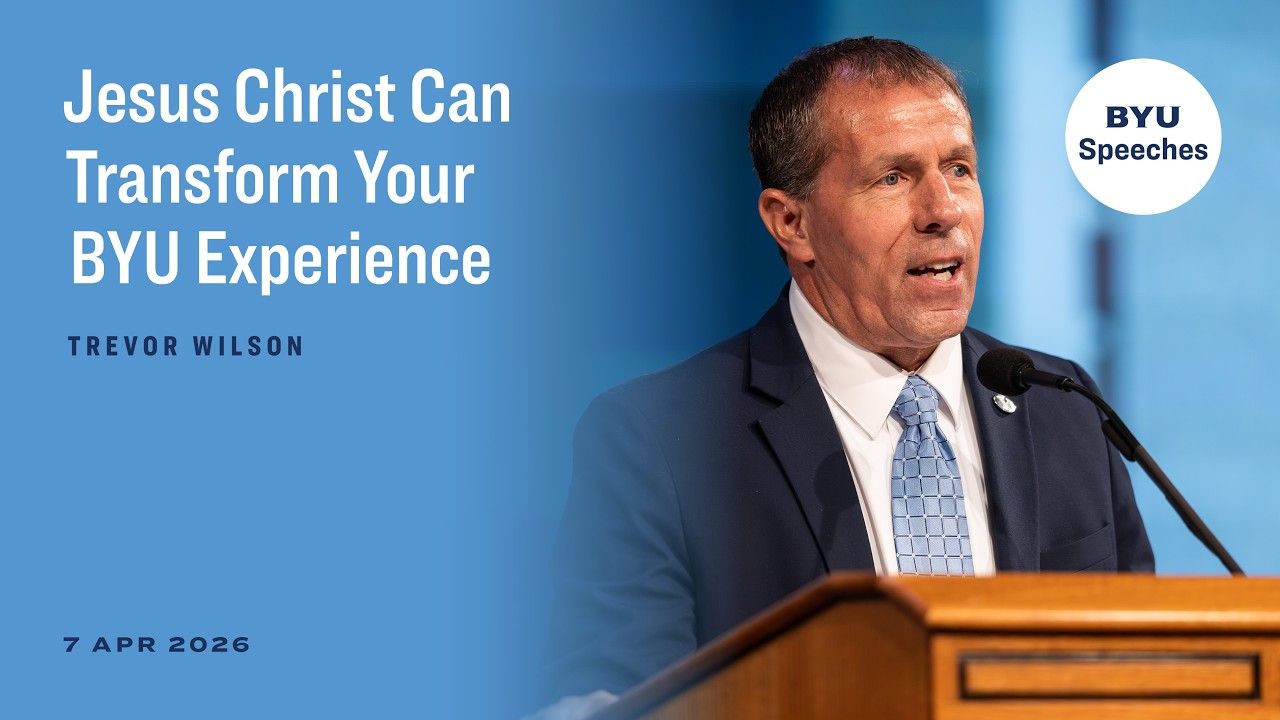
There is something transformative that happens when we are invited to keep our commitments and give up something we really like for the opportunity to be part of something greater.
Introduction
What a magnificent time to give a devotional at BYU. Last week we experienced the summit of the Easter season: the celebration of Jesus Christ, beginning with commemorating His entry into Jerusalem on Palm Sunday and then considering His infinite Atonement in Gethsemane, His Crucifixion on Golgotha, and His triumphal victory over the grave on Easter Sunday. On Saturday and Sunday we were blessed to hear the words of prophets, seers, and revelators and sustain a new living prophet, President Dallin H. Oaks, as prophet, seer, and revelator in a solemn assembly during general conference.
Throughout the scriptures we have examples of Jesus Christ taking regular and amazing events and making them transformative experiences. When we choose to have “ears to hear,”1 not only do we recognize that Jesus Christ is the power that makes these scriptural events transformative, but we see that He can take seemingly ordinary happenings in our lives and make them life-changing.
I testify that Jesus Christ can make occurrences in your life transformative. Through the Savior Jesus Christ, “sacred ordinances . . . available in holy temples make it possible [for us to be bound to Him through the eternities].”2 This reality is a blessing offered to men and women on the earth. However, if eternity and eternal progression seem like blessings that are difficult to anticipate now, let me add my witness that Jesus Christ can make your experience at BYU transformative beginning today.
Transformative vs. Transactional
Transformative experiences can be defined as ones that are profound and that fundamentally make us different. These experiences are long-lasting and often result in actions that lead to change. Most often, change occurs over time. It reshapes our thinking and our behaviors. Conversion rarely occurs in one moment or in one event; however, sometimes a single event can be the impetus for transformative changes.
Different from transformative experiences, many of our daily experiences are transactional in nature. Transactional occurrences are common and fundamentally include some type of give and take. There is an exchange of benefits that often meets a trivial need. Specifically, if two parties enter a transactional exchange, the exchange will meet a superficial need for both parties. Transactional exchanges lack depth or emotional involvement.
A simple transactional event occurs when I go to Chick-fil-A to purchase a menu item. I present the worker with a predetermined amount of money. The worker provides me with a delicious sandwich. Neither of us made a significant investment, but both of us received a short-term benefit.
Now, because I work in BYU Athletics, I must add a qualifying statement regarding the Chick-fil-A example I just described. If I happen to present the worker a QR code that offers me a free Chick-fil-A sandwich earned as the result of an opposing men’s basketball player missing two successive free throws in front of the Roar of Cougars (ROC) section during a basketball game the night before, the exchange, though still transactional, becomes much more satisfying!
Transformative Experiences in BYU Athletics
In BYU Athletics, I am fortunate to experience thrilling transactional moments as well as powerful transformative ones. Let me preface this with some perspective. Athletics is an exciting way to share our mission to the world. In fact, when one considers social media views, posts, and viewership in general, BYU Athletics reaches millions. Even with this outreach, athletics play a complementary role in the foundational objectives to this institution, which is striving to be an “educational Everest,”3 as described by President Spencer W. Kimball.
As leaders and students, we must maintain a proper perspective of the role athletics play at BYU. Sportsmanship trends in college athletics seem to be losing some ethical ground. In some cases, sports entertainment has become an obsession; cheering has become jeering; playful bantering has become insults; athletes have become targets; coaches and referees have become scapegoats; words have become weapons; and, in some cases, neighbors have become enemies. The passion that comes with athletics provides us with natural opportunities to win with humility and to lose with dignity.
Truthfully, in some ways we can all be better. At BYU we can lead out in demonstrating good sportsmanship rather than following societal trends. “Peacemakers needed”4 is an excellent guide for us to use when choosing how to act at BYU sporting events. Now, peacemaking can still include passionate, loud cheering! In every way, including in athletics, BYU is focused on helping people become disciples of Jesus Christ. Thankfully at BYU the limited negative behaviors are overshadowed by what I consider the best fan base in the world—that’s you. We do love our Cougs, don’t we?
Admittedly, I won’t cry watching a sentimental Hallmark show, but when I witnessed Evan Johnson intercept a pass to end the game at the 2025 Pop-Tarts Bowl and give the Cougar football team a season-ending 12-2 record, I sobbed like a baby! Or, back in December of 2025, when I saw AJ Dybantsa jump over an opponent, grab an offensive rebound with one hand, and dunk the basketball with authority—all in one spectacularly fluid motion—I joined many other fans in this Marriott Center (including some seated right on the south side) in a spontaneous leap off my seat!
As memorable as those moments are, and as much as they thrill me, I still consider them transactional. Let me share a few examples of some of the more transformative experiences I have witnessed.
For Coach Kalani Sitake, BYU is transformative. He often speaks of his time here as a student-athlete with deep appreciation and emotion. Under the mentorship of the great Coach LaVell Edwards and others, Coach Sitake had a meaningful college experience at BYU. In turn, he is transforming the lives of many of our student-athletes and reflecting a bright light on BYU Athletics to our followers. When you listen to Kalani Sitake’s postgame interviews—win or lose—you will find he is complimentary of the other team and complimentary of his staff, and he deflects praise, takes personal accountability, and refuses to blame others. He leads with his faith in Jesus Christ and is quick to remind his players that their identities as husbands, fathers, sons, brothers, and children of God are more important than their identities as football players.
A couple of years ago, in a tightly contested football game that came down to the last play on a rival team’s home field, Coach Sitake quietly did something that speaks to his character. Before the game ended, the opposing team prematurely stormed the field, only to be told by game officials to get back off the field so the final play could take place. The final play nearly swung the game in BYU’s favor but fell just short.
As the home-team student section stormed the field once again, many of the fans were charged with an emotion that I call “athletic-induced anger.” The situation became somewhat dangerous for players and coaches who found themselves in a wave of charging fans. As opposing fans approached Kalani to scream and jeer in his face, he invited them to take selfie photos with him. This small, humble act in a moment of high emotion instantly melted away the anger. Kalani’s reaction to the incident neutralized the entire situation. Rather than demeaning our coach, opposing fans swarmed him to take selfies. BYU runs deep for Kalani Sitake. Cougar Nation is thankful Kalani is with us!
Let me share another example. Fousseyni Traore came to BYU in the fall of 2021. Fouss, as he was affectionately called by BYU fans, came to the United States from Bamako, Mali, in West Africa, to play basketball at Wasatch Academy a few years prior to entering BYU. When he came to the United States, he spoke a Mali dialect of Bambara as well as French; English was his third language, and he spoke little of it.
Fouss left his loving family in West Africa and arrived with little more than a backpack, a small amount of clothing, and a few personal items. While at Wasatch Academy, he experienced the love and support of two host families: Troy and Holly Zentner and Rich and Lisa Saunders. Both families had transformative impacts on Fouss’s life.
Fouss was recruited by several high-profile college basketball programs, including BYU. In all reality, Fouss would not have ended up in Utah or at BYU if it hadn’t been for his exceptional basketball skills. When the time came for Fouss to decide what university to attend, he relied heavily on his faith. Fouss is a man of faith, and this began with his devotion to the Muslim religion. He made the decision a matter of serious prayer. His faith and prayers led him to select BYU.
Fouss’s Muslim faith matched well with BYU’s faith-based focus and high character standards, and he had a historic career at BYU. He left BYU as all-time leader in career field goal percentage (61 percent)5 and as sixth all-time in rebounds (868).6 More importantly, Fouss was an excellent representative of BYU to the world. Shortly after graduating from BYU, Fouss went on to play professional basketball in France. That was a great BYU ending for a terrific former student-athlete; however, the story doesn’t end there. In December 2025, Fousseyni Traore made the decision to become a baptized member of The Church of Jesus Christ of Latter-day Saints. Jesus Christ has the power to make BYU a transformative experience. It did for Fousseyni Traore!
Scriptural Examples of Jesus Christ and Transformative Experiences
For you to better understand how Jesus Christ can make your experience at BYU transformative, I want to share a few examples of change found in the scriptures. When young Joseph Smith entered the Sacred Grove to pray, “he had questions regarding the salvation of his soul and trusted that God would direct him.”7 Joseph had read, studied, and pondered a scripture found in the Bible: “If any of you lack wisdom, let him ask of God, that giveth to all men liberally, and upbraideth not.”8
Rather than simply reading this scripture, young Joseph pondered deeply what he had read. In his own words:
Never did any passage of scripture come with more power to the heart of man than this did at this time to mine. It seemed to enter with great force into every feeling of my heart. I reflected on it again and again.9
Instead of reading his scriptures and marking the task off a daily checklist—which would be a transactional experience—Joseph said he “reflected on it again and again.” This reflection and deep thought formed an experience that was transformative and that led to an extraordinary event:
I saw two Personages, whose brightness and glory defy all description, standing above me in the air. One of them spake unto me, calling me by name and said, pointing to the other—This is My Beloved Son. Hear Him!10
What insights can we gain from this experience? What laid the groundwork for Joseph Smith to have a powerful experience from pondering a simple scripture? Joseph had at least two things on his mind as he was reading the passages in the Bible:
- He had questions regarding the salvation of his soul.
- He wanted to know which church to join.
I believe these two questions weighed heavily on his mind as he came across the passage of scripture in James 1:5. Joseph’s motivation wasn’t simply to read; it was to receive answers with the intent to act. In other words, he involved Jesus Christ in his studies, and that led to transformative experiences. Like Joseph, we can have our own transformative experience as we contemplate the reality of the restored gospel. “The Restoration of the Fulness of the Gospel of Jesus Christ: A Bicentennial Proclamation to the World” gives this promise:
We testify that those who prayerfully study the message of the Restoration and act in faith will be blessed to gain their own witness of its divinity and of its purpose to prepare the world for the promised Second Coming of our Lord and Savior, Jesus Christ.11
In the Book of Mormon, Laman and Lemuel often treated their relationships with family and God as transactional. Speaking to their brother Nephi:
And thou art like unto our father, led away by the foolish imaginations of his heart. . . .
. . . These many years we have suffered in the wilderness, which time we might have enjoyed our possessions and the land of our inheritance; yea, and we might have been happy.12
The focus of Laman and Lemuel was on their possessions and on short-term gratification. They were content having transactional experiences.
Nephi, on the other hand, was searching for something deeper. What Laman and Lemuel referred to as “the foolish imaginations” of their father Lehi’s heart, Nephi viewed as “the words of Christ.”13 Nephi sought after those things that are more transformative. Whether it was while building a ship,14 calming a troubled sea,15 or obtaining the brass plates,16 Nephi put his trust in the power of Jesus Christ. At the beginning of the Book of Mormon, he summarized his experiences:
I, Nephi, having been born of goodly parents . . . and having seen many afflictions in the course of my days, nevertheless, having been highly favored of the Lord in all my days; yea, having had a great knowledge of the goodness and the mysteries of God, . . . make a record of my proceedings in my days.17
Nephi allowed Jesus Christ to transform his life.
In the New Testament, we learn of ten lepers who were healed by the Master. We read in the book of Luke:
There met him ten men that were lepers, which stood afar off:
And they lifted up their voices, and said, Jesus, Master, have mercy on us.18
Jesus healed all ten, inviting them to show themselves “unto the priests.”19
One of the ten who had been healed “turned back, and . . . glorified God.”20 Notice the interaction between Jesus and the one who returned to show gratitude. Jesus said, “Arise, go thy way: thy faith hath made thee whole.”21 All ten received physical healing, but only the one who returned and gave thanks to God22 was rewarded with more than physical healing. His faith gave him the opportunity to receive the spiritual grace from the Atonement of Jesus Christ. His healing was transformative and certainly lasted beyond his mortal life, whereas the other nine received a significant but temporary healing. By adding our faith and gratitude to the power of Jesus Christ, even our challenging experiences can become transformative.
Jesus Christ was rejected by many of those around Him because they were only seeking the seemingly transactional benefits that He could provide. For example, in John 6, we read how Jesus miraculously fed 5,000 (plus women and children) with “five barley loaves, and two small fishes,”23 meeting a temporary need for food.
Later, Jesus had an interaction with some of those who had been miraculously fed. His words indicate their expectations of His power: “Ye seek me, not because ye saw the miracles, but because ye did eat of the loaves, and were filled.”24 Rather than looking for the transformative experience, they seemed content with the miracle that had satisfied their hunger—a transactional exchange.
Jesus followed His declaration with counsel that, if followed, could make our experiences with Him deeper: “Labour not for the meat which perisheth, but for that meat which endureth unto everlasting life, which the Son of Man shall give unto you.”25
In the end of His mortal life, Jesus was betrayed for 30 pieces of silver by one of His disciples, Judas.26 Judas was frustrated by Jesus’s lack of focus on transactional matters.27 Ultimately, Jesus was mocked, scorned, and crucified by those who saw Him as a threat to their own transactional possessions and power.28
How You Can Allow Jesus Christ to Make Your Time at BYU Transformative
Now, how can you allow Jesus Christ to make your experience at BYU transformative? We “seek learning, even by study and also by faith,”29 not just to combine secular knowledge with spiritual knowledge but to open our minds to God’s intended learning pattern for us to understand Him. Fundamental to understanding God is understanding that His “work and [His] glory [is] to bring to pass the immortality and eternal life of man.”30 Fundamental to learning His work and His glory is understanding that “God so loved the world, that he gave his only begotten Son, that whosoever believeth in him should not perish, but have everlasting life.”31 Your capacity to learn at BYU is enhanced when you bind yourself to Heavenly Father and to His Son, Jesus Christ. The stronger you bind yourself to Them, the deeper your experience at BYU becomes.
President Oaks said, “In contrast to the institutions of the world, which teach us to know something, the gospel of Jesus Christ challenges us to become something.”32 As you seek Jesus Christ “with real intent,”33 He has the power to transform your experience at BYU. Let me suggest five practical ways to do this:
- Make each sacrament meeting a meaningful experience.
- Make the Book of Mormon a part of your daily life.
- Worship in your ward.
- Embrace the commitments you make as a BYU student.
- Seek first to build the kingdom of God.
First, give Jesus Christ your full devotion at least one hour per week. I am referring to weekly participation in sacrament meeting. For one hour each week, we have the opportunity to put everything aside and to focus on the joy of Jesus Christ. Elder Patrick Kearon made this point in a recent worldwide devotional for young adults: “We’d invite you to make one hour a week a real focus for finding joy: that sacrament hour on Sunday. Let us make that the most joyful moment in the week.”34
If you want to add to the joy of the sacrament meeting experience, worship the second hour on Sunday as well. The most important event that takes place nearly each Sunday is the ordinance of the sacrament. How transformative will each of our lives be if we will “always remember him and . . . always have his Spirit [with us]”?35
When Jesus Christ found three of His disciples asleep while He was suffering in the Garden of Gethsemane, He asked this question, expressing His disappointment: “Could ye not watch with me one hour?”36 Could He ask the same question today regarding our sacrament meeting worship?
Second, make reading, studying, and pondering the Book of Mormon a daily priority. President Russell M. Nelson emphasized:
My dear brothers and sisters, I promise that as you prayerfully study the Book of Mormon every day, you will make better decisions—every day. I promise that as you ponder what you study, the windows of heaven will open, and you will receive answers to your own questions and direction for your own life. I promise that as you daily immerse yourself in the Book of Mormon, you can be immunized against the evils of the day, even the gripping plague of pornography and other mind-numbing addictions.37
That is a transformative promise from a prophet of God.
Third, worship in your ward. This may sound like a repeat of the first suggestion, but I would like to emphasize the phrase “your ward.” Many of you attend young single adult wards, some attend married student wards, and others attend geographic wards. My suggestion is to attend regularly in the ward in which your church records reside. President Dieter F. Uchtdorf might say it this way: “Lift where you stand.”38 There is power when we engage in worship and activities in our established wards.
Think about it. When you attend units outside of where your membership records reside, you are a visitor. In The Church of Jesus Christ of Latter-day Saints, we practice the principle that visitors are always welcome. In fact, this saying is on signs posted in nearly every meetinghouse and stake center. There are benefits to being a visitor. Visitors can worship with fellow Saints, learn from excellent talks, sing hymns of praise, and even partake of the sacrament, be reminded of Jesus Christ, and renew sacred covenants with Him. However, being a consistent visitor has limitations. What Jesus really needs are disciples.
As if we are adding drops of oil to our lamps,39 our discipleship is increased as we worship in our own units, minister to ward members, serve in callings, receive ordinances under proper priesthood keys, and, as needed, repent under the authority of a common judge in Israel. Entering and remaining on the covenant path requires us to worship in defined units established through the Lord’s inspired “house of order.”40 Remember, in The Church of Jesus Christ of Latter-day Saints, visitors are always welcome, but disciples are needed!
Fourth, embrace the commitments you have made as a student at BYU. In my role in BYU Athletics, I have the privilege of meeting with prospective student-athletes (recruits) and their families. One of the purposes of visiting with me is to help them understand the aims of a BYU education,41 particularly the strong focus of a faith-based institution.
While explaining BYU and its model of “seek learning, even by study and also by faith,” I often use the following analogy: If you were being recruited to attend the United States Naval Academy and decided to select it for your university studies, you would enter an institution with a very specific mission. The mission of the Naval Academy is “to develop Midshipmen . . . with the highest ideals of duty, honor and loyalty . . . who are dedicated to a career of naval service.”42 Later, if you were to assess your experience at the Naval Academy and come to the conclusion that you loved the classroom experience and loved your athletic experience but you really struggled with the whole military part, I would inform you that choosing the Naval Academy was not a good decision for you. The military part is embedded throughout the entire Naval Academy experience.
BYU has a similar relationship with faith-based learning in its mission “to assist individuals in their quest for . . . eternal life.”43 The relationship between faith, learning, and keeping commitments is embedded in our mission. Embracing and living the mission is transformative.
As disciples of Jesus Christ, we are often invited to give up some of our personal preferences. The rich young man in the New Testament was invited to sell all that he had and to give to the poor.44 This invitation was given after he had shared that he had kept the commandments from an early age, which was remarkable. Yet Jesus invited him to do more: “one thing thou lackest.”45 Up to this point in the young man’s life, this invitation was likely the most strenuous step to discipleship: giving up things he really didn’t want to give up.
Elder Neal A. Maxwell referred to this as “the last portion”: “Thus, whatever else we may have already given, the last portion is the hardest to yield.”46 A reporter summarized Elder Maxwell’s perspective: “Many people are reluctant to surrender the final portion of their will to God.”47
This may be true for those choosing to follow the standards at BYU. Some elements of the Church Educational System Honor Code, or Code of Conduct, have direct connections to the doctrine of The Church of Jesus Christ of Latter-day Saints. Other parts of this code do not. Yet there is something transformative that happens when we are invited to keep our commitments and give up something we really like for the opportunity to be part of something greater.
Fifth, and last of all, “seek ye first the kingdom of God.”48 The Joseph Smith Translation of Matthew 6:33 gives clarity: “Wherefore, seek not the things of this world but seek ye first to build up the kingdom of God, and to establish his righteousness.”49 In its very core, your education at BYU is a lab for applying this scripture. You are learning the things of the world, but they are “bathed” in the teachings of the kingdom of God.50 Learning the things of the world and the things of the kingdom of God do not need to be mutually exclusive. When you embrace learning the things of God with everything else you are taught at BYU, it distinctly places the kingdom of God first.
At BYU’s centennial celebration in 1975, President Kimball stated:
We do not want BYU ever to become an educational factory. It must concern itself with not only the dispensing of facts but with the preparation of its students to take their place in society as thinking, thoughtful, and sensitive individuals who . . . come here dedicated to love of God, pursuit of truth, and service to mankind.51
Speaking with President Oaks in a recent video honoring the BYU sesquicentennial, the late President Jeffrey R. Holland stated:
[BYU] is a university. We come [here] to study and to take degrees—and it’s everything from art to zoology. But running through it is a foundation and a theme that these are children of God. We’re to teach them for eternity: “Education for eternity.”52
Educating minds for worldly gains is transactional. Educating for eternity is transformative.
Conclusion and Testimony
For me and my wife, Karri, our experience at BYU–Hawaii was transformative. Though we met in the sixth grade (as a sidenote, I fell for her hard in elementary school—she took a little bit longer), it was as a young married couple at BYU–Hawaii when we became determined to put our faith in Jesus Christ. We entered with almost nothing and left tightly bound to each other and to the Savior, Jesus Christ. As our relationship with Jesus Christ grew during that time, it allowed the BYU–Hawaii experience to transform us. That experience prepared us for our lives today and will prove to have prepared us for the life to come. Just as our experience at BYU–Hawaii was transformative for us, your experience at BYU can be transformative if you involve Jesus Christ in the journey!
As an institution, BYU is rooted in humble beginnings, yet those beginnings included a powerful prophetic destiny. In 1875, BYU Academy was scarcely “five barley loaves, and two small fishes.”53 Fast-forward 150 years, and Brigham Young University is metaphorically feeding thousands. Just as were those who witnessed Jesus’s miracle on the shore of the Sea of Galilee, you are part of one of His miracles today. Allow this miracle to be more than just a physical feast. You are at BYU for a purpose and by divine design, so invite Jesus Christ to make the miracle of BYU a transformative experience for you.
Your time here at BYU is preparing you for a day when “the kingdom of God” is met with “the kingdom of heaven.”54 This will be a transformative time when “every knee shall bend and every tongue”55 confess that Jesus is the Christ. “He will rule as King of Kings and reign as Lord of Lords.”56 His word will come forth out of Zion, and His law shall come forth out of New Jerusalem.57 The Lord is using your time here at BYU to prepare you for that future day when He returns and “the kingdom of God” and “the kingdom of heaven” come together. I testify of these transformative truths in the name of Jesus Christ, amen.
© Brigham Young University. All rights reserved.
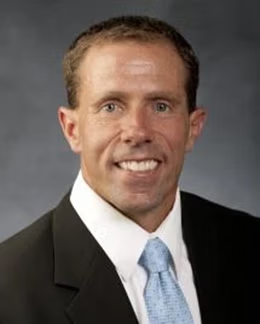
Trevor Wilson, BYU senior associate athletic director overseeing the Built4Life Center for student-athletes, delivered this devotional address on April 7, 2026.
Related Topics
Related Speeches